Print Story
X




Climatic factors, lack of food availability and habitat loss are leading to the extripation of vultures
| “W |
e used to see large flocks of vultures feeding on the dead livestock in Kohistan. They flew high in the sky, sat in the trees and moved across the hills. No one thought about their disappearance,” says Kamal Palari, a conservationist in Jhampir area of Thatta district.
Similar stories are recalled by members of various communities in the Kohistan region and Thar desert, where a small population of critically endangered long-billed and white-backed vultures still survives. “We rarely see vultures in our area now. Young people do not know much about these amazing birds.”
According to conservation experts at IUCN-Pakistan, an abundant population of white-backed vultures was reported in Pakistan, especially in the desert and hilly regions, as recently as the late 1980s. The vultures did not only live in the Thar desert, Changa Manga and the Kohistan region; one could also observe them flying high in cities like Karachi and up in the Himalayan mountains.
The steep decline in vulture species in the 1990s, mainly red-headed, white-backed and long-billed vultures, was intriguing for conservationists and local communities. This population collapse was not only evident in Pakistan, the issue also surfaced in other regional states including India, Bangladesh and Nepal, where there had been stable populations and diverse vulture species.
According to Naveed Ali Soomro, the IUCN Sindh programme manager, one of the key reasons for the decline of vultures is poisoning from a veterinary non-steroidal anti-inflammatory drug. He says that once vultures feed on the carcasses of dead livestock treated with diclofenac sodium, this leads to kidney failure and death in the birds. Some other medicines, such as ketoprofen or carprofen, also have serious impacts on vultures.
Vultures are efficient scavengers and one of the most threatened groups of birds. Globally, 23 species of vulture have been reported. They are found in every continent except Antarctica. Eight vulture species are found in Pakistan. A viable population of vultures inhabited various parts of Pakistan in the past. There were breeding colonies of vultures across Pakistan, including Sindh and the Punjab.
Threats to the vulture population in Pakistan include collisions with wind power plants. “The eco-guards in Jhampir wind power plants have reported several collisions,”says Palari. He also says the area is a hotspot for various resident as well as migratory birds, including five vulture species. The wind plants, set up over several square kilometres pose a serious threat to vultures.
To protect the declining population of vultures, experts urge a complete ban on the use of harmful drugs such as diclofenac sodium and other similar medicines.
Soomro says that the studies undertaken by the IUCN-Pakistan on vulture population dynamics have established that drastic climatic change, lack of food availability, habitat loss, including cutting of trees and damage to hills, have push these birds to local extirpation.
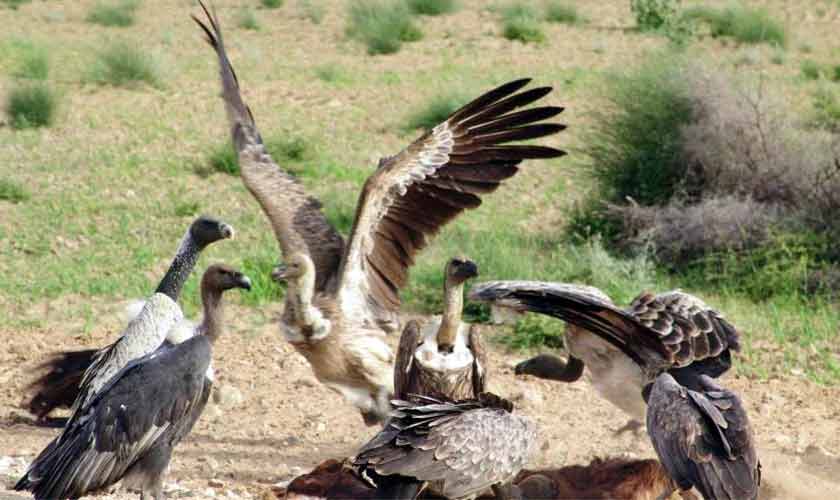
It has been believed that vultures play a vital role in the cultural heritage and ecological dynamics. They are large scavenging birds with magnificent bodies and long necks, feeding on the carcasses of dead animals. They keep the environment clean by consuming putrid carcasses infected with harmful bacteria. Thus, they are nature’s cleaners who improve the health of the ecosystem. The interdependence of the vultures, livestock and humans has a long history. Due to their scavenging behaviour, most vulture species are social and feed on the same carcass. This sets them apart from other raptors.
With a sharp decline in the wild population of vultures, conservation organisations such as the IUCN-Pakistan and the WWF-Pakistan, through collaboration and support from funding agencies and local communities, have taken on-ground steps to conserve these birds. For the long-term survival of vultures, these organisations have established a vulture safe zone (VSZ).
Through a community incentive programme, the IUCN-Pakistan has helped identify and protect hundreds of vulture nests in the Thar desert, including Tharparkar and Umerkot districts. Over eight years, this ongoing initiative has not only helped protect the vulture habitat but also significantly contributed to improve vulture population in Sindh.
According to Soomro, the organisation has raised awareness among local herder communities and veterinary staff to discourage the use of harmful drugs to treat sick livestock. “To assess the vulture population, IUCN-Pakistan has been undertaking regular surveys in Sindh, especially the Thar desert,” he says.
To protect the declining population of vultures, experts urge a complete ban on the use of harmful drugs such as diclofenac sodium. It has been recommended that, instead of these medicines, sick livestock should be treated with meloxicam. Some conservationists suggest that when an animal treated with harmful medicines dies the carcass should be buried so that vultures do not feed on it.
Experts have also called for steps to protect the forests, hills and mountains where vultures have their nests.
The writer is a PhD scholar in the integrative conservation and anthropology programme at the University of Georgia, USA.