Print Story
X




Beyond the complex ecosystem of Pakistan’s news media, what impacts the ability and capacity of reporters to do journalism and how

| P |
akistani media and freedom of expression are in the line of fire. The media’s vibrancy is fading away because of laws meant to curb press freedoms; targeted downsizing in media organisations; weak trade unions; and an ever-widening gap in professional training. A shackled press confronted with disinformation and its own professional deficiencies has curtailed its ability to keep a check on governance.
Resultantly, we have a compromised democracy—a hybrid one.
The World Press Freedom Day is observed on May 3. Pakistani politicians, who played a key role in the promulgation of laws like the Pakistan Electronic Crimes Act issue inspirational statements pledging to support press freedom. What they gloss over is the fact that Pakistan stands 158th globally on the Reporters Without Borders’ Press Freedom Index.
The long-standing issue of press freedom is not limited to direct censorship or bans; government pressure, weak institutions, lack of professional training and the processes of recruitment and downsizing in media outlets are also contributing factors.
Let me share the story of a veteran journalist from Islamabad, Syed Shehryar. He spent decades in the media, working for a large media organisation. Unfortunately, he broke his leg in a road accident. The organisation granted a month’s paid leave but did not pay his salary for the next 18 months while he underwent multiple surgeries. He was told to be grateful instead for not being fired. In the end, he was fired on the pretext of failing to obtain a government department’s version for his story despite having tried to reach the said authorities.
He is jobless. There is no gratuity or help from the government or the union. Shehryar’s children are not going to school for the last two years; the family is in a pile of debt.
There is another growing trend in Pakistan where representatives of the federal and provincial governments, especially the spokespersons, entertain only those journalists willing to support their agendas. If a journalist poses a question considered critical, he or she is unofficially blacklisted. Spokespersons for the government neither respond to their questions nor take their calls. Such journalists are not invited to media briefings either.
In a recent incident (on Wednesday), Chief Minister Sohail Afridi expelled Rani Andleeb, a reporter for Pakhtoon Digital from an event she was covering. Andleeb says that she had done a series of stories about the non-payment of salaries to the employees of a university in the province. There has been no acknowledgement by the provincial government on the incident.
Journalists across the country are working in a complicated environment. The constitution of Pakistan guarantees freedom of expression as well as freedom of the press. In practice, the freedoms are limited. As a result, many journalists practice self-censorship as a survival strategy. Public interest takes a backseat. They end up considering the potential legal, financial and other serious consequences of their stories.
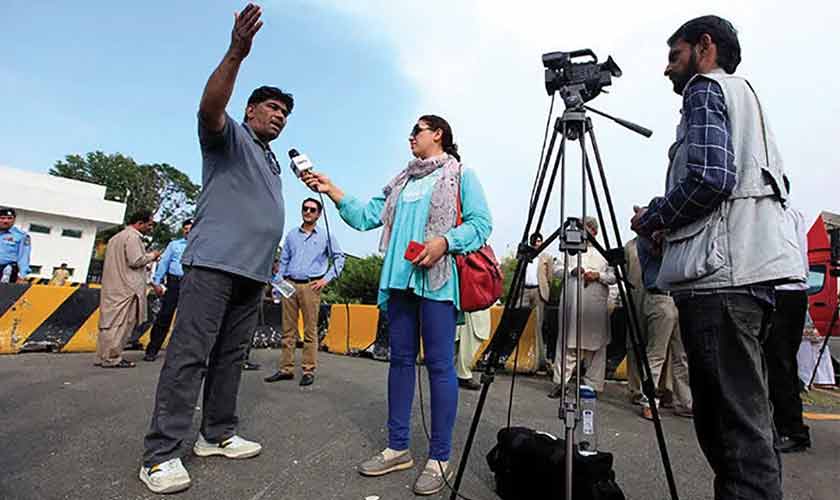
Many journalists use self-censorship as a survival strategy. Public interest takes a backseat. They end up considering the potential legal, financial and other serious consequences of their stories.
This atmosphere does not completely silence the press but it influences what is reported and how; and what is left unreported.
Another pressing issue is the uneven access to training, especially at the local level. The growth of the Pakistani media landscape over the last twenty years has not been matched by an adequate investment in professional development. Major urban newsrooms may have editors, legal counselling and occasional training, however, many reporters in smaller towns often rely on informal learning and peer support. Many enter journalism without structured training in ethics, investigative methods and digital verification; some even basic reporting skills. This lack of training has real consequences.
In most districts and tehsils, local journalists are often the primary, and sometimes only, source of information. Gaps in their training can lead to mistakes, sensationalism or susceptibility to manipulation by local power figures. A lack of strong editorial oversight makes these problems worse.
A reporter covering crime or politics in a remote region could face pressures that are more immediate than those in larger cities. They may also lack the institutional support or skills to handle them effectively.
Added to this is the economic instability associated with the profession. Many local journalists work without formal contracts, receive low salaries and lack social protections. This financial insecurity can blur the line between journalism and public relations, especially in areas where government advertising or local favoritism is vital for media survival.
In such circumstances, maintaining editorial independence becomes not just an ethical issue but also a practical necessity. Some training programmes exist—often run by media development groups and universities—but their scope is limited. Workshops occur sporadically and are often driven by donors and focused on urban areas.
What is needed is a long-term, structured approach to building skills that are built into media practices. Newsrooms should be places of learning, where mentoring, editorial standards and ongoing skill development are part of the daily routine.
The digital shift has brought both new challenges and opportunities. The rise of online platforms has lowered entry barriers, allowing a new generation of journalists to come forward. However, it has also increased the spread of misinformation, making professional training in verification and digital literacy essential. Without these skills, the credibility of the press, already under pressure, might deteriorate further.
Press freedom cannot be separated from the professional skills of those who practice it. A free press that lacks the tools, training or institutional support for accurate and responsible reporting is a fragile entity. Faced with restrictions, well-trained journalists may know how to push back and to what extent.
Moving forward means addressing both aspects at once.
Legal protections and regulatory changes must go hand in hand with real investments in journalism education and newsroom development, especially at the grassroots level. Strengthening press freedom is not just about removing restrictions; it is also about developing the ability to use that freedom wisely. Ultimately, the strength of Pakistan’s media will rely not just on how loudly it can speak but also on how well it understands what it is saying and why.
The writer is a journalist, teacher of journalism, writer and analyst. His X handle: @BukhariMubasher.