Print Story
X




The world today is not divided into isolated civilisational blocks. It is bound together through dense networks of energy, finance, trade and migration
| O |
n a recent morning, as global markets opened, oil prices again edged upward. Not dramatically - not enough to trigger panic, but enough to signal unease. Shipping insurers recalibrated risk in the Gulf. Traders adjusted expectations. Somewhere far from the Strait of Hormuz, a transport contractor recalculated costs for the coming week. Quietly, almost invisibly, the pressure began to travel.
This is how contemporary conflict unfolds. Not only through missiles, but through system.
Much of the commentary surrounding the tensions involving the United States, Israel and Iran has returned to a familiar frame: a clash of civilisations. The idea, most famously articulated by Samuel P Huntington, suggests that cultural and religious blocs now define the primary lines of conflict: the West versus Islam; a civilisation against a civilisation.
It is an appealing narrative: clear, dramatic and easy to communicate. It is also misleading because what we are witnessing does not resemble a clash. It resembles a rupture.
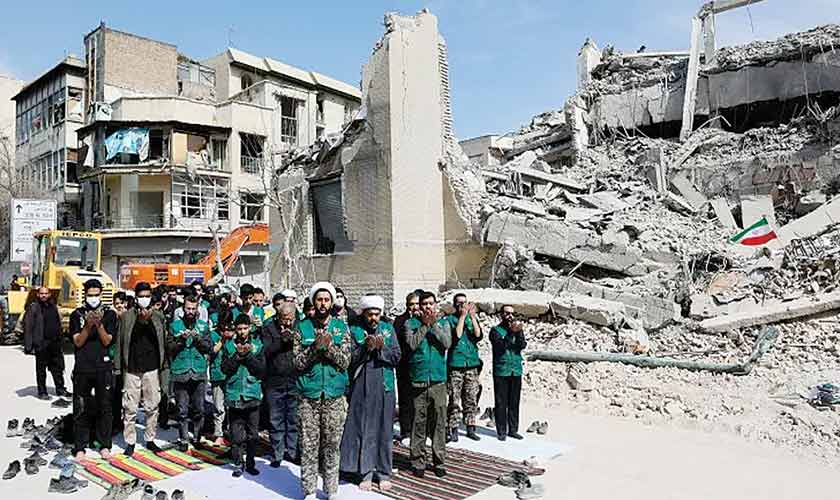
The distinction matters. A clash implies confrontation between separate entities. A rupture signals a break within a connected system. Today the world is not divided into isolated civilisational blocks. It is bound together through dense networks of energy, finance, trade and migration. Disruption in one region does not stay there. It travels.
Consider Pakistan. It is not a battlefield in this conflict. Still it sits directly within its consequences. Rising fuel prices translate into higher transport costs. Those costs ripple into food markets. Inflation, already a persistent concern, absorbs another layer of pressure. For a salaried household, this does not appear as geopolitics; it appears as a shrinking margin at the end of the month.
This is not civilisational conflict; it is lived disruption. The Strait of Hormuz offers a clear illustration. According to the International Energy Agency, a substantial share of global oil passes through this narrow passage. Any escalation in its vicinity does not require a blockade to cause a disruption. Anticipation alone alters behavior: shipping costs rise; insurance premiums increase; supply chains hesitate.
Hsesitation is enough. Energy does not remain confined to its sector. It spills outward. Fertiliser production becomes more expensive. Agricultural costs rise. The World Bank recently noted significant increases in urea prices during periods of Middle Eastern instability. In countries like Pakistan, where agricultural inputs shape food security, such shifts carry immediate consequences. A farmer pays more. A trader adjusts prices. A household absorbs the shock. Where, then, is the clash of civilisations?
Financial markets tell a similar story. They respond to signals of instability with speed and amplification. Capital moves toward perceived safety. Volatility increases. These movements do not reflect cultural antagonism. They reflect uncertainty about whether escalation can be contained.
According to the International Energy Agency, a substantial share of global oil trade passes through this narrow passage. An escalation in its vicinity does not require a blockade to cause disruption. Anticipation alone alters behavior: shipping costs rise; insurance premiums increase; supply chains hesitate.
Uncertainty becomes the operative force. Even diplomacy reveals rupture rather than clash. The difficulty of mediation today does not arise from irreconcilable civilisational values. It stems from geopolitical polarisation and the erosion of trust. Traditional intermediaries operate within narrower margins. Communication persists, but it feels thinner, more fragile.
This fragility matters. Because when systems are tightly coupled, even minor disruptions can cascade. Energy affects food. Food affects political stability. Political instability feeds back into markets. Each domain carries its own logic, yet none operates in isolation.
The system begins to echo itself. This is the condition we now confront. Not collapse. Not apocalypse. But strain across connected infrastructures.
Why, then, does the language of civilisational clash persist? Because it simplifies. It offers a story with identifiable sides. It transforms complexity into narrative. In a fragmented media environment, such clarity travels quickly and obscures the mechanisms through which risk actually operates.
The danger today lies elsewhere. It lies in the thresholds.
Modern societies depend on infrastructures that enable daily life at scale. Energy networks, transport system, financial flow and communication channels form the architecture of contemporary existence. When these systems experience simultaneous pressure, the question is no longer whether disruption will occur. It is how far it will spread and how deeply it will be felt. For countries like Pakistan, positioned at the intersection of global dependency, this distinction carries practical significance. To interpret the crisis as a civilisational clash is to misread its dynamics. To recognisse it as systemic rupture is to see both vulnerability and possibility.
A rupture creates space: space for mediation, space for recalibration, space for actors who can operate across geopolitical divides. Pakistan has, at various moments in its history, occupied such a role - not as a civilisational representative, but as a bridge in a fragmented system.
Whether it can do so again depends on clarity of diagnosis. Language shapes response. If we insist on seeing civilisations in collision, we prepare for confrontation. If we recognise systems under strain, we begin to think in terms of stabilisation. The difference is not semantic. It is strategic.
This is not a clash of civilisations. It is a rupture in a deeply connected world, one that reveals how fragile our systems have become, and how quickly disturbances can travel through them. Missiles may ignite crises. But it is the condition of our system that determines their reach.
The writer is a sociologist and senior fellow at Université Grenoble Alpes, France, and a professor at Quaid-i-Azam University, Islamabad. His work focuses on governance, mobility and systemic risk in contemporary societies.