Print Story
X




Dr Shahid Siddiqui’s book is an essential reference for scholars and policymakers
| D |
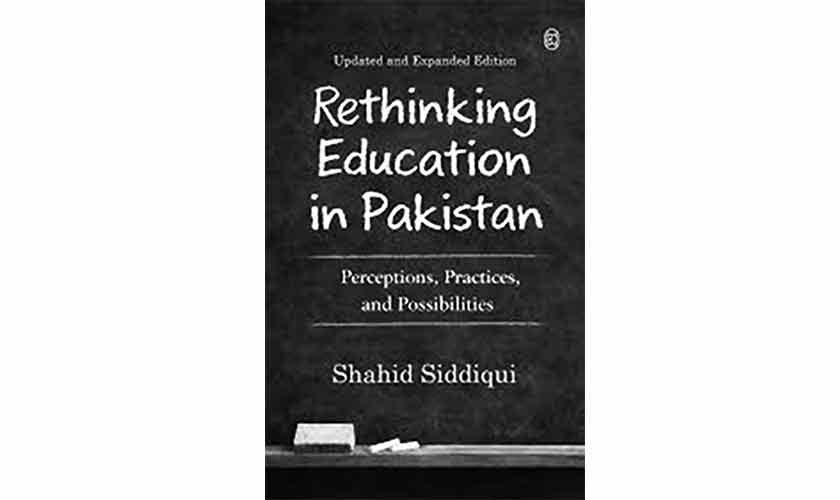
r Shahid Siddiqui’s Rethinking Education in Pakistan: Perceptions, Practices and Possibilities is one of the most rigorously conceived and thematically comprehensive treatments of the Pakistani education system to emerge in recent decades. Now in its third (updated and expanded) edition 2026, this volume — published by Book Corner in Jhelum — expands considerably upon its earlier iterations, incorporating updated empirical data, additional thematic sections and a more nuanced engagement with the structural impediments that continue to undermine educational progress in one of South Asia’s most populous countries.
Shahid Siddiqui, a distinguished educationist with decades of field experience and scholarly output, brings to this work both the analytical precision of an academic and the diagnostic sensibility of a practitioner deeply invested in institutional reform. He holds a PhD in linguistics from the University of Toronto and has served at prestigious academic institutions, including Aga Khan University, the Ghulam Ishaq Khan Institute of Engineering Sciences and Technology, the Lahore University of Management Sciences, the National University of Modern Languages and Allama Iqbal Open University. During his tenure as vice chancellor of Allama Iqbal Open University, he introduced a holistic and inclusive institutional framework that prioritised access, diversity and quality. He is currently the dean of the Faculty of Social Sciences, Media Studies, Art and Design at the Lahore School of Economics. This rich professional background lends credibility and depth to the arguments advanced in the book.
The book is organised into ten thematic parts. Each section comprises multiple chapters, ranging from tightly focused analyses such as The Touch-And-Go Teaching and The Mirage of Research to broad systemic critiques including Commodification of Education in Pakistan and Unpacking Research Paradigms. The modular design of the book renders it accessible to a diverse readership — from policymakers and administrators to classroom teachers and researchers — without compromising analytical depth and empirical rigor.
The opening sections of the book situate Pakistan’s educational malaise in a recognisable macro-structural framework. Siddiqui draws attention to the persistent inadequacy of state financing as a foundational variable. The appendices to this volume are particularly instructive in this regard. For example, Appendix F, which documents current, development and total expenditure on education across federal and provincial governments from 2018-19 through 2023-24, reveals a deeply troubling fiscal trajectory. Nationwide, educational expenditure as a share of GDP stood at two percent in 2018-19 and declined to 1.4 percent in 2020-21. It recovered marginally to 1.7 percent in 2021-22 before falling to 0.8 percent in 2023-24. These figures corroborate the author’s central argument that the Pakistani state has consistently failed to treat education as a developmental priority commensurate with its demographic challenge. Recent data from independent and international sources paint an even starker picture.
According to the Pakistan Institute of Education’s Public Financing in Education 2025-26 report, 25.37 million children remain out of school. Nearly 77 percent of ten-year-olds are unable to read and comprehend a simple sentence. Education spending fell to an estimated 0.8 percent of GDP for 2024-25 —dramatically short of the UNESCO and SDG-4 benchmark of four to six percent. Nearly 90 percent of the expenditure is absorbed by recurrent costs such as teacher salaries, leaving minimal fiscal space for infrastructure, teacher development and learning materials. These figures lend urgent empirical weight to Dr Siddiqui’s normative arguments and confirm the continued relevance of this volume’s central thrust. The regional literacy data analysed in the book, drawn from the Population and Housing Census 2023, substantiates the author’s arguments regarding spatial and gender-based inequity. The national literacy rate in 2023 stood at 60.65 percent. However, the aggregate masks severe disparities. Balochistan recorded a literacy rate of merely 42.01 percent, with rural female literacy standing at 26.59 percent. By contrast, urban male literacy in the Punjab stood at 80.37 percent. Such asymmetries are not incidental; they are the accumulated result of decades of policy neglect, resource misallocation and a failure to prioritise equity in educational planning.
The author has addressed these disparities with empirical and analytical rigor, linking them to broad questions of political economy and federalism. Pakistan’s comparative standing in international indices, presented in Appendices B and C, further contextualises the book’s arguments. In the Human Development Index 2025, Pakistan ranks 168th out of 193 countries with an HDI score of 0.544, placing it seventh among eight South Asian states — ahead of only Afghanistan. In the Sustainable Development Goal Index 2025, Pakistan scores 57.0, ranked 140th globally and seventh in South Asia. These rankings underscore the structural depth of Pakistan’s human development deficit and reinforce the author’s contention that educational reform cannot be disaggregated from broader questions of state capacity, fiscal governance and social policy.
Among the book’s most intellectually stimulating contributions are its sections on teaching practices and teacher education. Siddiqui’s essay on The Touch-And-Go Teaching offers a withering critique of the transmission-oriented pedagogy that dominates Pakistani classrooms, wherein teachers function primarily as conduits of rote learning rather than facilitators of critical inquiry. The chapter on Artificial Intelligence and Education is noteworthy for its engagement with emerging technological disruptions to pedagogical practice, though it might benefit from a more specific treatment of the infrastructural preconditions — reliable electricity, digital access, trained personnel — that are prerequisites for any meaningful AI integration in Pakistani schools and universities. The chapter on Holistic Approach to Teacher Education advances a compelling case for conceptualising teacher training beyond technical skill acquisition toward the cultivation of reflective professional identity, an argument consonant with contemporary scholarship in the field. In addition, the sections on language issues deserve particular attention, given their policy salience in a multilinsgual state. Siddiqui navigates the contentious terrain of English-medium instruction, Urdu as national medium, and the marginalisation of regional languages with scholarly balance and empirical soundness. His analysis of the Language Factor and ELT Scenario in Pakistan draws attention to the socio-linguistic dimensions of educational inequality. He holds that language policy functions not as a neutral pedagogical instrument but as a mechanism of social stratification. The argument that English proficiency has effectively become a proxy for class privilege, gatekeeping access to elite institutions and career pathways, resonates with a substantial body of critical linguistics scholarship.
His treatment of research culture and university ranking is perhaps the most courageous dimension of the volume. His critique of the PhD Rush — the institutional pressure to produce doctoral graduates and indexed publications as metrics of prestige rather than genuine knowledge production — will resonate with faculty across Pakistan’s higher education sector. Relatedly, the essay on The Politics of University Ranking raises foundational epistemological questions about the commodification of scholarly output and the distortions introduced by global ranking regimes into the academic priorities of universities in the Global South. These are not merely philosophical objections; they carry significant implications for how research budgets are allocated and how academic careers are structured.
Rethinking Education in Pakistan constitutes an essential reference for scholars, policymakers, and practitioners engaged with the formidable challenge of educational transformation in Pakistan. Shahid Siddiqui’s command of the field is evident throughout. His commitment to analytical thrust, empirical rigor and normative emphasis accords the volume a moral primacy that is rare in policy-oriented educational scholarship in the contemporary context. At a time when Pakistan’s declared education emergency risks becoming yet another unfulfilled institutional promise, this book serves simultaneously as a diagnostic instrument and a normative call to action. It deserves a wide readership within and beyond Pakistan’s academic community.
The writer has a PhD in political science from Heidelberg University and a postdoc from University of California, Berkeley. He is a DAAD and Fulbright fellow and an associate professor. He can be reached at [email protected]