Print Story
X




Security forces respond to unprovoked aggression by Afghan Taliban and the TTP militants
| T |
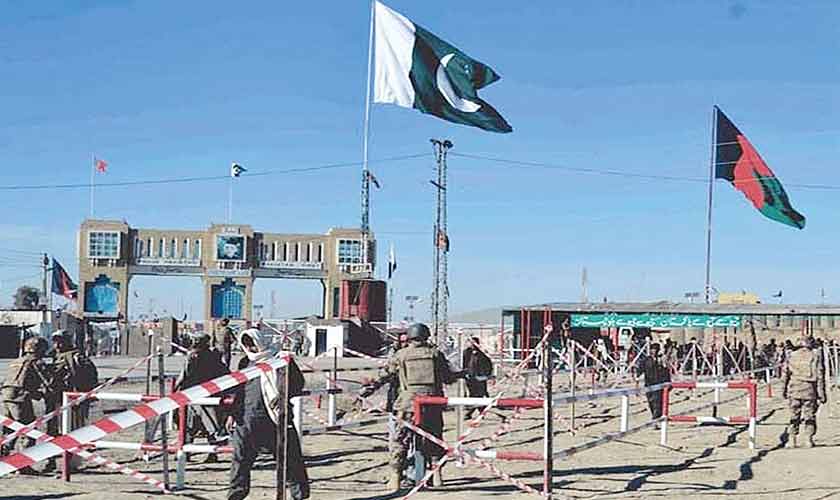
ensions along the Pakistan-Afghanistan border have escalated following unprovoked aggression by Afghan Taliban elements and the militant groups identified by the Inter Services Public Relations as Fitna al-Khawarij. By way of a response, the Pakistan Army has launched counter-action under its Operation Ghazab-lil-Haq, targeting several positions across the border. According to security officials, several Afghan Taliban posts in the Chaman sector were destroyed, including locations identified as Sarshan, Al-Marjan and Edhi Post. The response, they say, reflected an unwavering commitment to the defenxe of the country and a determination to neutralise threats posed by militant elements and their facilitators.
Interior Minister Mohsin Naqvi condemned the Afghan aggression and praised the armed forces for delivering what he described as a decisive response. Officials have reiterated that the anti-militancy operations will continue until all their objectives are achieved and the security situation is stabilised.
Beyond immediate military developments, these events revive a more complex debate: the misuse and misinterpretation of religion by extremist groups. Pakistan is not an ordinary nation-state. The foundational principle, articulated in the Objectives Resolution and embedded in the constitution, establishes that sovereignty belongs to Almighty Allah and that state authority is exercised as a sacred trust. The constitution declares Islam as the state religion and ensures that no law can contradict the Quran and Sunnah.
Within this framework, a fundamental question arises: if the state is structured in accordance with Islamic principles, how can armed violence against it be justified in the name of religion?
From both constitutional and religious perspectives, the answer is clear. Violence against the state and innocent citizens cannot be called jihad. Instead, it amounts to baghawat (rebellion) and fasad fil arz. Groups often described as khawarij misinterpret religious teachings, manipulate narratives and exploit faith motifs for their political objectives. Their actions are not grounded in Islam but in a distortion of its core principles.
The Holy Quran provides explicit guidance on the matter of authority and obedience: “Obey Allah, obey the Messenger and those in authority among you” (4:59). This verse emphasises respect for lawful authority. In the context of Pakistan, where the constitutional structure aligns itself with Islamic injunctions, rebellion against the state is not an act of religiously ordained self-defence but a direct violation of Islamic teachings. Classical Islamic jurisprudence treats such rebellion as a serious offence, strictly prohibited under sharia.
The sanctity of human life is central to Islamic ethics and laws. The Holy Quran declares: “Whoever kills an innocent person, it is as if he has killed all mankind” (5:32). This principle leaves no ambiguity. Yet, extremist groups continue to carry out lethal attacks against civilians, mosques and educational institutions to spread fear and cause instability. Such actions cannot be reconciled with Islam; they constitute fasad—a state of chaos and corruption. The teachings of the Prophet Muhammad (peace be upon him) reinforce this principle. He clearly prohibited the killing of women and children even during warfare.
A significant recent development is the Paigham-i-Pakistan initiative. Endorsed by more than 1,800 scholars, this declaration categorically states that terrorism and suicide attacks are forbidden (haram).
Khawarij have been recognised in Islamic history as a deviant group known for their rigid interpretations of sharia and violent tendencies. Authentic hadith literature describes them as people who recite the scripture but fail to grasp its essence. Their defining characteristics—extremism, declaring others unbelievers (takfeer) and rebellion—closely resemble the behaviour of some modern militant groups.
A significant contemporary development with regard to this understanding is the Paigham-i-Pakistan initiative. Endorsed by more than 1,800 scholars, this declaration categorically states that terrorism and suicide attacks are forbidden (haram). It says armed opposition to the Islami state lacks legitimacy and that extremist actors follow the way of the Khawarij. The joint statement represents a unified stance across diverse schools of thought.
Islam lays down clear parameters for jihad. Contrary to the claims of some extremist organisations, jihad is not envisaged as a private undertaking. It is a collective responsibility. Jihad can only be declared and regulated by legitimate authority. This ensures accountability and prevents misuse of violence. Any armed activity beyond this framework lacks religious legitimacy and is unlawful violence.
Religious scholars across Pakistan have consistently held this position. They emphasise that the country’s constitutional structure represents a legitimate Islamic order. A rebellion against it is both illegal and religiously impermissible. Major religious institutions and federations of seminaries have rejected extremism and distanced themselves from violent actors, reaffirming that the purpose of religious education is to promote knowledge, reform and peace.
The consequences of extremist violence extend far beyond national security. By associating Islam with brutality and terrorism, militant groups damage the global image of the religion and contribute to rising Islamophobia. This misrepresentation contradicts Islam’s identity as a religion rooted in justice, compassion and the protection of human dignity.
Within the framework of maqasid al-sharia—the higher objectives of Islamic law—the preservation of life, faith, property and honour is paramount. As an Islamic state, Pakistan carries the responsibility of upholding these objectives. Countering violent extremism, therefore, is not merely a political necessity but a religious obligation as well. Ensuring public safety, maintaining order and preventing societal breakdown are essential components of this duty.
Pakistan’s constitutional framework and Islamic teachings converge on the unambiguous message that terrorist violence is un-Islamic. It represents rebellion against lawful authority and a violation of fundamental religious principles. Those who engage in such acts do not serve Islam; they undermine it.
The author works for The News. He can be contacted at [email protected]