Print Story
X




In Exposed, Suleman Faisal elevates the overlooked rituals of everyday life into work that unsettles
| S |
ome banal acts are performed every day, but, like routine secrets, they prefer to remain hidden. Even mentioning them in public, among colleagues, depicting them in entertainment programmes or sharing them on social media platforms (which are supposed to be free and resilient to censorship) is considered indecent. In the worlds of visual art, cinema and, to a large extent, literature, this absence is normally accepted in accordance with etiquette, simply in line with good taste.
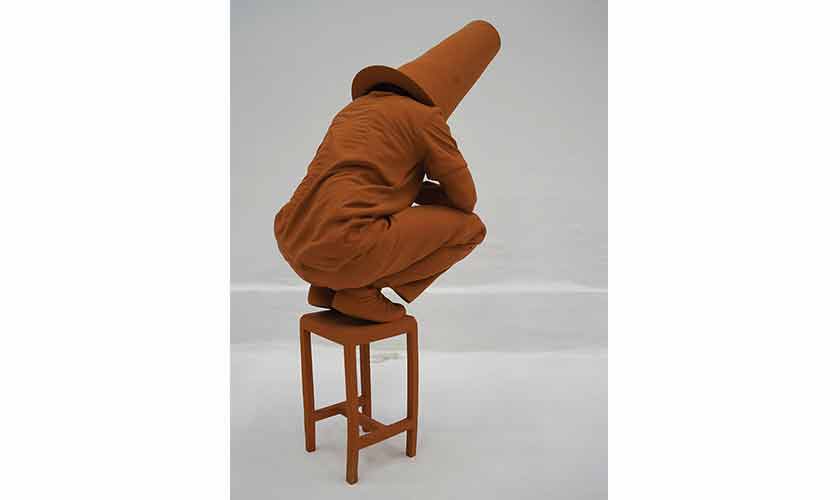
The recent sculptures of Suleman Faisal, by contrast, present the opposite side of this conditioning: the best behaviour. Urinating into the corner where two walls meet, sitting on a commode with trousers pulled down to the thighs, shaving an armpit with a safety razor, plucking a mole or a hair from one leg, brushing one’s teeth while standing over a sink, or buttoning a pair of trousers while tucking in a T-shirt are functions one is reluctant to disclose openly.
Faisal’s meticulously crafted work, produced in resin, paint, metal, stone, wood, MDF board, video and green fibre mesh, is part of his solo exhibition Exposed at the White Wall Gallery. The sculptures demonstrate the high level of skill Faisal possesses: the detail of a toenail, the curl of a finger, the flow of thick, dense hair, the precision with which a razor is depicted and the tautness of muscles bearing weight. The artist’s years at the National College of Arts (2013-17) testify to his command of capturing the world as we see it - in three dimensions.
This is not an uncommon quality; many sculpture graduates develop it. What separates Faisal, however, is his decision to minimise the use of his life-like figures for this exhibition. He adds another dimension to the genre of realistic reproduction, recalling what the poet Ted Hughes described as “Transfers” in a letter to his painter brother Gerald, through which “any fool can become a mirror if he practices hard.”
Faisal toys with the viewer’s perception, confronting them with naturalistically rendered figures averaging about two feet in height. This shift in scale unsettles the audience, prompting them to reflect on their own everyday actions. Partly exposed and partially concealed, the figures evoke the sense of peeping into someone’s private domain. This reading is reinforced by two videos: one shows a man adjusting his top and trousers (Between Shame and Control, 2026); the other depicts a man lying on his side within the confines, or cabinet, of his discomfort (Permission to Feel, 2026).
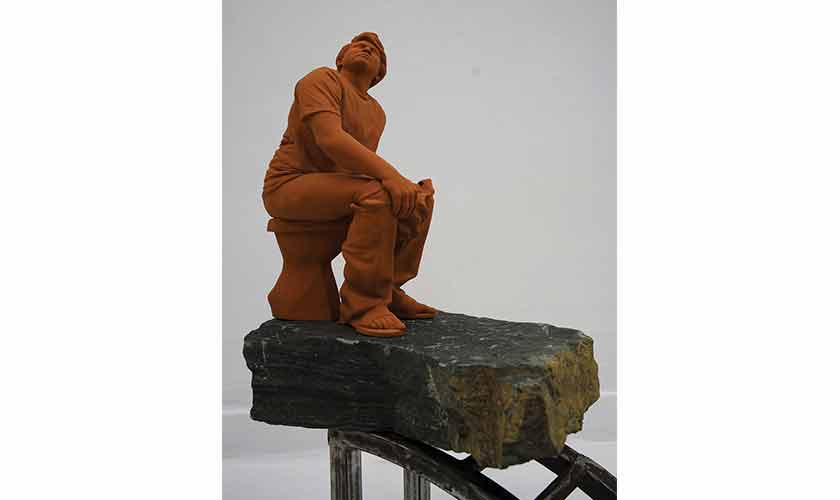
One is curious about the artist’s modification of the human body on more than one level. He has reduced the size of the human figure, from its usual proportions to a compressed version. This reduction is evident not only in scale but also in the mundanity of the acts depicted. Lifting two planks of wood; aimlessly sitting on a rock; sitting blankly on a simplified, minimally constructed chair; bending over an empty tin used to store thinner; relieving himself against two converging walls, oblivious to others; shaving his underarm while standing on wooden planks balanced on a metal structure; brushing his teeth while supported by a bathroom wall; wearing a cone-like form on his head or leaning against it; engaged in the daily routine of defecation; or plucking an unwanted part of the body, are all transformed into monumental (though physically small) figures engaged in grandiose endeavours.
Faisal toys with the viewer’s perception, confronting them with naturalistically rendered figures averaging about two feet in height.
In addition to their immaculate execution, Faisal has placed a number of these sculptures beside slender metal bars. The device of physically lifting them on long metallic supports elevates, in every sense of the word, these otherwise overlooked figures. Likewise, his decision to place some of them on unhewn stones recalls historic statues of rulers, conquerors and generals, bestowing a sense of monumentality on these ordinary individuals.
Not entirely ordinary, however, because each sculpture replicates the artist’s own face and body, making every work a self-portrait. Before studying art, Suleman Faisal had spent a brief period in the police, serving in a junior rank. Something of the humility of that phase seems to seep into these works, their earthen tones linking the human figure to terracotta brick, the most inexpensive building material, traditionally produced by bonded labourers, among the most marginalised workers in society.
The deliberate decision to turn some of the heads sideways enhances a tinge of shyness, restraint and reluctance to confront the world or, in this case, the gallery visitor. Yet another reading is possible. The composition of a twisted head with the body facing the spectator connects these small sculptures to Michelangelo’s David. There is, however, a subtle difference. Whereas the Renaissance master turned the head of David to the right, as if anticipating the approach of an adversary, Faisal’s figures appear reluctant to reveal either their identity or the seemingly insignificant tasks in which they are engaged.
This play of hide-and-seek resurfaces in his two videos. To view them, one has to move close to a peephole or opening, whether round or rectangular. The gesture invites, demands and forces an intimacy with a figure confined within a small structure – a box or an almirah. Faisal’s occasional disruption of the familiar relationship between the human body and its surroundings appears intended to unsettle established modes of perception. Perhaps this impulse also stems from his role as a faculty member at his alma mater, where art teachers often encourage students to question inherited assumptions and dismantle established ways of seeing.
Altering the proportions of the human figure and the objects it uses points to another possibility, one often neglected in our rational discourse unless articulated by a creative individual - someone like Sufi Tabassum, the legendary teacher, mentor and poet. Among his many achievements was a small book of verses for children. Nearly half a century later, I remember one of its lyrics, although I only came to understand its full meaning years later. Translated into English, the line reads: “The stream is going to drown in the boat.”
The aesthetics, strategy and conceptual approach of Suleman Faisal’s work, to some extent, echo the verse’s expansive imagination.
Exposed runs until July 10.
The writer is a visual artist, an art critic, a curator and a professor at the School of Visual Arts and Design, Beaconhouse National University, Lahore. He can be contacted at [email protected].