Print Story
X




The tragedy of Karbala reminds individuals and societies to remember how to act when confronted with injustices deliberately designed by power
| K |
arbala has lived across centuries not because it belonged to one religious community or one way of commemorating it, but because it touched something elemental in the human condition. It is remembered as a religious conduct, yet its moral force has always exceeded the boundaries of theology. When one looks closely, the event reveals itself as an embedded mode of resistance, as Michel Foucault puts it, that responds to power. This aspect speaks as clearly to liberal and secular sensibilities as it does to faith. At its core, Karbala is the story of a human being, who refused to surrender the last freedom available to him, in Sartre’s words, the freedom to say NO.
In a world where tyranny and coercion often leave no space for structural change, this refusal becomes the most meaningful assertion of human will. Silence is always an option under oppressive systems. So is compromise. So is withdrawal into private survival. Imam Hussain (with whom Allah was pleased) could have chosen any of those paths. Many did. They lived under Yazid without confronting the moral implications of their compliance. Hussain (with whom Allah was pleased) chose differently. His refusal was not merely a theological stance. It was an ethical one. Imam Hussain (with whom Allah was pleased) refused to legitimise a system built on coercion, corruption and inherited power. That choice is one of the purest expressions of conscience in human history.
Modern scholarship has increasingly recognised this dimension. Scholars such as Minoo Mirshahvalad have shown how Karbala has been repeatedly reinterpreted in contexts far removed from its original historical setting. The event has inspired movements, literatures and political imaginaries that sometimes contradict one another. This diversity of interpretation reveals something essential. Karbala is not owned by a single theological authority. It has become a moral vocabulary available to anyone confronting injustice.
It is precisely this openness that led the anthropologist Michael MJ Fischer to coin the term the Karbala Paradigm. Writing in the late Twentieth Century, Fischer suggested that Karbala should be understood not simply as a past event but as a recurring interpretive framework, a paradigm that provides models for living and a way of thinking about moral action under pressure. It serves as a prompt that reminds individuals and societies to remember how to act when confronted with injustices deliberately designed by power. In this sense, Karbala is continually reactivated rather than merely commemorated.
What follows from this insight is profound. A paradigm is never static. It can produce different, even opposing, moral outcomes depending on the context in which it is invoked. Karbala, therefore, becomes capable of supporting quiet endurance as well as open rebellion, accommodation as well as resistance. It is not a doctrine that dictates a single path. It is a moral grammar that allows human beings to interpret their circumstances and choose their response.
Ali Shariati moved decisively in this direction by recasting Imam Hussain (with whom Allah was pleased) as a symbol of existential revolt rather than ritualised commemoration. He transformed Karbala into a perpetual NO that no empire and their apologists can permanently absorb. Later scholars such as Kamran Scot Aghaie have shown that this flexibility is not incidental but fundamental. In different historical moments, Aghaie suggests, Karbala Paradigm has been used both to survive the status quo and to challenge it, serving at once as a language of dissent and a mechanism to sustain highest moral standards.
This interpretive openness also explains why Karbala has always been contested. One cannot understand its meaning without examining the groups that have tried to shape, confine or neutralise it. The first of these are the deniers of Karbala. Their response represents the most primitive reflex of power. Denial is always the first strategy of domination. Every oppressive system begins by erasing the memory of dissent. To deny Karbala is not merely to dispute a historical episode. It is to attempt to erase a moral precedent. It reflects a deep anxiety that if such acts of refusal are acknowledged, they may inspire others.
When denial becomes impossible, it gives way to minimisation. This second group, the minimisers of Karbala, treats the event as a political misunderstanding or a clash of personalities. Their method is familiar in modern political life. Acts of resistance are stripped of their ethical urgency and reduced to administrative errors or unfortunate miscalculations. By doing so, the moral clarity of the event is neutralised. The bureaucratic mind of empire prefers ambiguity because ambiguity weakens dissent. In this reading, Karbala becomes a footnote rather than a turning point. Among them were jurists who tried to challenge the legitimacy of Imam Hussain’s (with whom Allah was pleased) stance by folding it into delicate legal reasoning, as if language of jurisprudence could soften what history had already carved into the human heart.
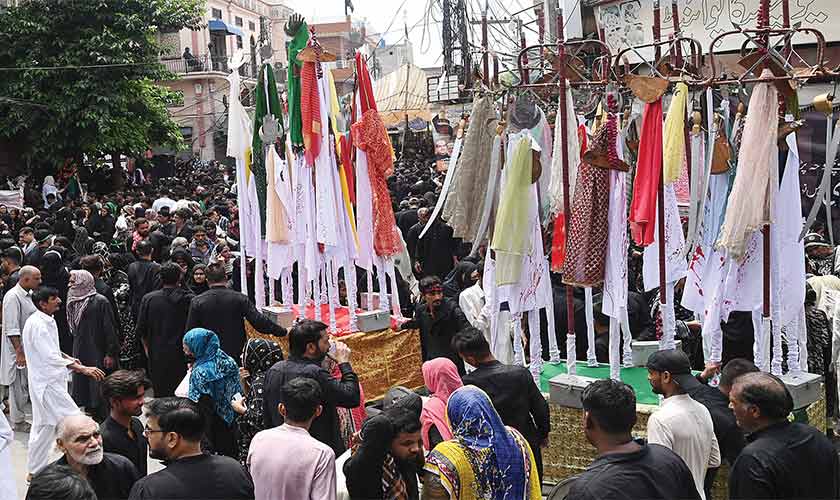
The third group, the devotional interpreters, occupies a more complex space. They preserved Karbala through ritual, poetry and collective memory when political power sought to bury it. Without them, the story might not have survived with such emotional depth. The marsia, in particular, transformed grief into moral energy and gave literary expression to courage, loyalty and defiance. Yet devotion, for all its power, sometimes confines Karbala within a sacred enclosure. The event is preserved, but its meaning risks being restricted to a particular community. The fire is kept alive, but it is placed within a shrine.
It is the fourth group, the secular and liberal interpreters, that bring Karbala back into the open space of human ethics. They see the event not as sectarian memory but as a universal expression of resistance. Imam Hussain’s (with whom Allah was pleased) refusal becomes the highest form of free will under coercion. Zainab’s testimony becomes the archetype of witness. The companions of the Imam form a small community bound not by tribe or interest but by shared conscience. In this reading, Karbala is not about debilitating mourning but about reactivating ethical responsibility.
A fifth group, the political strategists, extends this interpretation further. They treat Karbala as a case study in legitimacy, authority and the psychology of power. It becomes a site where political theory meets moral philosophy. The questions it raises are not confined to the Seventh Century. What legitimises authority? When does obedience become complicity? What is the cost of dissent? In this framework, Karbala stands as a foundational text for understanding how power operates and how it may be resisted.
Together, these perspectives reveal that Karbala is not a closed event. It is a contested moral landscape. The deniers show the fear of power. The minimisers show its strategies of narrative control. The devotional interpreters show how memory survives. The secular interpreters reveal its universal meaning. The political strategists demonstrate its analytical depth. What emerges from this mosaic is a simple but profound conclusion. Karbala is a human inheritance.
This universality becomes even more apparent when one looks at the ways in which Karbala speaks to modern conditions. We live in a time when oppression often appears overwhelming. Authoritarian regimes, economic exploitation, cultural erasure and global indifference create a sense of suffocation. In such a climate, Karbala does not offer a single prescription. It offers a spectrum of moral possibilities.
The first is refusal. It begins with the decision not to legitimise injustice, the very act with which Hussain (with whom Allah was pleased) began his journey. The second is the preservation of moral clarity, the insistence that even when you cannot change the world, you will not let the world change you. The third is the creation of witness, embodied most powerfully by Zainab (with whom Allah was pleased), who showed that resistance continues through speech, memory and testimony. The fourth is the cultivation of solidarity, the recognition that resistance grows through community. The fifth is the assertion of dignity, which the Imam (with whom Allah was pleased) and his family maintained even in captivity, refusing to grant the oppressor the satisfaction of humiliation. The sixth is the refusal to surrender hope, the understanding that moral action is meaningful even when it does not produce immediate results. The seventh is the distrust of power, the instinct to question authority when it demands the erasure of human suffering. The eighth is restraint, the wisdom to remain silent when conflicts are merely contests between competing power centres rather than struggles for justice.
These lessons become even more urgent when viewed through the lens of the psychology of colonialism. Colonialism is not only a political or economic system. It is a mental condition. It reshapes how people perceive power, authority and their own agency. It teaches the colonised to admire strength and distrust vulnerability. It conditions individuals to align instinctively with power centres and to view resistance as futile or irrational. Over time, this produces a form of internalised submission in which people begin to police their own dissent, believing that survival depends on compliance.
Karbala disrupts this psychology at its root. It reverses the colonial instinct. Instead of asking where power lies, it asks where truth lies. Instead of equating survival with success, it redefines success as moral integrity. Instead of glorifying victory, it dignifies resistance. In this sense, Karbala becomes a profoundly decolonising force. It teaches that even when one cannot defeat power, one can refuse to be shaped by it.
Ultimately, the enduring power of Karbala lies in its simplicity. It reminds us that human beings always have choices, even in the most constrained circumstances. Those choices may not transform power structures immediately, but they shape the moral imagination of history. A single act of refusal can echo across centuries because it affirms something fundamental. That oppression is never absolute. There is always a space, however small, where human freedom of saying NO can assert itself.
To reduce Karbala to a narrow religious frame is to diminish it. It is not a dispute of the past. It is the human refusal to bow, a refusal that will endure as long as humanity itself endures. It is the courage to say NO when no path seems left. It leaves behind a stark and unsettling truth: even in military defeat, moral clarity is a victory. Truth gathers strength in silence, returns in memory and action, and in time, it transforms itself into revolt.
The writer is a principal clinical psychologist in the Republic of Ireland. He can be contacted at akhtaralisyed @gmail.com