Print Story
X




Questions abound after a 9-year-old is killed in police firing
| A |
hmed* says while planning a visit to his country of origin, Pakistan, he had never thought he would be returning to his homeland, Australia, without his nine-year-old daughter, Hania*.
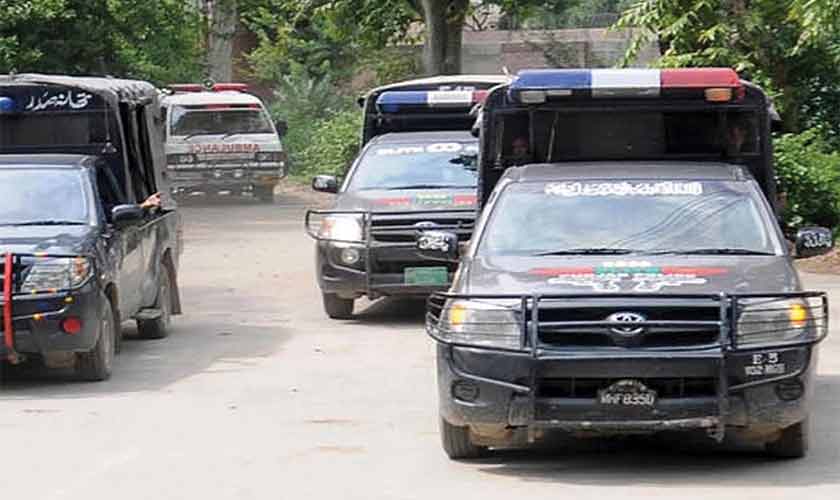
Hania suffered multiple bullet wounds and died on the night of June 10 when Crime Control Department personnel, responding to a street robbery complaint by Ahmed shot at their car.
Ahmed, an Australian citizen of Pakistani origin, had gone to visit his in-laws in Chakwal. There, at around 11.40 pm, he was robbed by two unidentified men riding a motorcycle. The incident occurred within a few yards away of the CCD police station in Chakwal. Ahmed says his in-laws live close to the police station. He says he was trying to ring the doorbell to enter the premises when he heard the gunfire. He says he rushed back to his car and tried to speed away from the scene. Ahmed says the CCD men shot and injured him, his son Affan and his daughter Hania.
According to the post-mortem report, Hania was hit by 11 bullets.
The family, whose ancestral home is in Dhadial, lives in Perth, Australia. Ahmed and his wife had recently returned from Makkah after performing Hajj. The children, Hania and Affan, had meanwhile been staying with their grandparents in Dhadial.
CCD chief, Sohail Zafar Chattha, has said that investigations are under way and promised ‘justice.’ Speaking to the media in Chakwal, he described the episode as an ‘accident.’ He said there appeared to have been a violation of the standard operating procedures but insisted that it would be unfair to blame the CCD for the “mistake of one official who opened fire on the car, thinking that the robbers were fleeing in it.”
Chattha said it might have looked like “the CCD team had successfully intercepted an armed robbery.” He said “an error resulted in the unintended death of Hania and injuries to two others.”
Chattha said an officer had misidentified the threat, wrongly concluding that the suspects were fleeing in the vehicle. He said the officer who discharged his weapon had been arrested and that further investigations were under way. Chattha also visited the bereaved family and promised them ‘justice.’
Speaking to the media, Ahmed expressed dissatisfaction with the CCD chief‘s statement and the investigation. He also said the CCD’s version was inaccurate. There were, he said, at least five policemen shooting at their car, not a single officer. Ahmed and the Australian government have urged Pakistani authorities to hold a transparent investigation. Australian Prime Minister Anthony Albanese has also issued a statement condemning the incident.
Some human rights groups have pointed out that no independent inquiry has been announced so far. In effect, they say, the same police and the CCD will be investigating the case. Earlier this year, the Human Rights Commission of Pakistan had called for a judicial inquiry into more than 900 deaths in CCD-led encounters and alleged extrajudicial killings in the Punjab. Advocate Azhar Siddique, who has previously initiated public interest litigation questioning CCD encounters, has written a letter seeking justice for Hania.
The incident has caused fear and anxiety to other overseas Pakistanis as well.
“Many overseas families visiting Pakistan might now avoid outdoors after dark, especially on highways where robberies have been reported,” said Imran Ali, a Canada-based Pakistani.
The officer misidentified the threat, wrongly concluding that the suspects were attempting to flee in the victims’ vehicle.
Ali said children raised in other countries were accustomed to entirely different styles of policing, road safety and emergency response. “They do not instinctively know how to behave during a Pakistani police encounter or a robbery. Parents should think about whether their children are equipped for such situations.”
“The honest answer is that most families will be afraid and will exercise far greater caution after this incident,” said another British national of Pakistani origin, Muhammad Akif, who lives with his family in London. “The emotional pull is powerful. Many overseas Pakistanis wish to take children ‘back home.‘ Such visits are seen as acts of cultural identity, family bonding and connecting the next generation to their roots. This will not disappear overnight,” he said.
He said the Hania Ahmed tragedy was hard to dismiss as a freak accident. The facts point to structural issues: street robberies, inadequate police training, late-night vulnerability and weak accountability.
This may also lead to fewer visits. Families may continue visiting urban centres such as Lahore, Karachi and Islamabad, where security infrastructure is relatively better, while avoiding ancestral villages and late-night inter-city travel.
“Many people, once they start living abroad, begin to fear for their safety in Pakistan. They keep receiving news of crime and terrorism in Pakistan. That’s what the media keeps highlighting. This event is a huge embarrassment,” said Aman Malik, another Australian-Pakistani.
Malik said there was little confidence among overseas Pakistanis when it came to safety in Pakistan. He said that it would not be surprising if the number of visitors, particularly from Australia, declined. “This will be a huge loss,” he added.
Many people settled abroad come with their families and young children to build a connection with their roots, but such incidents shatter their confidence and raise serious questions about safety, security and the justice system, observed Shaiq Hussain, a US-Pakistani.
“Sometimes it becomes very difficult to answer young people’s questions after such episodes. Efforts to build a connection with the country of origin are thus disrupted,” he said. Such incidents also erode confidence for investment in Pakistan.
“Overseas Pakistanis and their families begin having second thoughts, reconsidering their plans and sometimes choosing other countries for holidays and vacations rather than their country of their origin,” Hussain said.
He said the criminal justice system in the country had clearly collapsed. He also said in his view, the recent case had received attention only because the deceased child was an Australian citizen and because the Australian government had taken up the matter. He said this should become a test case for the CCD and the Punjab government which must not allow a cover-up.
Note: Names have been changed to protect the victim’s identity.
The author is a staff reporter. He can be reached at [email protected].