Print Story
X




There has been a sharp decline in enrollment for the humanities, especially in language and literature
| A |
s the world witnesses the marvels of artificial intelligence (AI), there appears to be a paradox at its core. The revolutionary language models, such as ChatGPT, have been developed with the help of the human language, drawing upon centuries of books, literature, journalism and everyday communication. However, teaching and studying of the same languages, especially English, are on the wane.
Educators and policymakers have observed and deliberated on the sharp decline in enrollment for the humanities, especially English language and literature, in many universities around the world. Some commentators on the subject have described the trajectory either as “decline” or “death” of the English Departments. In a Quillette post of April 5, 2023, titled The Real Reasons Why the English Department Died, the author, Adam Ellwanger, shared some insights into what he described as causes of the ‘death.’
Four of his insights stand out. First, pursuit of instant wealth, which a degree in English does not readily guarantee. Second, the curriculum for a degree in English and literature constantly breaks away from objective standards of value and attacks the very existence of the canons. Similar to this concern is college professors’ neglect in enforcing the ethos of grammatical and mechanical accuracy due to their disdain for formal rules of writing. Ellwanger says that English departments place emphasis on reading, thinking and critiquing instead of speaking, writing and creating. Due to these conditions, intake levels continue to plunge.
In August 2015, Jay Schalin, director of policy analysis at the John W Pope Centre for Higher Education Policy published The Decline of the English Department on the centre’s official website. Schalin argued that the decline in the discipline was predominantly either intrinsic or due to a marketing challenge in meeting the demands of an increasingly career-oriented higher education system. Greater accessibility to higher education, especially among zealous youth from the middle and working classes, means more programmes to meet diverse needs and more competition in filling the available spots in the job market. Such an economy pushes students into pursuing seemingly more prestigious career prospects rather than the desire to become educated gentlemen and gentlewomen or out of a love for learning. As a result, the English Departments in colleges and universities began their long decline in enrollments for nearly half a century. Moreover, the arrival of new modes of communication has given rise to careers that blend writing and technology. Consequently, some departments—according to Schalin—began developing curricula that “blur the lines between English and communications by inventing new quasi-disciplines as the ‘digital humanities’ and media studies.”
These anecdotes may have been drawn from the West but the situation is not much different in Pakistan. For years, humanities disciplines—especially languages and literature—have been dismissed as economically irrelevant.
On the other hand, the current revolution changing the world, is the direct result of the birth of large language models (LLMs): programmes based on human language itself. Bots first educated through reservoirs of written texts: books, fiction, newspapers and digital archives.
This is how AI encounters the corpus of linguistics. In the training of AI systems, data is taken from Oxford English Corpus (2.1 billion words), the Corpus of Contemporary American English (1 billion words), the British National Corpus (100 million words), Europarl Corpus (60 million words) or the American National Corpus (22 million words). This clearly shows that without literature, books, storytelling and centuries of linguistic production, the contemporary AI systems will not be able to function as they are doing. For the humanities, the nature of the LLM technology is especially significant. These LLMs’ ‘intelligence’ owes itself to language and the power of computation.
The new programmes are nothing like earlier software that was programmed through traditional/ fixed rules. They learn by recognising patterns within language. By being able to use/ access huge amounts of human writing, they can guess the context and choose the right words. This type of ‘intelligence’ is derived from linguistic/ literary production.
To understand these LLMs, let us examine the 2021 research of Emily M Bender, Timnit Gebru, Angelina McMillan-Major and Shmargaret Shmitchell, titled On the Dangers of Stochastic Parrots: Can Language Models Be Too Big?”
The authors closely examined the training of LLMs. OpenAI’s GPT architecture responds by guessing the most likely order of words based on statistical probabilities learned during training. Bender et al refer to this system of mimicry and probability selection as a “stochastic parrot,” suggesting that the system assembles plausible-sounding text without true comprehension or intent and mimics human language based on probabilistic associations.
Bender et al (2021) cite the case of a Palestinian man, who was arrested by Israeli police after his Facebook post “good morning” (in Arabic), became “hurt them” (in English) and “attack them” (in Hebrew) through machine translation. The Brazilian linguist, Tony Berber Sardinha, in his paper, Corpus Linguistics and Artificial Intelligence, posits that AI predictions rest on the observation that registers co-occur in predictable ways when the communicative context remains constant and shifts once the functional demands on language are altered, requiring human intuition rather than AI’s ingenuity to decipher contextual differences.
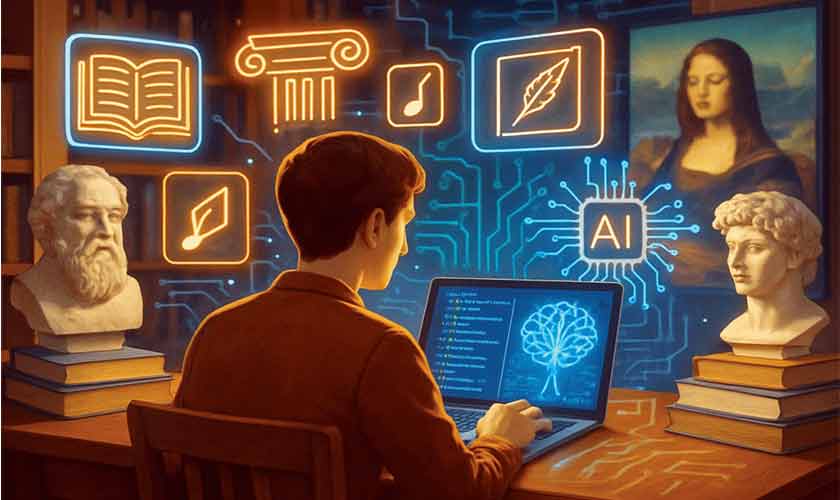
On the other hand, the study of languages and literature has been on the decline. The focus has been on STEM-related disciplines. Students of literature and languages are often told that their disciplines belong to the past and the future lies in technology and engineering. Countries like South Korea and Taiwan are investing heavily in AI ecosystems. Wall Street and global finance are integrating AI tools in their routine operations. While AI tools receive applause for their contribution to economic advancement, many fail to recognise that these systems depend fundamentally on linguistic intelligence. The AI systems now driving innovation in places such as South Korea, Taiwan and global financial centers are fundamentally dependent upon language. Had these models not been trained on centuries of human expression—our stories, debates, philosophies, histories and literary imagination—their remarkable conversational and analytical abilities would not have been possible. AI, in this sense, did not emerge in opposition to language and literature; it emerged through them.
The lesson of the AI revolution is not that engineers matter less, but that language, literature and technology are far more interconnected than some debates about education assume. AI has not made language obsolete. It has demonstrated, perhaps more clearly than ever before, that human civilisation is built through language and that the machines now reshaping our world learn to speak from humanity’s libraries.
The writer is a post-doctoral fellow at the Islamic Research Institute, International Islamic University, Islamabad, and the Head of the Department of English Language and Literature at the University of Lahore. [email protected].