Print Story
X




Wahab Jaffer played a singular role in shaping Pakistan’s visual arts landscape
| W |
hen I last met him on April 6, there was an eerie feeling that I would never see Wahab Jaffer again. I went to his house with two friends to offer condolences on the passing of his wife and was shocked to come across a person so different from his familiar self. Withdrawn, weakened, wilted; almost disassembled – these were not descriptions to be associated with a person known for his openness, energy and support for artists. In that unforgettable meeting, glimpses of his true persona surfaced sparsely. Responding to the question of whether he recognised my two companions, he, with a twinkle in his eyes, named one as a leading gallerist and the other as a famous artist.
The news of Wahab sahib’s death brought back a small pack of personal memories and a huge stack of his contributions to the art world in Pakistan. Earlier in his life, he was admired and acknowledged as an art collector. Only later, as Ijaz-ul Hassan informs us in his book Painting in Pakistan, “He turned to painting as a means of discovering himself after his industry was nationalised in the 1970s.” Akbar Naqvi wrote in Image and Identity: “Wahab took lessons from Ali Imam in his studio and found inspiration in the paintings of Ahmed Parvez, whom he took into his home and looked after not long before his death.”
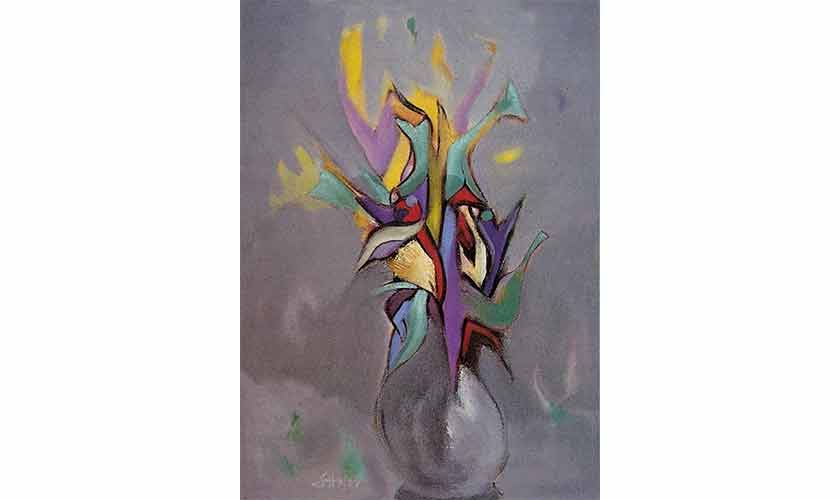
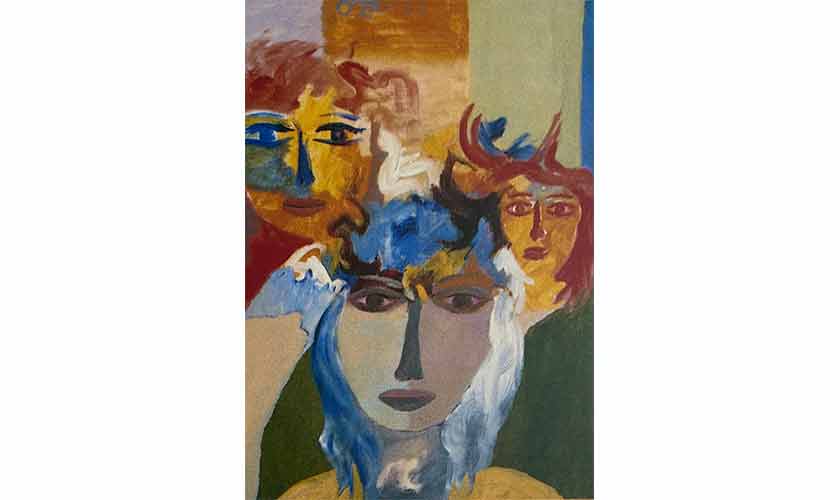
Wahab Jaffer’s connection to Ahmed Parvez is visible in his early work, but he soon developed an independent vocabulary, one that bore little resemblance to the pictorial solutions of Parvez. Instead, it suggested Jaffer’s preference for constructing an atmosphere of joy, exuberance and excitement. In comparison with his mentor, celebrated for his expressive, energetic and abstract surfaces, Jaffer chose recognisable faces and identifiable characters. The artist’s palette added to the sense of pleasure, calm and satiation springing from faces, features and hair that resemble sprouting flora.
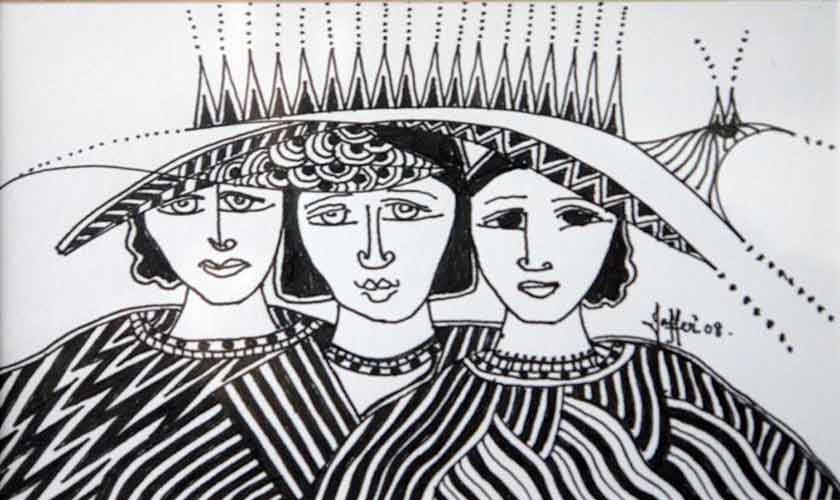
The untiring painter explored other dimensions, too. For instance, a series of black-and-white drawings which, owing to the artist’s attachment to paint, were handled as though they were translations of colour into monochrome. The man’s unyielding passion for art was evident in the period when he used to paint in a tiny space in the house – a disused bathroom. During our first meeting, he took me to his studio, a workplace that reminded me of Amos Oz, who wrote his first two novels while seated on the toilet so as not to disturb his family.
In a diverse and expanding art circle in Pakistan, several artists are at work, as they were in the past and will be in the future. What distinguished Wahab Jaffer was his varied connection to this realm. He became a collector when the word was still alien, especially in the context of art; particularly modern art. The affluent class was, and still is, spending on expensive artefacts, exquisite furniture, precious carpets and extravagant interiors to satisfy its lavish longings, but hardly bothered to consider art an investment, let alone something of aesthetic value. Against this background, artists sought someone who not only encouraged them by buying their work, but also paid respect and became a member of the community.
Wahab sahib’s house always remained open to artists, his partners in the prime act of art-making. On visiting him, they received a sincere and warm welcome from their host and found a part of their personalities installed on a wall or placed on a plinth. Jaffer owned works by every well-known artist, including those who had only recently started their careers. He spotted talent at an early stage. I had no idea of the extent (or value) of his collection until he opened his storage space, where significant works by Pakistani artists were carefully kept. One could imagine the importance of these landmarks, which helped shape the history of the country’s visual culture.
Several of them were reproduced in the first publication on Pakistani art, Art in Pakistan (1954), by Jalal Uddin Ahmed. It was a rare privilege to see Shakir Ali’s Still-Life with Pineapple, included in the book’s chapter, Evolution of New Visual Vocabulary; and Repose by Sadequain, depicting a female figure stretched across the back of a bull, illustrated in the chapter, Experiments by Younger Artists.
At a certain stage, Wahab Jaffer, probably realising that this large collection ought to be shared with an institution, sold part of it to the Rangoonwala Trust. However, his fervour for owning art was not extinguished. After parting with a major portion of his acquisitions, he purchased a bronze by Shahid Sajjad from the artist’s retrospective held at the National College of Arts in 2014.
In fact, unlike typical collectors, works from his collection were not merely stored away in a cellar but also preserved in his recollections. Off the cuff, he was able to name artists and describe their creations.
He was not only interested in the materiality of an object; its meaning, context and history intrigued him as well. Once, he took me to the lower section of his ancestral home in Karachi to show me files and folders filled with artists’ catalogues and statements, as well as clippings of articles, reviews and exhibition news. Preserving this substantial body of documentation was a habit Jaffer had acquired from Ali Imam, who maintained boxes dedicated to individual artists, retaining all related printed material.
Wahab Jaffer donated this archive to the library of the Indus Valley School of Art and Architecture. However, he found another way of transferring knowledge about art to a wider public interested in the visual arts: those unable to enter a collector’s residence, unlikely to visit an art gallery, hesitant to step into an artist’s studio and unable to access art discourse, which in our context is largely conducted in English. He sponsored the publication of Shafi Aqeel’s books on art in Urdu. Containing the author’s encounters with his artist friends, they are full of anecdotes, intimate histories of their growth and commentary and critique of their creative practice. One volume comprises Aqeel’s weekly art columns from the daily Jang, which, in the late 1970s, introduced me to art and inclined a young boy towards adopting this profession.
Like me, I feel, many adolescents, deprived of art writing in Urdu after its disappearance from the major newspapers, can benefit from Aqeel’s books on art. They owe a great deal to Wahab Jaffer’s behind-the-scenes role, a recurrent motif in his continuous effort to promote the art of Pakistan, a world of which he remained an integral part, even after physically departing it on June 19.
The writer is a visual artist, an art critic, a curator and a professor at the School of Visual Arts and Design, Beaconhouse National University, Lahore. He can be reached at [email protected].