Print Story
X




Sometimes misunderstood as charity, social protection is actually an investment in people
| F |
ew public programmes generate as much debate in Pakistan as the Benazir Income Support Programme. As the government prepares to unveil the federal budget for 2026-27, discussions have once again intensified over the future of social protection spending. With the BISP allocation reaching Rs 716 billion in the outgoing fiscal year and expected to increase further, some critics question whether the programme has become a fiscal burden. Some argue that public money would be better spent on job creation, factories and infrastructure projects. Others contend that in a country where millions remain vulnerable to poverty, inflation, climate shocks and economic uncertainty, social protection is not a luxury but a necessity.
The beneficiaries
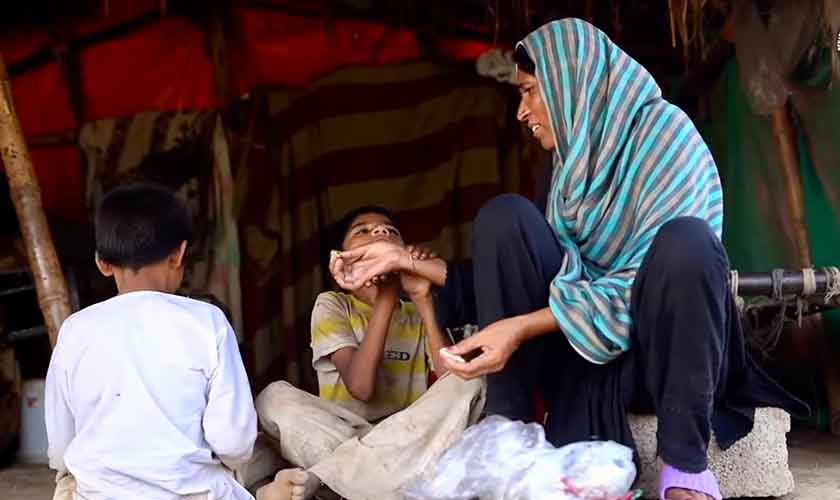
Lost amid these competing arguments are the voices of the families whose lives are directly shaped by such policies. One such beneficiary is Samina Bibi, a 46-year-old mother of five who lives in a makeshift shelter of wooden poles and plastic sheets in Golra village on the outskirts of Islamabad. Two of her children have special needs. Before joining the BISP during the Covid-19 period in 2022, the family survived on the meagre earnings of her husband, a chronic asthma patient who collected recyclable waste from streets to support the household. “It was very difficult to manage,” she recalls.
When Samina received her first BISP payment, she invested part of the money in a small bangle-selling business. Over time, she saved enough to buy a goat, which later gave birth to three kids. The proceeds from their sale helped pay for her son’s hernia surgery. A few hens now contribute to the family’s income and food supply. Three of her children now attend school. A part of the assistance is spent on education and healthcare.
Asked what would happen if the support stopped, she pauses before replying. “We will not die, but life will become harder. We will have to compromise on food, education and healthcare. I may have to pull my children out of school or reduce the expenditure on medicines for my two special-needs children.”
Samina’s story is not unique. For millions of vulnerable households, social protection is not a substitute for work. It is a modest but critical cushion that helps families survive shocks, invest in their children, access healthcare and gradually build productive assets that improve their future prospects.
Economic rationale
Social protection is often misunderstood as charity. In reality, it is an investment in people. Pakistan recognised this nearly two decades ago when it approved the National Social Protection Strategy in 2007, aiming to move from fragmented welfare initiatives towards a more integrated and transparent system. There has been significant progress, particularly through the expansion of the BISP and the development of the National Socio-Economic Registry, although important challenges remain.
Some people think of the BISP as an unconditional cash transfer programme for 10.2 million vulnerable women-led households. In reality, it has evolved into a broader social protection and human development platform. While Benazir Kafaalat provides income support to poor families, the Benazir Nashonuma Programme supports around 2.2 million pregnant and lactating mothers and young children through conditional cash transfers and specialised food supplements aimed at improving maternal and child nutrition during the critical first 1,000 days of life. Benazir Taleemi Wazaif supports the education of approximately 12.4 million children from beneficiary households through stipends linked to school enrolment and attendance. More recently, the Benazir Hunarmand Programme has been launched to equip beneficiaries and their family members with marketable skills and pathways to sustainable livelihoods.
Together, these initiatives reflect a life-cycle approach that seeks not only to protect vulnerable families from poverty but also to invest in nutrition, education, skills development and long-term economic mobility.
The economic case for such investments is strong. According to a study by the Ministry of Planning and the World Food Programme, child and maternal malnutrition costs the country approximately $7.6 billion annually, equivalent of nearly 3 percent of GDP. These losses stem from premature deaths, widespread stunting, higher healthcare costs, poorer learning outcomes, lower productivity and the long-term erosion of human potential.
This is where social protection becomes an investment rather than a fiscal cost. An independent impact evaluation by Aga Khan University found that the Benazir Nashonuma Programme reduced stunting among children under five by 6.4 percent; reduced stunting at six months by 20 percent; increased immunisation coverage by 10 percent; improved breastfeeding practices by 11.6 percent; and reduced the incidence of low-birth-weight babies. These improvements are not merely health gains, they represent future gains in education, productivity and economic growth.
Dependency concerns
The criticism that cash transfers create dependency also deserves close examination. An independent evaluation by Oxford Policy Management found no evidence that BISP beneficiaries curtail their participation in the labour market after joining the programme. Around 80 percent reported spending part of the assistance on food. A significant proportion spent it on healthcare, clothing and education-related expenses. Some households used part of the support to acquire productive assets such as sheep, goats and poultry, helping diversify income sources and strengthen household resilience.
These spending patterns are hardly surprising given that beneficiaries belong to some of the most vulnerable segments of society. Most of the assistance is spent immediately in local markets on essential goods and services, supporting small shopkeepers, traders, transport providers and other local businesses. Rather than encouraging dependency, the evidence suggests that the transfers help families meet basic needs, invest in their children, build modest economic security and contribute to economic activity within their communities.
The findings are consistent with international evidence. A UNICEF review of more than a decade of research from the Transfer Project, which evaluated government-run cash transfer programmes across 10 African countries, found little support for the notion that beneficiaries misuse assistance or become dependent on it.
The dependency argument also overlooks how the programme actually operates. Through periodic recertification and dynamic updates of the National Socio-Economic Registry, beneficiary households are continuously reassessed. In the past year alone, around three million families were removed from the programme for no longer meeting eligibility criteria. Approximately three million newly vulnerable households were brought into the system. This continuous updating shows that the BISP is not a permanent entitlement but a targeted programme that adjusts as families move in and out of vulnerability.
False binary
The argument that the state should spend money on factories and jobs instead of social protection presents a false choice. Successful countries do not choose between economic growth and social protection, they invest in both. A malnourished child cannot wait for a factory to be built. A flood-affected family cannot postpone food consumption until industrial investment begins generating employment. Social protection helps preserve the human foundation on which future economic growth depends.
Recent evidence suggests that social protection itself contributes significantly to economic activity. A World Bank-supported analysis presented this month found that every rupee transferred through the BISP generates approximately Rs 2.34 in real income across the economy. The programme contributes an estimated Rs 1.67 trillion in annual income and Rs 1.21 trillion in additional production while supporting around 1.66 million jobs. Nearly 68 percent of these gains accrue to the poorest 40 percent of households. These findings challenge the notion that social protection is merely consumption spending. When low-income families receive predictable support, they spend it in local markets, creating multiplier effects that benefit traders, shopkeepers, farmers and service providers.
Gender gap
Perhaps one of the BISP’s most transformative achievements has been its contribution to women’s empowerment. Since its inception, the programme has directed payments to women, making them the primary recipients of assistance. Making a computerised national identity card (CNIC a prerequisite for enrolment, brought millions into the formal administrative system for the first time. In doing so, women gained not only access to financial assistance but also greater visibility. Possession of a CNIC enabled many to open bank accounts, exercise voting rights, access public services and claim legal entitlements, including inheritance and property rights. For women like Samina, receiving assistance in their own name often means greater control over household spending and decision-making.
Accountability
Any programme serving more than 10 million families and managing hundreds of billions of rupees in public funds must be held to high standards of governance. While operational challenges and complaints have emerged from time to time, the BISP has consistently strengthened its delivery systems to reduce leakage and human interference. Approximately 7.7 million beneficiaries have already received SIMs and digital wallet accounts. Future payments are expected to be routed directly through these wallets. These reforms are designed to create auditable payment trails, reduce reliance on intermediaries and strengthen financial inclusion.
Serendipity
BISP’s importance extends beyond its regular programmes. During the Covid-19 pandemic and the devastating floods of 2022, its nationwide database and payment infrastructure enabled the government to rapidly identify and support vulnerable households. More recently, the Prime Minister’s Ramazan Relief Package was also delivered using BISP’s database and systems. Few public institutions possess a comparable combination of poverty data, delivery mechanisms and nearly two decades of operational experience. This makes the BISP not only a social protection programme but also a critical national platform for responding to economic, social and climate-related shocks.
The debate over BISP ultimately reflects a broader question about how Pakistan defines development. For decades, development has often been measured through visible infrastructure such as roads, bridges, motorways and public buildings. Such projects are important, but they are not the only measure of progress. Investments in nutrition, education, healthcare, women’s empowerment and poverty reduction may be less visible, but they are equally important to the country’s long-term prosperity.
At the same time, legitimate concerns remain about the broad architecture of social protection in Pakistan. Over the years, multiple federal and provincial programmes have emerged, often operating with different eligibility criteria, databases and delivery systems. As a result, Pakistan’s social protection system has expanded but remains fragmented due to overlapping federal-provincial roles, limited data integration and weak coordination. The challenge for policymakers is not whether social protection should exist, but how it can become more integrated, efficient and transparent. Rather than creating parallel systems, Pakistan may benefit from using the BISP as a platform to better integrate nutrition, education, skills development, financial inclusion, disaster response and other social protection initiatives across federal and provincial governments.
The 10.2 million BISP beneficiary families rarely feature in policy debates though they are among the people most affected by public policy decisions. The evidence suggests that social protection is not simply a budgetary expense but an investment in people’s health, education, resilience and future opportunities. The challenge for Pakistan is not whether to support its most vulnerable citizens, but how to do so most effectively, transparently and in ways that help them move out of poverty.
The writer is an Islamabad-based journalist, researcher and media trainer. A former Daniel Pearl/AFPP fellow, he shared in The LA Times’ 2016 Pulitzer Prize for breaking news.He tweets @AounSah