Print Story
X




Building actionable pathway for fostering security and stability
| F |
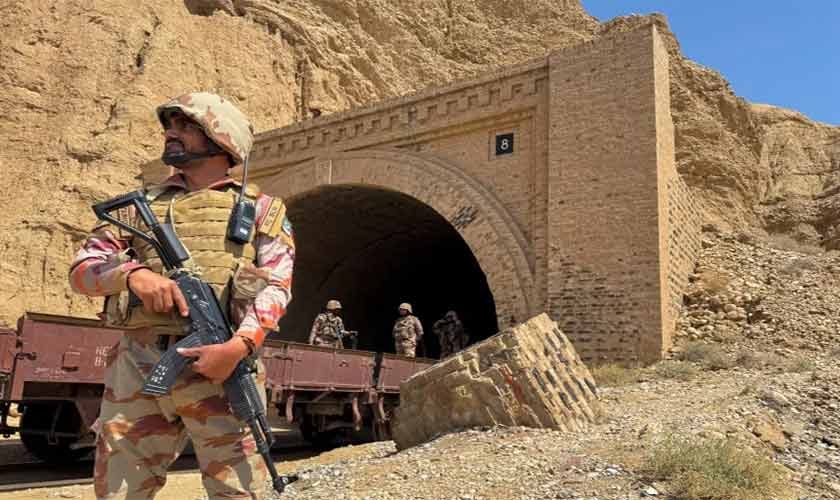
or decades, Pakistan has been fighting terrorists on physical battlefields. The memories of the Jaffar Express hijacking, the devastating suicide bombing of its Quetta shuttle and the APS Peshawar massacre, the February suicide blasts at an Islamabad imambargah are constant reminders of the horrific cost of a kinetic conflict.
Even as such attacks continue, the battlefield is shifting to include the battles fought in WhatsApp forwards, TikTok algorithms, YouTube echo chambers and X spaces. The February blasts in Islamabad showed how kinetic violence and digital radicalisation reinforce each other.
This is the age of hybrid threats. Fake news, proxy wars, cyber attacks and ‘ideological’ extremism merge into complex, borderless challenges. MNA Jamal Raisani warned in a recent statement that Pakistan is now facing a ‘silent’ yet highly dangerous war. He said the main theatre of the war had moved from the mountains to mobile phones. He said the modern conflict relied less on bullets and explosives and more on propaganda and narratives to win over minds even before a single shot is fired.
Scholars, policymakers, religious leaders and civil society representatives recently gathered at Minhaj University, Lahore, for the First International Conference on Countering Terrorism and Violent Extremism. Hosted by the Department of Peace and Counter-Terrorism Studies, the conference focused on Dynamics of Hybrid Threats and Counter-Terrorism in Pakistan: Challenges, Responses, and Pathways beyond Stalemate. The gathering did not just diagnose the problem; it also offered a comprehensive, actionable roadmap: the Peace Framework, presented by Prof Dr Hussain Mohi-ud-Din Qadri.
The Lahore Peace Declaration issued at the conclusion of the conference identified hybrid threats as a “complex and serious challenge” where armed militancy, cyberattacks, proxy wars, disinformation and ideological extremism are linked through international networks. The declaration said state-centric counter-terrorism, while necessary, had proven insufficient.
Pakistan, it said, had fought conventional terrorism for over two decades. It now stood at the brink of a new kind of war that targets minds as much as the bodies. The shift is not merely tactical. It is psychological, social and digital as well.
Dr Qadri’s PEACE Framework is a community-based model for de-radicalisation and reintegration in Islamic intellectual tradition. In his keynote address, he said that we must move beyond a defensive posture. “We must not remain on the defensive. Through knowledge, research and narrative, we must uproot the roots of extremism. Our Peace Framework is a roadmap for sustainable peace.”
Unlike approaches that rely mostly on security operations, the Peace Framework treats prevention as a social, educational and intellectual process. It recognises that violent extremism thrives in a vacuum of knowledge, social trust and lack of economic opportunity. The Peace Framework has five actionable pillars: Prevention, Engagement, Accountability, Counter-Narrative and Economic Empowerment:
P – Prevention: This means addressing the material conditions that make individuals vulnerable to extremist recruitment—poverty, inadequate education, lack of healthcare and social marginalisation. Prevention is about building resilient communities before radicalisation takes hold, not responding after violence has occured. The Framework draws on Pakistan’s constitutional obligations under Article 29 to promote social justice and Article 37 to ensure education and economic security.
E – Engagement: Engagement must be wise, compassionate and reasoned, as guided by Surah An-Nahl 16:125: “Invite to the way of your Lord with wisdom and good instruction.” This is the antithesis of the extremist approach and the most effective counter to it. The conference participants emphasised that community-based de-radicalisation programmes in Pakistan must adopt this methodology as their operational philosophy. Engagement is not about confrontation; it is about creating space for dialogue and doubt.
A – Accountability: Institutions, scholars, religious leaders and other citizens must be accountable for promoting hate or for remaining silent in the face of extremism. The Lahore Declaration recommended integrating peace and counter-terrorism studies into national curricula and establishing research linkages between universities and state institutions. Accountability also means holding digital platforms responsible for the spread of hate speech and disinformation.
C – Counter-narrative: Extremist narratives thrive in an information vacuum. The Framework calls for using digital spaces to promote a positive narrative based on knowledge, not hatred. As multiple scholars noted at the conference, “A narrative that ends prejudice is more powerful than a gun.” This requires training a new generation of scholars, journalists and influencers to articulate a narrative of peace, pluralism and constitutionalism.
E – Economic empowerment: Sustainable reintegration requires giving former extremists and at-risk youths a real economic stake in the society. Without livelihoods, deradicalisation stalls, and recidivism becomes likely. Economic empowerment links counter-extremism to development, making it a whole-of-government and whole-of-society effort.
The PEACE Framework is grounded in both Islamic tradition and Pakistan’s legal framework. The model draws on the Constitution of Madinah—one of history’s earliest charters of multi-religious coexistence, which established principles of collective security, institutional conflict resolution and equal citizenship for Muslims, Jews, Christians and polytheists in 622 CE.
It also aligns with Pakistan’s constitutional commitments. The National Action Plan, adopted after the APS massacre of December 2014, represents the state’s most comprehensive counter-terrorism framework. Its twenty points include commitments to madrassa reform, countering hate speech and community engagement. PEACE operationalises these commitments by giving them an intellectual and community-based structure.
Dr Ahmed Javed Qazi, the Punjab home secretary, stressed the need to strengthen the intellectual bridge between security institutions and the academia to counter hybrid threats. His remarks signaled a shift in the state’s approach. He argued that public order and national security depend on a healthy educational environment. He said that the conference’s real value lay in creating a “focal point for research and dialogue” to shape policy.
Prof Dr Niaz Ahmad Akhtar, the HEC chairman, argued that universities must play an effective role in promoting research, dialogue and intellectual guidance to address complex challenges like extremism and terrorism. He said the youth must be provided a positive direction through the promotion of tolerance, critical thinking and moderation.
Dr Brian J Phillips from the UK and defence analyst Gen Ghulam Mustafa (retired), contributed comparative perspectives. Sikh leader Dr Taranjit Singh Batalia and Rehmatun-lil-Alameen Authority chairman Khurshid Ahmad Nadeem spoke on interfaith harmony and the role of religious leadership in countering extremism.
The Lahore Peace Declaration issued concrete recommendations: make peace and counter-terrorism studies part of the national curricula; use social media and digital spaces for positive narratives under the PEACE Framework; establish permanent research linkages between state institutions and universities; and ensure that every individual, institution and state acts as an agent of peace.
Hybrid threats will not be defeated by kinetic operations alone. They require a battle of ideas, fought with knowledge, love and dialogue. The PEACE Framework offers a plan for that battle. It is rooted in Pakistan’s reality, grounded in its constitutional and Islamic heritage and aligned with international best practices in community-based counter-extremism.
The PEACE Framework has transitioned from theory into an actionable pathway for fostering stability and countering extremism. The question is no longer whether Pakistan can respond to hybrid threats. The question is whether we will act on the roadmap before us.
The writer is a PhD scholar and senior journalist. His work focuses on international relations, peace, counter-extremism and hybrid security challenges. He can be eached at Kashifmuhammad79@yahoo.com