Print Story
X




Security forces have been mobilised to restore calm in Azad Jammu and Kashmir
| A |
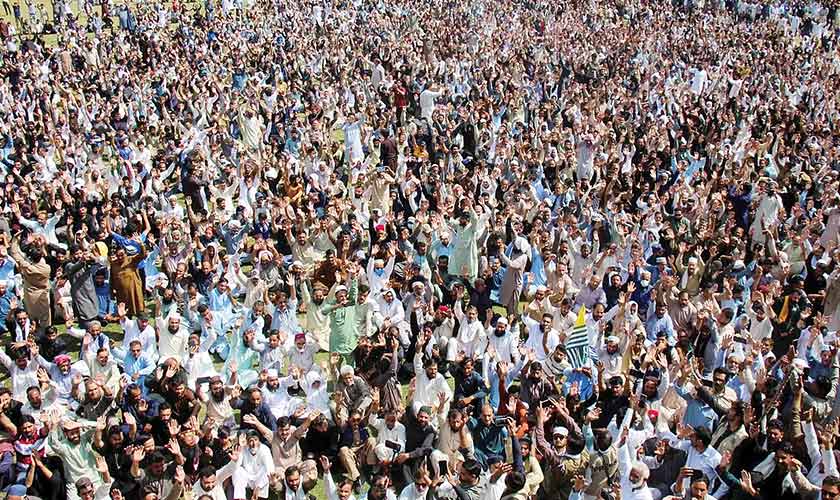
zad Jammu and Kashmir is at a critical crossroads in its history. What began as a movement to highlight public grievances - including wheat prices, electricity tariffs, inflation and governance failures - has turned into a violent confrontation. Rawalakot, which saw violence during earlier unrest, is once again seeing popular anger and fear.
The latest reports place the death toll at 11, including law-enforcement personnel. More than 70 people have been injured.
The AJK government banned the Joint Awami Action Committee on June 5. It invoked anti-terrorism laws to deal with protests called for June 9. 72 people associated with the banned JAAC have been arrested. Internet and communication services in many areas remain suspended. Rangers and Frontier Corps personnel have been deployed in sensitive areas and to protect key state installations and civil infrastructure. The government has announced a Rs 10 million reward for information leading to the arrest of four JAAC leaders. It has initiated sedition proceedings against some of the JAAC cadre.
The JAAC is no longer being treated as a citizens’ movement.
Come June 9, most shops and markets were shut and public transport was affected. Protest rallies originating from various areas continued to march towards Poonch and Rawalakot. In Mirpur, Kotli and Dadyal, the protesters confronted the security forces.
In Rawalakot, the confrontation had already turned deadly on June 6 when JAAC executive member Shahzaib Habib was killed and Umar Nazir Kashmiri was injured in a clash. Officials said a crowd led by JAAC supporters attacked the Combined Military Hospital [when?], killing four police officers and injuring several others. JAAC claimed that security forces fired in the direction of Shahzaib’s funeral.
The Human Rights Commission of Pakistan has expressed concern over the escalating confrontation and the loss of lives. It has called for immediate de-escalation and an impartial investigation.
The AJK government banned the Joint Awami Action Committee on June 5 and invoked anti-terrorism laws to deal with protests demonstrations called for June 9.
Context
The roots of the JAAC activism go back to protests over electricity bills and commodity prices that had been building since 2022. The JAAC – a 31-memer platform - was formally set up on September 16, 2023. Originally its demands centred around affordable wheat flour, lower electricity tariffs and economic relief. Over time, the JAAC expanded this into a much broader political agenda, questioning elite privilege, governance failures and the limits of local control over local resources.
One of the most sensitive demands was for the abolition of 12 seats in the AJK Legislative Assembly reserved for refugees from Indian-occupied Kashmir who settled in Pakistan after 1947. JAAC argues that these enable political parties in Pakistan to influence the governments of AJK via candidates and voters who have little direct stake in what goes on in AJK.
The AJK Supreme Court recently upheld the constitutional provision for these seats, ruling that these cannot be abolished through street protest or executive decision. An all-parties conference convened by the AJK government – but not attended by the JAAC - also resolved that any change to the AJK constitution could only be made by elected representatives of the people.
So far, the JAAC is not a conventional political party. Its claim to representing the people rests on the massive street protests it has organised with the support of various traders’, students’, lawyers’ and transporters’ oragnisations.
Beyond AJK
The crisis is now showing signs of spreading beyond territorial AJK. Sections of the Kashmiri diaspora have protested outside Pakistani diplomatic premises. Protests and criticism from British Kashmiris and UK-based people have shown that the issue is no longer confined to Rawalakot, Muzaffarabad and Mirpur. The AJK and Pakistani authorities may dismiss these voices as external interference, but its symbolism cannot be ignored.
The writer is a freelance contributor from Azad Jammu and Kashmir, currently pursuing an MS in development studies at NUST, Islamabad. She can be reached at hunainmehmud101 @gmail.com and on X:@hunain_mahmood