Print Story
X

| T |
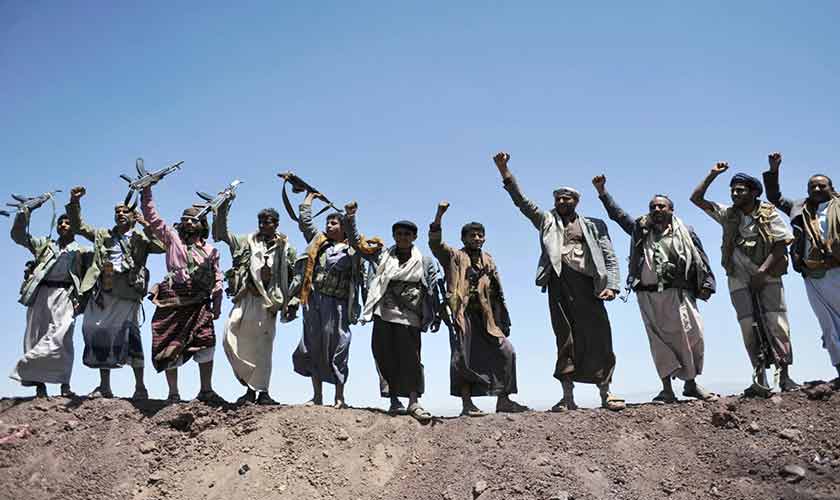
he Houthi movement, formally known as An r All h (God’s Defenders), emerged from the rugged highlands of northern Yemen as both a revivalist religious movement and a political rebellion rooted in the historical anxieties of the Zayd community.
Over time, it evolved into one of the most consequential non-state actors in the Middle East, reshaping Yemen’s internal balance of power, altering regional geopolitics and eventually disrupting global trade routes through the Red Sea. Its trajectory reflects far more than the rise of a militant organisation. It is the story of how sectarian identity, state failure, foreign intervention, regional rivalries and anti-imperialist rhetoric converged to produce a movement capable of challenging states far more powerful than itself.
To understand the Houthis, it is necessary to begin with the historical position of the Zayd s in Yemen. Zaydism is a branch of Shi i Islam that established itself in northern Yemen in the Ninth Century. For centuries, it formed the backbone of political authority in the region. Unlike Twelver Shi ism dominant in Iran, Zaydism historically maintained theological positions closer to Sunni Islam in several respects. Yet despite doctrinal moderation, Zayd society preserved a distinct religious and political identity centred on the authority of the imam, who combined spiritual legitimacy with temporal leadership.
This order survived for centuries until the Yemeni revolution of 1962 overthrew the imamate and replaced it with the Yemen Arab Republic. The overthrow was not merely a change of government; it represented the collapse of a centuries-old social hierarchy and the beginning of a prolonged process of Zayd marginalisation.
The republican regime that emerged after 1962 remained deeply suspicious of Zayd elites, fearing the restoration of monarchical authority. Although the civil war between republicans and royalists formally ended, the political culture of the republic continued to sideline Zayd institutions and identities.
Over subsequent decades the Yemeni state increasingly aligned itself with Saudi Arabia and, by extension, with the ideological influence of Wahh bism. This development profoundly unsettled many Zayd s because Wahh b doctrine rejected practices and traditions central to Zayd religious life. The spread of Saudi-funded religious schools and clerical influence in northern Yemen appeared not simply as theological competition but as an existential threat to the cultural continuity of the Zayd community.
The establishment of a Wahh b seminary near a dah in the 1980s became a symbolic turning point. For many Zayd s, the encroachment of Saudi-backed religious ideology represented an attempt to erase their identity from Yemen’s social fabric. In response, a broad Zayd revival began to take shape.
This awakening emphasised overtly Shi i symbols and narratives, particularly the veneration of Al and his descendants, not only as acts of devotion but also as declarations of communal distinctiveness. The revival was therefore simultaneously religious, cultural and political. It was a defence mechanism against perceived absorption into a Sunni-dominated order shaped by external influence.
The democratisation that followed Yemeni unification in 1990 provided Zayd activists with an opportunity to organise politically. The Al- aqq Party emerged to defend Zayd interests and resist Saudi ideological penetration. However, the parliamentary politics proved insufficient for younger activists who believed that the community required a more comprehensive social movement.
Among the most influential figures in this new generation was Hussein Badr al-Din al-Houthi, whose name would eventually become synonymous with the movement itself. Hussein al-Houthi combined political activism with religious revivalism and established the Believing Youth network in the late 1990s. Initially supported by the Yemeni government, the network offered religious education, welfare services and communal solidarity to Zayd youth. However, its growing popularity and increasingly vocal criticism of President Ali Abdullah Saleh gradually transformed it from a tolerated movement into a perceived threat.
The transformation of the Houthis from a revivalist movement into an armed insurgency occurred in the context of regional and international upheaval after the attacks of September 11, 2001. Saleh’s cooperation with the United States in the War on Terror and his support for the American invasion of Iraq intensified anti-American sentiment among Houthi supporters. To many in the movement, foreign intervention in the Middle East appeared directly linked to the historical erosion of Zayd autonomy.
Hussein al-Houthi increasingly framed local grievances in a wider narrative of resistance to American and Israeli influence. The slogan adopted by the movement — “God is great, death to America, death to Israel, curse the Jews, victory for Islam” — reflected this fusion of local identity politics with trans-national anti-imperialist rhetoric. While the slogan echoed revolutionary discourse associated with Iran, it also functioned domestically as a symbolic rejection of the Yemeni regime’s alignment with foreign powers.
The Yemeni state responded with force. In 2004 Saleh issued an arrest warrant for Hussein al-Houthi. The confrontation soon escalated into open warfare. Hussein was killed later that year. Rather than extinguishing the movement, his death transformed him into a martyr and deepened support for the rebellion. Leadership eventually passed to his brother, Abdul-Malik al-Houthi, under whom the movement became more disciplined, militarised and politically sophisticated. The government’s harsh repression proved counterproductive. Military campaigns in northern Yemen destroyed villages, displaced civilians and reinforced the perception that the state sought to eradicate Zayd identity itself. As a result, the rebellion expanded beyond its original social base.
One of the most significant misconceptions about the Houthis is the tendency to portray them as an Iranian proxy. Although Iranian support became increasingly important over time, especially in the form of weapons, training and strategic assistance, the movement’s origins were fundamentally local.
The Houthis emerged from specifically Yemeni grievances rooted in political exclusion, sectarian anxiety, economic marginalisation and opposition to foreign influence. Iran did not create the movement; rather, the chaos of Yemen’s civil conflict created conditions in which cooperation between Tehran and the Houthis became strategically advantageous for both sides. Iran saw an opportunity to pressure Saudi Arabia on its southern border and the Houthis gained access to military technologies and regional networks that dramatically increased their capabilities.
The Arab Spring uprisings of 2011 accelerated Yemen’s collapse and provided the Houthis with an unprecedented opportunity to expand. Mass protests against Saleh weakened the state and fractured the political elite. Although Saleh formally transferred power to Abd Rabbuh Mansur Hadi in 2012, the transition failed to produce stability. Hadi lacked broad legitimacy and alienated several factions, including the Houthis. In a striking political reversal, Saleh eventually allied himself with the Houthis against Hadi’s government. This alliance was less ideological than opportunistic, reflecting Yemen’s fluid political landscape where survival often outweighed principle.
The Houthis capitalised on widespread dissatisfaction with Hadi’s administration, particularly after cuts to fuel subsidies in 2014 triggered public outrage. Protests in Sanaa escalated into armed confrontations. By September 2014, Houthi forces had seized significant portions of the capital. In January 2015 they overran the presidential palace, forcing Hadi to resign. Their rise demonstrated not only military effectiveness but also the extent of state disintegration. The Yemeni army fragmented, tribal alliances shifted and central authority collapsed.
(To be continued)
The writer is a professor in the Faculty of Liberal Arts at the Beaconhouse National University, Lahore.