Print Story
X




Elwood P Dowd, the unconventional protagonist of Harvey, this essay explores why kindness can seem strange in modern life and why absurdity is often how gentleness can still be admitted
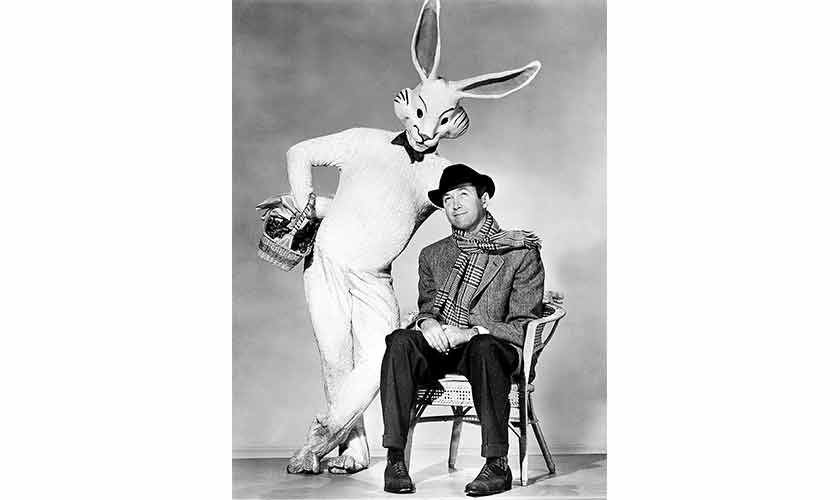
“Oh, every day is a beautiful day,” Elwood P Dowd says in the opening five minutes of Harvey. Almost immediately, he appears as the sort of man modern life has forgotten how to place. He is not witty in the usual sense, not charismatic and not eccentric for effect. He does not possess the rehearsed brightness of someone trying to charm a room. His manner sounds believable: not just to the characters in the film, but to you as the audience member. Elwood enters as a man whose openness is so complete that it almost feels anachronistic. That matters because it sets the film’s moral temperature. Before we know anything else about him – before the rabbit, before the concern of others, before the question of his sanity – we are given a man who speaks as though beauty was still available to him.
Elwood is the central figure of Harvey, a 1950 film built around a premise that sounds too whimsical to bear much weight: the story of a mild, courteous bachelor whose closest companion is an invisible six-foot rabbit named Harvey. To those around him, this makes him an embarrassment. His sister attempts to have him sequestered at a psychological facility. The film’s comedic core comes partly from that tension. Elwood moves through the world with perfect ease, while everyone else strains to explain him, contain him or save him from himself.
This is part of what makes Harvey so sly. Elwood is not only an old figure, a sage, a fool, a lover, a man whose kindness has made him look strange; he is also a figure that the modern world can only seem to admit under the cover of absurdity. It is easier, now, to believe in him if he comes accompanied by an invisible rabbit. The absurd premise does not simply make the film whimsical; it makes Elwood legible to a culture that has grown suspicious of the mystical, the ethereal and the unguardedly kind. In another age, such a man might have appeared as a saint, a dervish, a holy fool or a village innocent. In a modern one, he must first be made ridiculous.
And yet the type is ancient. One meets him in Dostoevsky, in the disarming moral clarity of Prince Myshkin; and in a more earthbound form in Razumikhin, whose warmth and loyalty survive a world built to coarsen them. One meets him, too, in Bulleh Shah, in that long tradition of the lover who becomes foolish in the eyes of the world because he no longer accepts its terms of value. Elwood belongs to this lineage, even if Harvey clothes him in mid-Century comedy. He is the man the world mistrusts because he is not playing its game.
What makes Elwood memorable, though, is not simply that he is kind. It is the peculiar force of his kindness: he does not flatter; he does not moralise; he does not seem interested in correcting anyone, exposing them, or defending himself against them. Instead, he has that rarer quality by which some people make room around others without trying to master them. The remarkable thing in Harvey is how quickly apprehension turns into ease around him. People who ought, by the terms of the plot, to dismiss him as a crank find themselves speaking freely in his presence. But the film’s clearest measure of Elwood comes at the end, when his sister asks him to take the injection that would separate him from Harvey and he quietly agrees. He is prepared to surrender the thing by which his inner life has been enlarged, not because he has been corrected, but because someone he loves is unhappy.
His gentleness is disarming because it is unarmed. It asks nothing, performs nothing and demands no return. In a world where so much social conduct is driven by anxiety, status and the need to manage impressions, such openness begins to look less like innocence than a kind of difficult wisdom.
He is the man the world mistrusts because he is not playing its game.
This is where Harvey edges into deeper territory than its premise first suggests. The film is often described as whimsical, but whimsy is too light a word for what it is actually circling. What it is really interested in is the border - sometimes very thin - between kindness and foolishness, between inward freedom and social absurdity, between the person who refuses the world’s terms and the person the world judges unfit for reality. Elwood seems mad only if one begins by accepting that the ordinary rules of adult life are sane: suspicion, calculation, guardedness, the quick division of the world into sides, the endless effort to appear appropriate. But Harvey keeps quietly asking whether this arrangement deserves the dignity of sanity at all. It is not Elwood who is frantic, after all. It is everyone around him. He is the one person in the film not wholly ruled by embarrassment.
That question runs through Dostoevsky. Prince Myshkin in The Idiot belongs unmistakably to the same family as Elwood, though in a far more tragic key. Myshkin’s innocence is not childishness; it is a kind of moral nakedness, an inability to live by the calculations that govern everyone around him. He embarrasses the world not because he is weak, but because he is open in a way the world can only read as weakness. Razumikhin, in Crime and Punishment, offers a more practical version of the same grace. He is not mystical in Myshkin’s way, nor does he stand outside the world to the same extent. But he remains warm where others have become fevered, loyal where others become abstract, capable of ordinary human care in a world increasingly warped by pride, theory and suffering. Between them, Myshkin and Razumikhin show two forms of kindness: one almost saintly, the other sturdily human.
Both characters find unlikely companionship in Bulleh Shah’s philosophical thought as well. His world is not Dostoevsky’s and Elwood’s American gentleness is far from the ecstatic vocabulary of Punjabi Sufi verse. Yet the kinship is real. Bulleh Shah repeatedly returns to the scandal of love: the way true attachment makes one appear foolish, excessive, even mad in the eyes of the world. The lover crosses boundaries that society insists upon, refuses the prestige of distance and accepts humiliation if that is the price of proximity. Again and again, one finds in his work the sense that what the world calls wisdom is often only ego made respectable. The lover, by contrast, is willing to be misread. That is why the figure of the fool and the figure of the mystic so often meet. Both have ceased to organise their lives around the values by which society distributes dignity.
That is why Elwood matters. He is not simply a charming eccentric at the centre of an old film. He is a reminder of a type of modernity that struggles to admit except as comedy: the man whose gentleness has not made him weak, the fool who turns out to possess a different wisdom, the one who can still be moved by beauty without first protecting himself from it. Harvey hides that recognition inside whimsy, but it does not diminish it. If anything, the whimsy is the camouflage the film needs to say something serious. Elwood himself says as much, in his own quiet way, when he recalls what his mother told him: in this world, one must be ‘oh so smart’ or ‘oh so pleasant.’ “For years,” he says, “I was smart. I recommend pleasant. You may quote me.”
That, finally, is the quiet achievement of Harvey. Beneath the rabbit, beneath the comedy and the social embarrassment that makes the plot move, it preserves the possibility that such a person might still exist: a man to whom beauty remains available, who is kind without strategy, open without embarrassment and sane enough not to let the world dictate the terms of his soul. Where armour is often mistaken for maturity and public hardness for good sense, Elwood P Dowd stands in an older line of characters and asks something both simple and nearly impossible: what would it mean, after all this, just to be kind?
The writer is a Lahore-based educational counsellor, teacher and researcher. He may be contacted at sarangaamir405 @gmail.com.