Print Story
X




A reflection on the life of one of Urdu’s most beloved ghazal poets
| L |
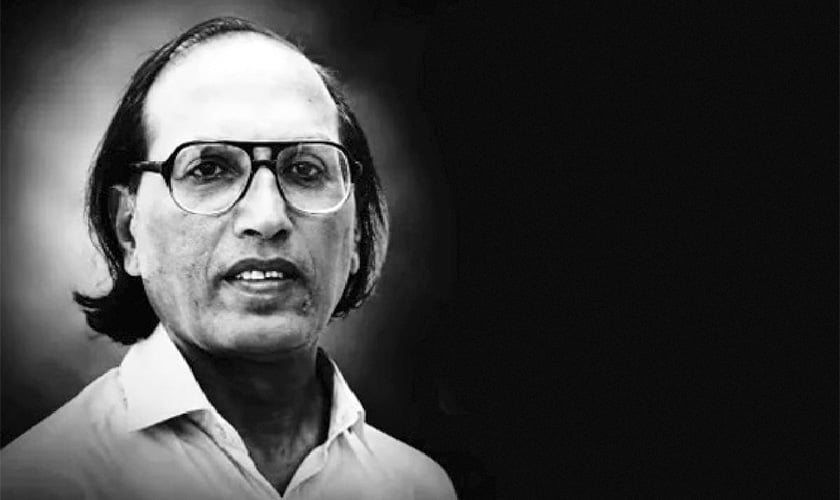
ife and death are an interplay of appearance and disappearance; presence and absence. The fact is that nothing ever disappears entirely. Every appearance bears traces, shadows, colours and residues of disappearance, just as every absence contains echoes of presence. When death removes a person from the scene, his presence is often felt most intensely; his entire existence, his character, achievements and contributions, suddenly come alive in collective memory.
Soon after his death, Bashir Badar, once among the most celebrated poets of Urdu but for many years living in near-isolation, confined first to his home and later largely to his bed, felt vividly present. It was as though the days of his popularity had returned. He was discussed everywhere; his couplets circulated widely; recordings of his poetry recitations and interviews flooded social media. Alongside this renewed attention, an old debate resurfaced: was Bashir Badar merely popular, or was he a truly great poet? We shall return to this question.
Badar had been a household name in both India and Pakistan since the 1960s. Although geographical and ideological borders had separated the two countries since 1947, poetry continued to defy political boundaries. A considerable number of Badar’s verses became permanently etched in public memory. Perhaps none is more widely remembered than:
Ujalay apni yadon kay hamaray saath rahnay doe,
Na-janay kis gali mein zindagi ki shaam hoe jaye
[Let the radiance of your memories remain with me;
Who knows in which street I maybe when the evening of life descends.]
This couplet is among the most memorable verses of modern Urdu ghazal. Among others, it was reportedly a favourite of then Indian prime minister Indira Gandhi and the actress Meena Kumari. In one mushaira, Badar recalled that the then Pakistani prime minister Zulfikar Ali Bhutto had recited the following couplet before Indira Gandhi:
Dushmani jam kar karo lekin yeh gunjaish rahay,
Jab kabhi hum dost hoe jayein toe sharminda na hon.
[Be steadfast in enmity if you must, but leave room for reconciliation;
So that if friendship returns one day, it embarrasses neither side.]
Born on February 15, 1935, in Kanpur, India, to Syed Muhammad Nazir, an accounts officer in the Police Department, Bashir Badar received his formal education in Kanpur, Etawah and Aligarh. The formative phase of his life included the experiences of colonialism, Partition, nationalism, identity politics and the role of language in both the negation and affirmation of cultural identities.
Badar’s mother did not allow him as a schoolboy to mingle freely with children in the streets. She may have feared the sectarian tensions of the period. He was mostly confined to the home. The resulting loneliness and boredom proved a blessing in disguise. As a teenager, he may have lacked the wisdom to appreciate solitude, but solitude often teaches one ways to discover the hidden treasures of self. He began writing a history book using colour pencils. These colours reflected not merely a child’s attraction to beauty and variety but also an intuitive recognition that history itself is a mosaic of diverse events. Around that time, he also started composing poetry and reciting it at school events.
One of his ghazals appeared in Nigar, the famous Urdu literary magazine edited by Niaz Fatehpuri while he was still in his teens. In 1947, a sum of nearly eighteen thousand rupees was stolen from the Police Department where his father worked. To compensate for the loss, the family was forced to sell almost everything of value. His father never recovered from the trauma. He passed away in 1959. Badar was forced to abandon formal education midway and assume the responsibilities of the head of the family - supporting his parents, two younger brothers and two sisters. Five years later, he resumed his studies by enrolling at Aligarh Muslim University. By then, he was already known as a poet. The intellectual environment of the university and the influence of distinguished scholars such as Al-e Ahmad Suroor and Khalilur Rahman Azmi, played helped shape his literary outlook and critical sensibility.
Criticism, however, was not his strongest suit. Ghazal remained his principal intellectual interest. As the cultural emblem of Indo-Islamic civilisation, it naturally attracted him. He chose modern Urdu ghazal as the subject of his doctoral dissertation.
The third major event that profoundly affected his life was the destruction of his home during the Meerut riots of 1987. He was away at the time but his children were at home. His wife had already passed away in 1984 while he was visiting Pakistan. Although his family survived the riots, he suffered not only the loss of his home but also a devastating blow to his belief in India's secular culture. For years, he was unable to write poetry about the riots. Eventually, he composed one of his most poignant couplets:
Log toot jatay hain aik ghar banane mein,
Tum taras nahin khatay bastiyan jalanay mein.
[People wear themselves out building a single home;
Yet you feel no compassion while burning entire settlements]
Aligarh remained close to his heart throughout his life. He studied there, taught for a few years as a visiting teacher in the Urdu Department; and served as editor of Aligarh Magazine. In 1969, he compiled a special issue on Mirza Ghalib to commemorate the centenary of the great poet. He had hoped to settle permanently in Aligarh, but circumstances did not permit it. Instead, he joined Meerut College, where he taught until his retirement in 1994. In 1995, he moved to Bhopal. One can reasonably assume that the bitter memories of the destruction of his home in Meerut contributed to this decision.
Although he had been composing poetry since his school years (in the early 1940s), his career as a ghazal poet effectively started at the age of twenty. Initially, he was more interested in publishing his poetry in literary journals than in reciting it at mushairas. His ghazals appeared regularly in Savera, Naqoosh, Naya Daur and Alamgir—all prestigious Pakistani Urdu magazines. Later, however, he immersed himself in the world of mushairas. These gatherings brought him fame, prestige, wealth and status, but also peer jealousy and the pressure to continue producing the kind of poetry that appealed to large audiences.
How popular poets get caught in rivalries is illustrated by a famous anecdote. In 1983, Bashir Badar and Muneer Niazi shared the stage at a mushaira in Sukkur. Malikzada Javed recounts that the two initially did not speak to each other. After nearly half an hour, Niazi asked, “Who are you and where are you from?” Badar introduced himself and replied, “I belong to the house of poetry.” Another half hour passed. Then Badar asked Niazi the same question. After hearing his answer, Badar remarked mischievously, “You seem to work for the Sukkur Municipal Committee. Would you kindly bring me a glass of water?”
Ikai (Oneness), published in 1969, was his first collection of ghazals. It was followed by Image, Aamad (Arrival), Aas (Hope) and Aasman (Sky). There was perhaps a deliberate symbolism in choosing titles that begin with alif, the first letter of the Arabic, Persian and Urdu alphabet. Although literary criticism was not his primary field, his books on modern Urdu ghazal deserve attention. The chapters dealing with love and modernity are particularly relevant.
Badar was a prolific poet. However, he experienced a severe creative block after the tragic death of his first wife, Qamar Jahan Shehnaz, herself a poet, in 1984, while he was visiting Pakistan. It appears that he allowed grief to take its natural course, letting it seep into the deepest layers of his being until it became a permanent part of his inner life. After a few months of silence, he resumed both writing poetry and participating in mushairas.
Being prolific is usually the result of mastery over craft and an abundance of themes. In some cases, however, it conceals repetition. Thematic abundance often arises from an extensive knowledge of literary tradition coupled with practical wisdom. Yet possessing knowledge of a tradition and creatively employing it are two different things. Badar’s approach to tradition was shaped by a moderate, modern and broadly progressive outlook. He wrote about the dehumanisation of urban life, modern experiences of love, poverty and social exploitation. This outlook is reflected not only in his themes but also in his style.
In Ikai, one encounters numerous couplets that challenge conventional poetic norms in a distinctly modernist manner. English words such as pullover, jeans, hook and zip are used without apparent hesitation. Yet, Badar cannot be described as an experimentalist.
There is a subtle but important distinction between being experimental and being novel. Popular poets often cultivate novelty in theme, style and tone, thereby imparting freshness to their work. Experimentation, however, involves a more radical departure, not only from tradition but often from the very grammar of poetry. Such an enterprise entails considerable risks. One may be ignored, misunderstood, dismissed or fail altogether. Bashir Badar enjoyed widespread acceptance and appreciation throughout his career.
Soon after his death, Bashir Badar felt vividly present. It was as though the days of his popularity had returned. He was discussed everywhere; his couplets circulated widely; recordings of his poetry recitations and interviews flooded social media.
Badar's ghazals draw more upon common sense than imagination. Most classical poets, too, were prolific writers. They generally relied on common sense while also traversing the vast deserts of imagination. Common sense and imagination are not exclusive, however, there is a subtle distinction between the two. Imagination is inclined to venture into unfamiliar territories, sometimes into worlds beyond existence, whereas common sense remains close to the realms of familiarity. Familiarity, however, should not be confused with cliché. Common sense is the repository of real, collective and widely shared human experiences that are easily recognisable and explainable.
The fact that much of Bashir Badar's poetry is simple, spontaneous and closely related to our everyday social, personal and occasionally political experiences; that it is written in familiar descriptive and narrative modes; that it employs rhythmic, cadenced metres; and occasionally comes close to prose, springs from common sense. His poetry is less cerebral than sensuous, less abstract than experiential.
Consider the following couplets:
Dil-shikasta koi hum jaisa yahan dafn hai kya
Raat dair tak ronay ki sada aati hai
[Is someone heartbroken like me buried here?
Late into the night, the sound of weeping can be heard]
Zameen nay maang liya, aasman nay chheen liya
Hamaray paas na ab jism hai na saya hai
[The earth demanded it, the sky snatched it away;
Now neither body nor shadow remains with us]
Woh balcony mein aaye tod rasta ruk jaye
Sarak peh chalnay lagay toe hamaray jaisa hai
[When she appears on the balcony, the traffic comes to a halt;
But when she walks the street, she seems just like one of us]
Chai ki pyali mein nai tablet gholi
Sahmay sahmay hathon nay ik kitab phir kholi
[A new tablet was dissolved into a cup of tea;
Timid hands once again opened a book.]
Ghazlein pehlay sharab peeti thin
Neem ka ras pila rahay hain hum
[Ghazals once drank wine;
Now we are making them drink the (bitter) juice of neem]
Aankhon mein raha, dil mein utar kar nahin dekha
Kashti kay musafir nay samandar nahin dekha
[He remained in the eyes, never descended into the heart;
The passenger of the boat never truly experience the sea]
Kuchh toe majburiyan rahi hongi
Yun koi bewafa nahin hota
[There must have been some compulsions;
No one becomes faithless without a reason]
Koi haath bhi na milayega jo galay milogay tapaak say
Yeh naye mizaj ka shahr hai, zara faslay say mila karo
[No one will even shake your hand if you embrace too warmly;
This city has acquired new manners, meet people from a distance]
Dushmani ka safar ik qadam doe qadam
Tum bhi thak jaogay, hum bhi thak jayengay
[The journey of enmity lasts only a step or two;
You will grow weary, and so will we]
Sar say chadar, badan say qaba lay gayi
Zindagi hum faqiron say kya lay gayi
[It took the veil from the head and the robe from the body;
What has life not taken away from us poor?]
Zindagi tu nay mujhay qabr say kam di hai zameen
Paon phailaun to deewar mein sar lagta hai
[Life, you have given me less space than a grave;
If I stretch my feet, my head hits the wall]
Inhi raston nauy jin par kabhi tum thay saath mairay
Mujhay rok rok poochha tera humsafar kahan hai
[These very roads on which you once walked beside me
Keep stopping me to ask: where is your companion now?]
Khuda hum ko aisi khudai na day
Keh apnay siwa kuchh dikhai na day
[May God never grant us such godliness
That we see nothing except ourselves]
Kabhi kabhi toe yun laga hum sabhi machinain hain
Tamam shahr mein na koi zan hai na koi mard hai
[At times it seems that we are all machines;
In the entire city there is neither a woman nor a man]
Yet, at certain moments Badar departs from his characteristic mode of composition. He then leaves behind the familiar world of common sense and enters the less familiar territory of imagination, metaphysical reflection and existential anxiety. He wrote mostly about love, urban life, the wretched of the earth, religious bigotry, the narrowness fostered by identity politics and various forms of oppression, but he also wrote about human destiny and existential anguish. Here his voice acquires a greater gravity, tinged with melancholy.
Sham aankhon mein, aankh pani mein
Aur pani saraye-fani mein
[Evening rests in the eyes, the eyes are filled with water,
And that water itself dwells in a transient existence]
Woh hawa hai, usay kahan dhoondhun
Aag mein, khaak mein keh pani mein
[He is like the wind, where shall I seek him?
In fire, in dust or in water?]
Isi liye toe yahan ab bhi ajnabi hun main
Tamam log farishtay hain, aadmi hun main
[That is why I remain a stranger here;
Everyone else is an angel, while I am a mere human]
Bashir Badar was an extraordinarily popular poet. Popularity has always been both coveted and disparaged. During his lifetime and since his death, his popularity has remained a subject of debate. At the height of his fame in 1984, a lively discussion concerning his literary worth appeared in the pages of The Hindustan Times. The debate revolved around whether he was merely a popular poet or a truly great one. Implicit in this distinction was the view that greatness is complex, multi-layered and often paradoxical - beyond the taste and interpretive capacities of ordinary readers.
The verdict on Bashir Badar's literary stature will continue to evolve. Perhaps this is not the time for that debate. It must be acknowledged, however, that his popularity is by no means synonymous with mediocrity. A remarkable number of his ghazal couplets have become part of the collective memory of at least three generations of readers and listeners. That is no small achievement.
The writer is a Lahore-based Urdu critic and fiction writer. He is also the current head of publications at Gurmani Centre, LUMS. His new book Mera Daghistan-i-Jadeed is in press.