Print Story
X




In Rogue Planet, Mina Malik explores the peculiar loneliness of a marriage that has become a place of exile
| A |
s Tolstoy famously said, all happy families are alike, but each unhappy family is unhappy in its own way. Mina Malik’s poetry debut, Rogue Planet, brings on the realisation that each unhappy marriage toes a line between universality and uniqueness.
I am the product of a marriage that was loudly, violently unhappy. For too long, I naively believed that this was the only kind of bad marriage in existence: the kind that makes people shake their heads in pity; the kind that, once it ends, no one asks why, because they already know. Rogue Planet is not about that kind of marriages. In 14 terse poems, it details the slow, almost anticlimactic dissolution of a relationship that has quietly descended into loneliness, neglect and misery. Significantly, the first two are titled after women from the Western literary canon; one from Greek mythology, one from Shakespeare.
The Andromeda Paradox, the first - and in my opinion the strongest - poem in the collection, starts not with myth but with science: Einstein’s theory of relativity, the fact of “motion changing time.” This is the only full stop in the entire poem. The narrator then likens herself to the trapped princess, and her partner to Andromeda’s saviour Perseus, and there’s a lot to unpack there. It’s an analogy that gets more painful the longer you sit with it: you see, when Andromeda meets Perseus, her husband, she is not frolicking free in a field. She is chained to a rock. “him, flying/ her, fixed,” Malik writes. She is asking: how does being trapped change our perspective? How can we forget that whether we are free or forced to remain frozen in space completely changes our experience of reality? Would Andromeda have fallen in love with Perseus, were she not imprisoned and desperately in need of rescue? And why exactly is she trapped in the first place? What is the rock that our Andromeda is tied to as her parents’ punishment for boasting too loudly of their daughter’s beauty? Who is her Cetus? That’s a rhetorical question, of course. Every Pakistani woman knows what the rock is; every Pakistani woman has a Cetus that she tries to escape by running off with a Perseus.
The second poem brings us back to reality: this Juliet is more preoccupied with laundry than she is with Romeo, who is “wiping chocolate on [her] thousand thread count sheets.” Our heroine laments the waste of both her beauty – “my shapely waist my glittering eyes” – and brains – “is this why i memorised shakespeare?” – now that her days are spent “defrosting a deep freezer. This is one of the bravest pieces in the book, because women are taught from day one that any acknowledgement of our desirability negates it, bringing on accusations of vapidity, vanity and ugly self-indulgence. You don’t know you’re beautiful, as the One Direction bop goes, that’s what makes you beautiful. Well, I do know, Malik seems to say defiantly in After Juliet, so there.
Every Pakistani woman knows what the rock is; every Pakistani woman has a Cetus that she tries to escape by running off with a Perseus.
This departure from the abstract and metaphorical in favour of the literal and material continues in the next two poems. In Storage, our narrator continues the never-ending domestic labour that is too familiar to every weary wife, until she herself feels like one of the inanimate possessions that she spends her days organising. In Inventory, Malik measures out a marriage, not in coffee spoons but in pens and kids and houses and months and years.
In a country where matrimony is half of faith and about 97 percent of respectability, to write about divorce is an act of courage. Thhis context is addressed in the sixth and eleventh poems. Sabr, Shukar is aptly named after the two things women are told to embody in the face of a failing marriage. Malik quotes the familiar refrain of “it could be worse,” the imagery she evokes at the end, “thank the gods… meditate with crystals,” is deliberately pagan and polytheistic. Galileo begins by dryly reminding us where saying what we really think lands us, but ends by reminding us that once we do, what can anyone else really “do, except speak?” - a delicious little antidote to the familiar chorus of “log kya kahen gay?”
Like any honest record of a breakup, Rogue Planet contradicts itself. In These Are The Days, Malik describes a desert devoid even of mirages, declaring “my heart is a wasteland where nothing grows.” In I Follow My Heart, the same organ becomes a bright-eyed, bushy-tailed creature unto itself, who believes itself “able to bloom.” The weakest piece, Smoke/ Mirrors, is also the most heartbroken; it drifts rather halfheartedly from one metaphor to another. Circe is simultaneously the loneliest, loveliest and sexiest poem of the lot, a lush ode to unrequited desire, reminding the reader that there is, in fact, no shame in not being desired back, because sometimes it really is a case of casting pearls before swine.
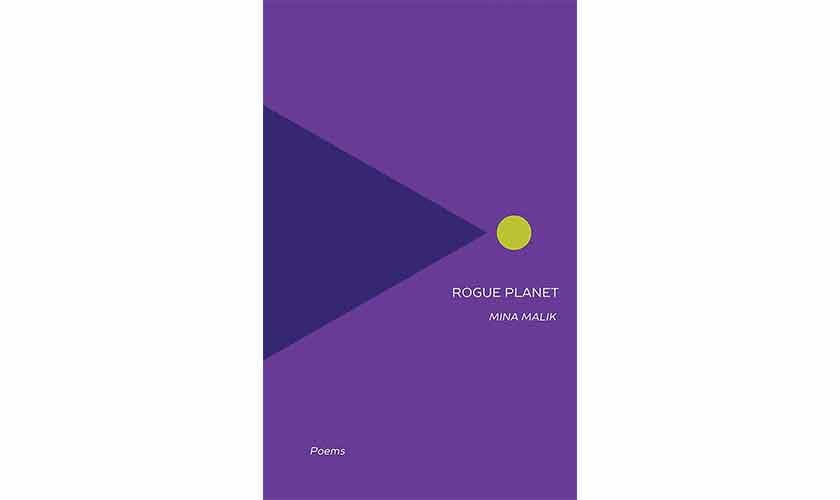
Rogue Planet
Author: Mina Malik
Publisher: The Peepul Press, 2026
Price: Rs 1,000
Pages: 20
The writer is a Pushcart nominated poet, comedienne and consultant from Lahore. She holds an MFA in Poetry from Sarah Lawrence College. She currently resides in Islamabad. You can find her on Instagram as @yusraamjadwrites.