Print Story
X




Ferwa Ibrahim’s solo exhibition is less about what is seen and more about what is felt
| A |
few phenomena are fully experienced but cannot be described, not even partially: the fragrance of a blooming flower; the touch of an early morning breeze on a spring day; the uncanny feeling at the hurried juncture of dusk; the delight of witnessing the undulated laughter of a new-born. These cannot be caged in words, arrested in pictures or analysed through the lens of science or by applying the tools of technology.
Visual artists have historically aimed to convey these sensations, however symbolically and remotely, on paper, canvas and stone - impressive endeavours, but scarcely convincing. The camera, an invention equipped to record changes in people’s expressions, momentary shifts of sunlight and the movements of a slowly progressing entity, captured not the inner responses but the external world. This facility expanded the pictorial archive; it also forced artists to find subjects beyond the range of conventional, or more recently introduced, methods of producing images. The arrival of Minimal Art is one such by-product, along with its outcome: the commentary used to explain, contextualise and expound the “meaning” of a surface that otherwise lacks ready-to-grasp imagery.
Tomes containing these textual elaborations have assumed more power and popularity in art circles than the creation of objects that serve as subjects for art historians, critics and curators. If one compares artists’ words about their work with the language of academic discourse and the often incomprehensible passages in art books, one realises the reality, honesty and openness in a maker’s version.
One such example is Ferwa Ibrahim’s artist statement for her recently opened solo exhibition at Rohtas 2 Gallery (June 1 - July 1). Her lines lead into work that is otherwise not easy to access, unless one is prepared to dive deep into the visuals.
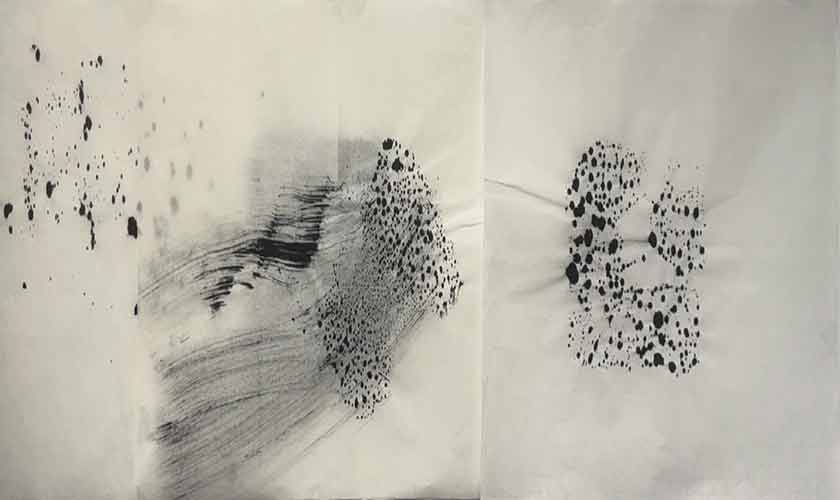
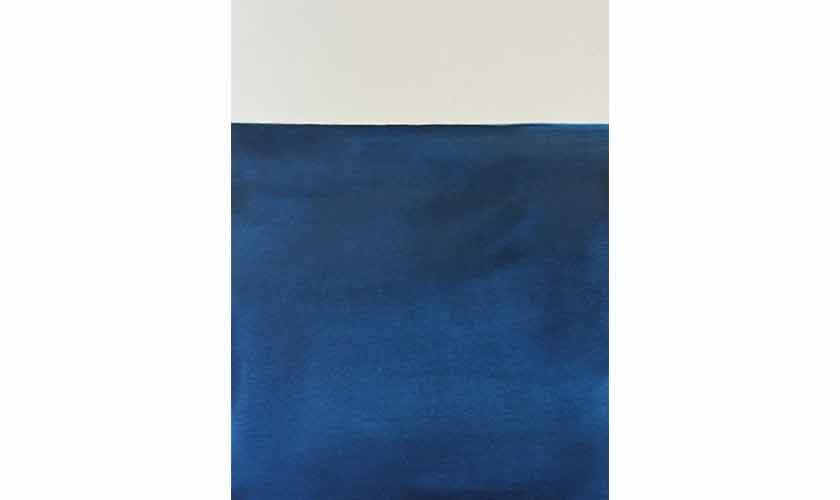
The visuals appear at once aquatic, airy, atmospheric and tactile; enticing not because they invite one to connect the dots of an image and discover what plainly lies at hand, but because they unfold the sensation and sensitivity manifested in Ibrahim’s surfaces. She tactfully chose paper as her medium, since the tone of her imagery is subtle, soft and whispery, like the rustling of a thin sheet.
The title of her show, Permission to be Honest, amplifies this aspect of being truthful and low-key, in contrast to some practitioners who are pompous in their presentations, outputs and outfits.
Ferwa Ibrahim’s work is installed throughout the gallery in a thoughtful scheme. A visitor moves from wall to wall and confronts layers of the artist’s touch, emotions, intentions, forms and ideas. Not divided, but integrated, in spite of being created on various scales and in different media and techniques.
Her large drawings (Body Remembers and Unfold) offer a fleeting sensation of being grazed by a surface, or of gazing at the details of skin, the softness of hair or the ripples of water. However, none of these descriptions fits fully, since both invite the viewer into an unknown realm: a hemisphere where familiar, recognisable and tangible reality evaporates and is replaced by an unforgettable encounter.
This experience continues throughout the display, which is divided into small series. One section comprises three jet-black photographic prints (The Star is a Satellite), punctuated by needlepoints of white that pierce the omnipresent (and overpowering) dark sky. It is an observation familiar to anyone who has looked at, or imagined, the vast expanse of the night sky from a desert or barren landscape.
Ferwa Ibrahim’s move to the UAE could be a factor in the construction of such images. Another work, Oil and Rain Variations, is also an attempt to discern, or bridge, the links between the human body and its natural surroundings.
This effort is evident in a number of other artworks too, where one is unable to distinguish between the contours of a human body and the layout of geological plateaus. This is especially true of Horizon-Surrender and Horizon-Surrender IV, in which elements of nature mingle with sections of the human figure. Interestingly, the horizon line connects the two, even though the horizon itself remains a linear separation between land and air. Hito Steyerl, in her book The Wretched of the Screen, explains: “Our traditional sense of orientation, and, with it, modern concepts of time and space, are based on a stable line: the horizon line. Its stability hinges on the stability of an observer, who is thought to be located on a ground of sorts, a shoreline, a boat, a ground that can be imagined as stable, even if, in fact, it is not.”
Through experiences one realises that the ‘horizon’ is an abstract idea and an illusory construct. A spectator sees it, but is unable to approach, reach or touch the horizon line. The more one steps forward, the more the solidity of the horizon recedes, yet never disappears. The body, on the other hand, belongs to the human domain. This physical substance moves in varying directions, i.e. vertical, angular and irregular.
Ferwa Ibrahim locates this paradoxical relationship and manipulates it in such a manner that one remains engaged in differentiating between the two zones. She also adds other visual elements to expand her content in smaller works on paper, Hair As Cloud, Flight, Fall and A Surface’s Response to Touch and Chance. In these pieces, one deciphers the presence of rain, travelling clouds, ruffled puddles and the ever-changing surface of the soil.
These shifts in nature have strong effects on human character, temperament, behaviour, thoughts and beliefs – particularly in reference to our ancestors thousands of years ago, who considered, conceived and converted parts of nature into divine entities.
Another body of work - muted, yet vigorous and enduring - is a group of drawings consisting of ink on rice paper, collectively titled Like Gauze. The evidence of these marks, drops, drips, spills and stains absorbed by the natural paper, reinforces a relevant meaning and context: that of womanhood, traces of a wound an accidental scratch or an intentional cut.
Extending the reading of these delicate and quietened images, one may connect them to a political content. Whether implied by the maker or independently gleaned by a viewer who, for the past three years, has been reduced to the role of spectator, watching the latest news reports and footage covering the genocide of Palestinian civilians, particularly the inhabitants of the Gaza Strip.
On a daily basis, one witnesses the suffering of a population subjected to an oppressive force that has occupied its land and continues to pursue the expansion of its territorial control.
An interpretation (or over-interpretation) may be supported by the title of this body of work, Like Gauze. Gauze is usually employed in the process of healing an injury, stopping blood flow or fixing a broken bone. Gauze, the name of this common product available in pharmacies the world over, “has long been popularly believed to come from the place name, Gaza,” which has a prolonged history of textile manufacture and export.
“The production of gauze in Gaza is first described by Pliny the Elder (c. 23-79) in his book Natural History.
The writer is a visual artist, an art critic, a curator and a professor at the School of Visual Arts and Design, Beaconhouse National University, Lahore. He can be contacted at [email protected].