Print Story
X




Securing a bureaucratic post through CSS exams is considered the ultimate achievement in our society. But is it?
| P |
ublic service motivation is the fundamental value that propels thousands of university graduates to invest their resources, time and emotions in competing for a limited number of executive positions in state administration through the Central Superior Services exams. However, many argue that public service value has now considerably degenerated into mediocrity, conformity, glitz and glamour. This transformation is a great tragedy, with alarming consequences for public policy, administration and bureaucratic knowledge production.
How did this transformation occur?
A considerable disparity exists between the principles the recruitment process claims to uphold and the methods it actually employs. The main aim of the civil service examinations should be to assess candidates’ current analytical, creative and problem-solving skills, as well as their leadership potential for effective and efficient delivery of public goods and services. One must acknowledge that female participation in public services has surged, driven by rising female educational attainment, weakening gender-based norms and economic pressures that enable female labour market participation. Despite this development, new technologies and social complexities demand unique knowledge and abilities to handle new social realities. Yet, the current CSS examination system is stuck in the past, relying heavily on traditional assessment techniques, with limited scope for innovation or spontaneous critical thinking.
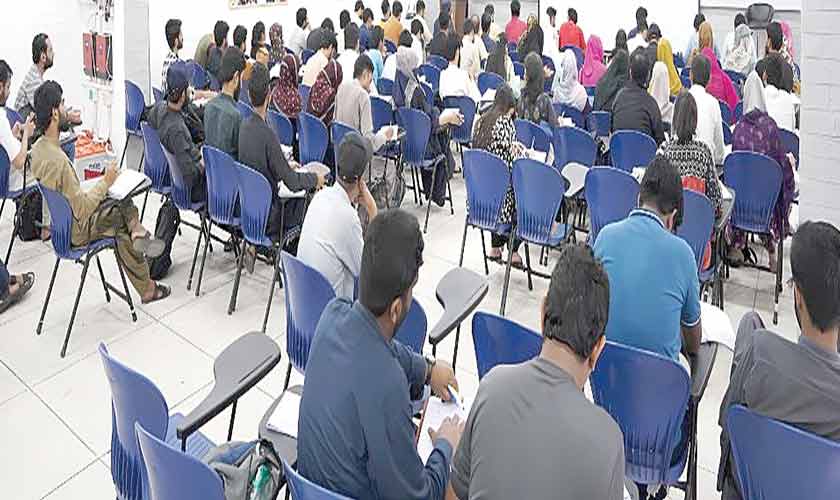
In the traditional assessment scheme—primarily dependent on rote learning—certain writing styles are considered “safe.” For quite some time, coaching centres have instilled in candidates an instinct to gain proficiency in reproducing essays in safe styles. Narrating coherently, at the expense of creativity and novelty, is thus considered the most important yardstick for evaluating success in the exams. As a result, a new industry of academies and coaching centres has emerged, training candidates to “crack” the exam using predictable techniques. This lacks a balanced view and a critical examination of historical, political and economic phenomena, as well as public administration and promotes increased mechanisation of education and leisure.
This paradox is also found in essay writing, which is often thought to reflect intellectual evaluation.
An exemplary essay should demonstrate analytical ability, original and creative thinking and should also demonstrate coherence and strategy of argumentation. In actual exams, candidates often score high for producing long, clichéd and fancy answers that follow a stereotypical pattern. Therefore, the candidates put forward safe arguments to align with the examiner’s psyche or mentality to score high; otherwise, they may be marked down or failed if they contradict the examiner’s point of view, despite being novel, creative and logical.
Furthermore, the optional subject system is vulnerable.
Some subjects have a higher proportion of higher-scoring papers, suggesting that candidates opt for them for the sake of scoring high rather than their interest and expertise. Thus, learning becomes a gamble in this kind of ‘trend scoring,’ undermining the idea of ‘merit’.
With a solid literary or sociological/ historical background, the candidate might avoid studying a particular subject that may not be as secure or promising. For instance, a candidate opts for a regional language (eg, Punjabi, Sindhi, Pashto, Balochi, etc) over accounting and finance, despite having training in the latter.
Another negative impact of the CSS culture is that civil service examinations in Pakistan, especially among the middle class, have become an obsession, seen as a sign of social security, stability and resilience amid rising demands on families and by society. Despite some investment in their golden years, young people are ill-prepared, lack sufficient professional and practical learning experience and have a reduced social involvement. Many of them appear to have a strong theoretical foundation but are deficient in administrative skills and/ or experience in addressing current administrative challenges.
Moreover, the interview is often considered to compensate for the shortcomings of the written exam. However, this is not the case with the CSS interview, which is full of subjectivity and inconsistency. It is not aimed at gauging the integrity or abilities of administration, but too often is about looks, demeanor, attitude and linguistic fluency or communication skills. While people from privileged urban settings have better communication skills and are exposed to a variety of experiences, those from the marginalised and rural contexts, despite being endowed with intellect, may lack exposure, communication skills and self-confidence.
Furthermore, the agency attitude that is imposed on the CSS exam is very conventional and intense: candidates will soon discover that there is no passing if they take risks, go beyond the set standards, do not stay safe, do not stick to the set storylines or follow set conditions. This better-safe-than-novel-and-creative mindset translates into professional lives of successful candidates. Later, the public service suffers because of these mediocre and cowardly minds, not engaged in innovative and visionary thinking on policy and institutional development, but rather on paperwork and procedure.
The country is currently grappling with unprecedented challenges, including climate change, economic volatility, population growth, the digital revolution, an education crisis and a governance deficit. This requires an innovative administrative procedure that can think outside the box and substantiate its rationale to inform visionary and evidence-based decision-making. In the current system, however, these attributes are not officially recognised—hardly at all. Instead, it often filters out unconventional thinkers in favour of candidates who excel at examination techniques.
A cross-country comparison of Pakistan’s public services recruitment system with that of industrialised countries can yield insights into the Pakistani system’s problems. Many countries around the world are increasingly focusing on situational judgment tests, policy simulations, group assessments, personality tests and problem-solving exercises. The activities are intended to demonstrate their ability to solve problems, work collaboratively, communicate and think critically in real-world situations.
However, Pakistan’s CSS exam is firmly within a colonial structure, producing “picky” government servants rather than those who can innovate.
The need to reform the CSS exam is irrefutable. It should develop from rote-learning to creative and analytical thinking. Essay writing should not repeat or duplicate content. The possibility of marking discrepancies and elective or optional subjects should be streamlined. The importance of policy analysis, governance simulation, communication skills, ethics and efficient administration needs to be accentuated.
Beyond this, the testing body should be consistent and transparent in its decision-making on evaluations. The examiner should be ready to evaluate a variety of viewpoints and levels of analysis that go beyond a mere recitation of the story. Interviews ought to be more competency-based and structured to mitigate social prejudice and subjectivity.
The existing coaching system is geared towards the well-off, who can afford better academies and can wait years for a job. The public service can achieve the diversity it deserves—rather than the luxury it enjoys in urban settings—by improving public universities to properly prepare the people for public service.
The current examination system—a gateway to mediocracy—is nothing but memorisation and cannot produce leaders capable of bringing about this change in Pakistan. Thus, the country must reform its civil service examination system not only to discover and nurture talented individuals who are innovative, honest, fearless and solution-oriented, but also to revive the spirit of public service motivation that once defined the bureaucracy. The sooner it is done, the better. Otherwise, CSS exams will remain a talent trap, continuing to promote mediocrity and marginalise originality.
Mazhar Abbas, author of The Aftermath of the Bangladesh Liberation War of 1971: Enduring Impact (Routledge, 2024), has a PhD in history from Shanghai University. He is a lecturer at GCU, Faisalabad, and a research fellow at PIDE, Islamabad. He can be reached at [email protected]. His X handle is @MazharGondal87.
Bilal Hassan is an independent researcher. He can be reached at [email protected].