Print Story
X




Xi warns Trump against the ‘Thucydides Trap’ as China, US try to stabilise ties
| T |
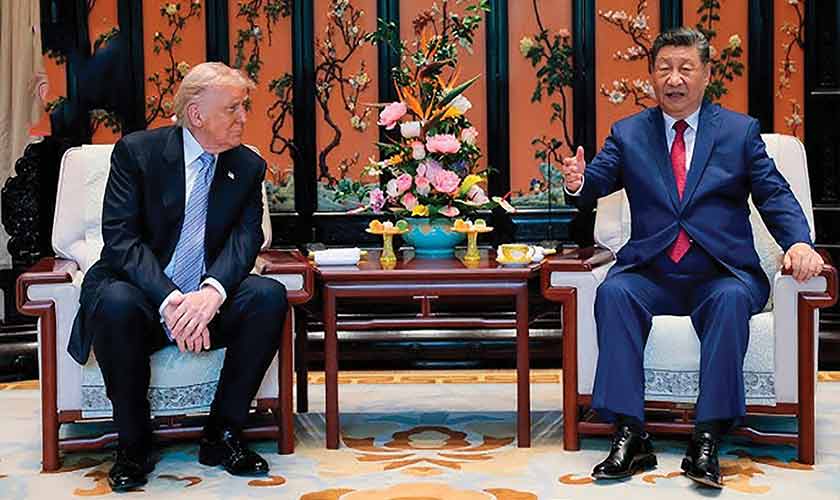
he Xi-Trump meeting in Beijing took place amid intensifying US-China rivalry, with both sides seeking to manage competition without changing the underlying direction. The key outcome was political, with both countries agreeing to work towards what Chinese President Xi Jinping described as a “constructive China-US relationship of strategic stability”—a broad framework intended to guide ties over the next three years and beyond, if possible.
After a year of tariff exchanges, rare-earth retaliation, soybean boycotts and US-Israel war on Iran, both leaders arrived in Beijing with clear but different priorities. At the outset of the summit, President Xi Jinping asked President Donald Trump whether China and the United States could avoid the so-called “Thucydides Trap.” To avoid this trap, Xi proposed a framework of “constructive strategic stability” to manage long-term competition within defined limits. The Thucydides Trap is a political theory that discusses the inevitability of a conflict when a rising power challenges an established one. In today’s geopolitical context, China is often cast as rising Athens confronting the United States as dominant Sparta of the 5 Century BC. The US-China containment strategy fuels fears of such a conflict. Despite these looming fears, Trump’s own dealings with Beijing took a markedly different tack.
Unlike his approach with dependent European allies, Trump’s engagement with Xi was notably more calibrated and rapport-focused, signalling recognition of China’s economic and strategic weight. He appears to have recognised a structural constraint. This evolution makes sense. Pressuring Beijing carries direct costs for the global economy and US domestic consumers. China is not the weak Soviet Union of the late Cold War, whose economy was smaller than Italy’s. China is the world’s second-largest economy, top trading partner for over 120 countries and a leader in EVs, batteries, AI, drones and advanced manufacturing. It outproduces the US, Japan and Germany combined in manufacturing.
Talking to The News on Sunday, Pakistan’s former ambassador to China, Masood Khalid, says: “China seeks peaceful coexistence and cooperative engagement with the US. It wants stability in their relations, avoiding any conflict. China espouses constructive competition without it becoming an active hostile relationship. Three years probably refer to President Trump’s remaining term.”
Managed competition is important because the two economies are closely intertwined. While they have serious differences, their economies together contribute around 44 percent to the world economy.
“If their relationship unravels, it would not only adversely impact their economies but also the global economy. China says that both itself and the US are biggest powers and have a responsibility to maintain a stable world order, ensuring peace and stability in their relations,” he argues.
“Balancing their rivalry through managed competition is not going to be easy and both sides will have to reach a strategic understanding to respect each other’s red lines and conduct their relations in line with international norms and principles of the UN Charter. They have to respect each other’s sovereignty and independent development path. The US may have to review its China containment policy in order to maintain world peace and security.”
Khalid, however, also issues a warning.
“There is a strong anti-China lobby in the US which can try to scuttle the process. So it will be a test for the American leadership not to succumb to that lobby. The world cannot afford conflict and a clash between two world powers as the result would be a catastrophe.”
Khalid argues that as expected, the meeting did not result in any major breakthrough. However, both agreed to reach an agreement on trade issues, forming a Board of Trade to identify roughly $30 billion in goods for possible tariff reductions. It is likely to meet in the near future to prepare a draft for signing. It produced a series of incremental economic understandings, including Chinese purchases of over $10 billion in US agricultural goods and a Boeing deal for around 200 aircraft. The two sides also agreed in principle to establish a Board of Investment to review potential Chinese investment in the US, though no specific deals were announced.
The most consequential exchange concerned Iran.
According to Pakistan’s former ambassador to China Naghmana Hashmi, Trump’s post-summit remarks suggest that Xi had assured him China would not transfer military equipment to Tehran, while both sides broadly aligned on the need to de-escalate the Iran crisis.
A parallel understanding also emerged around the importance of keeping the Strait of Hormuz open to maritime traffic. Beijing’s approach is shaped by its structural energy dependence on Gulf oil flows, with the Strait of Hormuz serving as a critical artery for Chinese imports. Any disruption—whether through Iranian pressure tactics or regional escalation—would not only raise global energy costs but also intensify Beijing’s concern over the security of other chokepoints, particularly the Strait of Malacca.
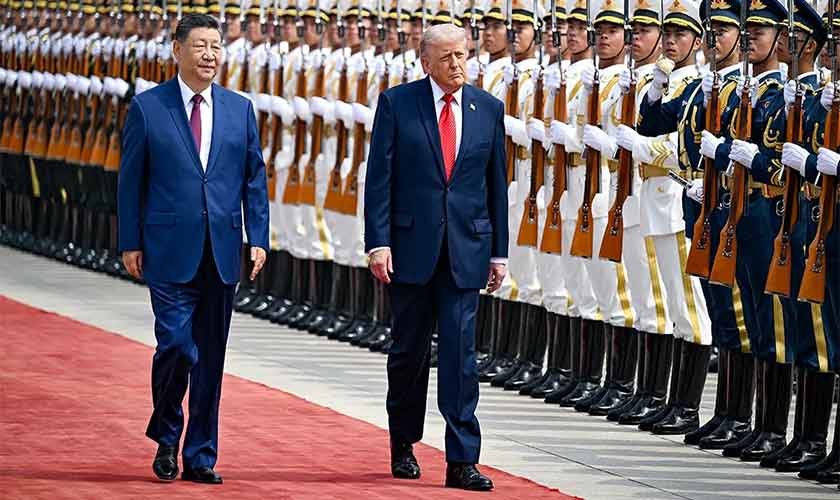
The Trump-Xi summit delivered a cautious pause rather than a breakthrough. For now, it stabilises the managed competition framework, giving both sides some breathing space. Xi’s framing of “strategic stability” is, in the classical sense, a process rather than a destination. It represents a three-year window in which both powers continue competing across chips, supply chains, AI governance and influence in the Global South.
On Taiwan, Hashmi highlights that Xi reportedly warned Trump that mishandling the issue would place bilateral ties in “great jeopardy,” adding that Taiwan’s independence was “as irreconcilable as fire and water” with peace in the Taiwan Strait.
Notably, Taiwan was absent from the official US readout, an omission widely interpreted as deliberate. The signal was read in Taipei and among US lawmakers as a warning that even long-discussed commitments, including the proposed $14 billion arms package, could become subject to broader diplomatic bargaining.
Trump himself avoided directly addressing whether the US would defend Taiwan, despite reports that Xi raised the issue during the talks. He later remarked that “the last thing we need is a war 9,500 miles away,” a comment widely interpreted as signalling reluctance towards military confrontation, though it was likely viewed differently in Taipei.
“Once the choreography is stripped away, Xi appears the clearer winner. He hosted an American president with full imperial honours; secured the language of strategic equality; kept Taiwan out of the American readout; and was invited to Washington — all without visible concessions on technology controls, the South China Sea, human rights or the Jimmy Lai case that Trump had publicly promised to raise,” Hashmi explains.
“Trump’s gains are narrower but politically marketable. These include tangible purchase commitments he can cite domestically; a verbal Chinese assurance on Iran; cooperation on the Strait of Hormuz; and the optics of a visible personal rapport with Xi.”
“The costs are harder to quantify but strategically significant, particularly in the subtle softening of declaratory policy on Taiwan and the perception among allies that long-standing US commitments may be increasingly conditional,” says Hashmi.
Hashmi identifies three key implications for Islamabad. “First, a stabilised—even if temporarily—Washington–Beijing relationship eases the binary pressure on middle powers. Pakistan, long balancing an all-weather partnership with China against a cautious re-engagement with Washington, gains more room to manoeuvre when the two capitals are not forcing alignment choices on third countries.”
Second, she notes, “Beijing’s elevated role as an interlocutor on the Iran conflict and the Strait of Hormuz potentially reopens space for Pakistan’s traditional mediation diplomacy. Pakistan’s geography, historic ties with Tehran and Riyadh, and its position across the Gulf faultlines give it a potential role, particularly as the summit signals that Iran-related outcomes now require Chinese engagement alongside US pressure.”
Third, she argues, “the Taiwan signalling carries wider strategic implications. If a $14 billion arms package to a long-standing US security partner can become a bargaining variable in talks with Beijing, allies across regions—including South Asia—may begin reassessing the reliability of American security commitments.” That recalibration, she suggests, will be reflected as much in New Delhi as in Islamabad, with “broader implications for regional balance.”
The Trump-Xi summit delivered a cautious pause rather than a breakthrough. For now, it stabilises the managed competition framework, giving both sides some breathing space. Xi’s framing of “strategic stability” is, in the classical sense, a process rather than a destination. It represents a three-year window in which both powers continue competing across chips, supply chains, AI governance and influence in the Global South. This competition, however, is expected remain bound to agreed guardrails and sustained leader-level engagement, remarks Ambassador Khalid.
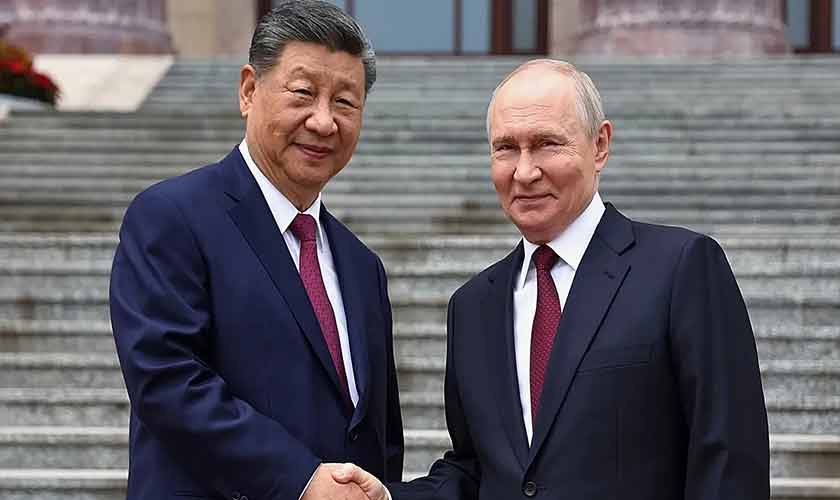
President Xi just hosted both Trump and Putin in a single week—Trump desperate for an Iran war exit, Putin bogged down in Ukraine. As Brookings notes, Xi holds the stronger hand against both rivals, positioning China as global stability’s anchor.
Hashmi assesses that the Putin-Xi summit, deliberately timed on 5-2-0—a homophone in Mandarin for “I love you”— was not accidental. Coming exactly five days after Trump’s Beijing visit, sent Washington a clear signal that the Moscow-Beijing axis is not for sale. Their joint statement reaffirmed the strategic partnership; condemned “unilateralism,” the Golden Dome; and backed a Hormuz ceasefire. All this while 40 defence-industrial deals quietly turned Russia’s Ukraine-war experience into China’s classroom.
However, Hashmi warns: “The ‘no limits’ partnership is gone—Wang Yi’s March 2026 ‘non-alignment, non-confrontation, non-targeting’ formula marks a deliberate downgrade.” The asymmetry widens as Russia needs China far more than vice versa.
“Thirdly, the Trump-Xi-Putin triangle is unstable, if Trump’s September invitation to Xi offers tariff and chip incentives it will further dilute the Russia axis.”
Hashmi advises Islamabad not to be intoxicated by 5-2-0 symbolism. “The Sino-Russian embrace is real but contingent; the Sino-American thaw is shallow but consequential, and the US-Iran war is the wild card that could collapse all three into something none of the principals control.”
Pakistan must work all three corners of this triangle simultaneously—a discipline it has too often failed to muster, she cautions.
The writer is a senior The News staffer in Karachi.