Print Story
X




China’s development is driven by an education system that has transformed human capital into the core engine of its economic and technological growth
| A |
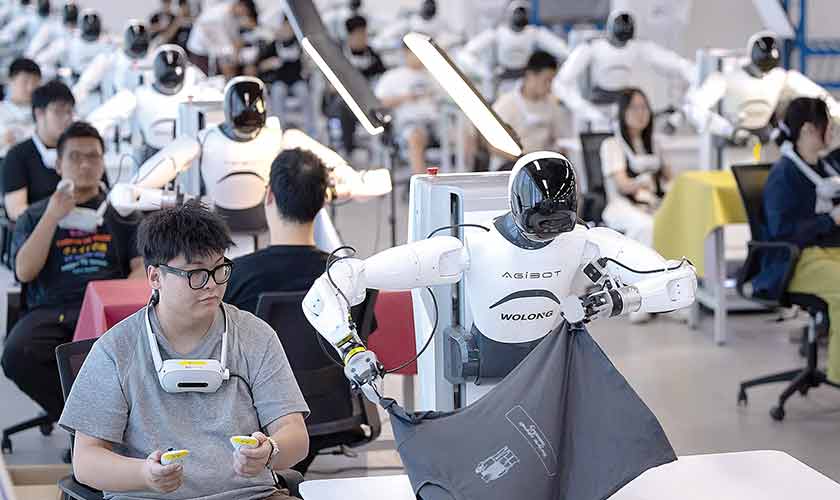
s Donald Trump recently descended on Beijing, flanked by CEOs of some of the world’s largest corporations, the American delegation encountered a China far different from the low-cost manufacturing giant once imagined in Western strategic circles. From AI-powered infrastructure and autonomous transport systems to advanced robotics and cutting-edge semiconductor research, China showcased technological marvels that signalled not merely economic growth but the arrival of a rival superpower determined to challenge Western dominance in the 21st Century.
Behind this transformation lies not only industrial policy or state investment but a deeply strategic educational revolution that has quietly become the backbone of China’s geopolitical rise.
Having studied and undertaken research in China for more than a decade, I have seen these changes unfold at close range, particularly in how education has been systematically aligned with technological and industrial transformation.
At the end of the 20th Century, China stood at a geopolitical and economic crossroads. Decades of isolation had left its infrastructure lagging behind the world, especially the West. Yet, under the visionary leadership of Deng Xiaoping, the central government recognised that true national sovereignty and economic dominance could not be built on cheap manufacturing alone. It required intellectual capital.
Today, China does not merely compete with the West; in critical sectors of science, technology, engineering and mathematics (STEM), it is actively surpassing it. At the heart of this tectonic shift is a meticulously planned, hyper-focused education system that serves as the ultimate engine for the country’s geopolitical ambitions.
Unlike Western democracies, where educational policies often shift with four-year election cycles, China’s educational strategy is dictated by the central government’s long-term planning. The country operates on a dual-timeline strategy. Its short-term goals, dictated by the current Five-Year Plan, focus on immediate market trends, adjusting university quotas to plug labour shortages in emerging industries and upgrading vocational training. At the same time, long-term strategies, guided by blueprints such as China Education Modernisation 2035, aim to establish a world-class educational system that leads globally in innovation and ensures technological self-reliance.
By tightly aligning curriculum development with state objectives, the central government ensures that schools and universities are not merely spaces of academic inquiry but incubators for national security and economic growth.
Walk into a modern Chinese classroom and the future of pedagogy is already on display. China has integrated artificial intelligence and big data into its schooling system at a scale unmatched anywhere else. Traditional rote learning has evolved into AI-driven adaptive learning focused on producing targeted industrial talent.
AI assistants analyse student performance in real time, tailoring homework and identifying conceptual gaps with remarkable precision. While Western debates on AI in education often focus on the risks of cheating, China treats AI as a vital educational utility. New technologies such as virtual reality laboratories now allow students in rural provinces to conduct complex physics and chemistry experiments that were once restricted to elite urban academies.
This digital transformation ensures that China’s massive population is rapidly upskilled to meet the demands of highly focused industries, including quantum computing, semiconductor manufacturing, renewable energy technology and biotechnology.
To understand China’s current educational supremacy, one must look back to the policy of Gaige Kaifang (Opening Up), initiated in 1978. In the late 20th Century, China opened its doors to the outside world, sending millions of its brightest minds to top-tier Western universities. For years, critics mocked this as “brain drain.” In reality, it became a long-term intellectual harvest.
Through aggressive and heavily funded state initiatives such as the Thousand Talents Plan, China began bringing back its overseas intellectuals. Returned scientists were offered world-class laboratories, political prestige and financial autonomy.
At the same time, China transformed itself from being merely an exporter of students into a global educational hub. By offering lucrative packages, fully funded scholarships and state-of-the-art research environments, China successfully attracted foreign young minds and expert researchers for research and development as well as academic roles. This reverse brain drain significantly weakened the Western monopoly on high-tech innovation.
Several strategic pillars define the Chinese model. The Gaokao system, an ultra-competitive national college entrance examination, standardises meritocracy and filters the country’s most analytically gifted students into elite research institutes. The Double First-Class Initiative channels massive state funding into selected universities such as Tsinghua University and Peking University, elevating them into the top ranks of global academia. Meanwhile, military-academic integration ensures direct collaboration between research universities and strategic state sectors, accelerating the transition of laboratory discoveries into market-ready national technologies.
This educational engine has fundamentally altered global geopolitics. Washington and Brussels are increasingly confronting a reality in which Chinese research outputs in fields such as hypersonics, 5G/ 6G infrastructure, and artificial intelligence now rival or surpass Western output in both scale and impact.
By commanding the educational high ground, China has successfully reduced its dependency on Western technological systems. It no longer relies primarily on importing brains or innovation; increasingly, it produces both domestically.
For the rest of the world, China’s educational rise should not be viewed merely as a threat but also as a blueprint and an opportunity.
Western and developing nations alike must move beyond outdated stereotypes of Chinese education as purely rote-based learning. The modern Chinese model demonstrates that sustained state investment in STEM, combined with technological integration and clear industrial direction, can produce extraordinary national outcomes. Other countries must reassess their education spending, strengthen scientific literacy and bridge the gap between academia and industry.
For countries such as Pakistan, the implications are especially significant. Pakistan continues to struggle with inconsistent education policies, underfunded universities, weak research ecosystems and a persistent disconnect between academic training and industrial needs. At a time when global power is increasingly defined by technological capacity, Pakistan risks long-term marginalisation unless it undertakes serious structural reform in education and research.
Crucially, isolation is no longer a viable geopolitical strategy. The global scientific community thrives on collaboration, not fragmentation. Future stability depends on countries building constructive and balanced engagement with China. Through joint research initiatives, student exchanges and shared technological standards, nations can benefit from China’s immense research capacity while maintaining healthy global competition.
To compete in the 21st Century, the world must learn from China’s educational transformation and find ways to innovate alongside it.
The writer is a tenured professor at the Interdisciplinary Research Centre in iomedical Materials (IRCBM) at COMSATS University Islamabad, Lahore Campus. He has a PhD in Materials Science from Shanghai, China. He can be reached at [email protected].