Print Story
X




Under the revised arrangement, shops, bazaars, shopping malls, restaurants and food outlets can operate till late in the night
| W |
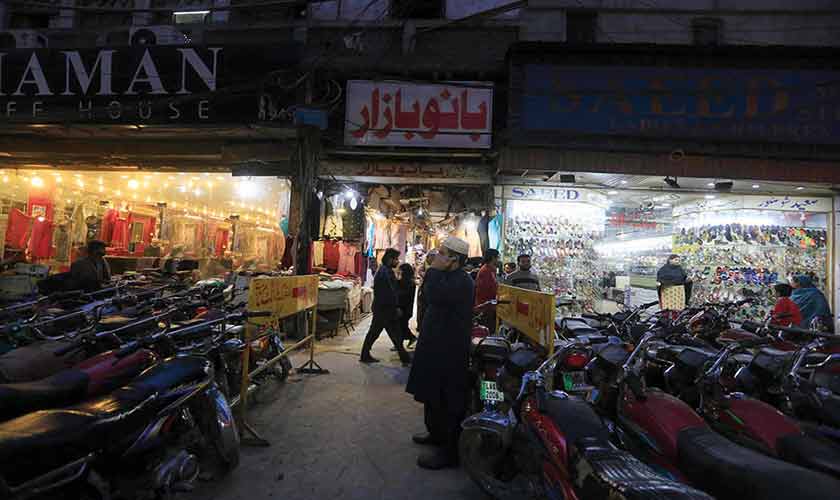
hen the Punjab government — following the federal government’s lead — announced an 8 pm market closure policy on April 6, Gulberg’s Main Market would look deserted by 8:15 pm.
“Action against violations was harsh and nobody wanted to be penalised,” recalls Adil, the proprietor of a glassware shop at Raja Centre.
Recently, however, the government relaxed the restriction, allowing businesses to remain open until 10 in the night. The decision followed weeks of intense pressure from traders’ associations in the high-stakes lead-up to Eid-ul-Azha shopping.
Under the revised arrangement, shops, bazaars, shopping malls, restaurants and food outlets can operate until the extended deadline. This temporary relief, introduced as an exception to the energy-saving measures, is slated to remain in place until June 1.
The relaxation has generated mixed reactions. While merchants have largely welcomed it as a much-needed move for commercial activity, the general public remains divided, with many questioning the government’s consistency in planning and enforcement.
“This makeshift arrangement does no real good for traders or the public,” argues Shafiq Ahmed, president of the Raja Centre Traders’ Union in Gulberg. “Traders struggled initially to adapt to the sudden 8 pm mandate. After June 1, we will be forced back into that routine, meaning another slump in business.”
The sentiment on social media mirrors this divide, with public discourse split between those supporting extended hours and those criticising the government’s frequent policy U-turns. Some critics argue that restrictions should not have been imposed in the first place if those were to be relaxed so quickly.
Meanwhile, lifestyle-focused citizens maintain that early closures are better for maintaining a healthy morning routine. Adding to the friction is widespread public confusion over whether the 10 pm extension applies to dine-in restaurants.
For the traders’ community, the core issue remains a lack of clarity. According to Ahmed, the policy’s chaotic rollout created confusion not just for shopkeepers, but also for enforcement officials.

The sentiment on social media mirrors this divide, with public discourse split between those supporting extended hours and those criticising the government’s frequent policy U-turns.
“There was no proper notification initially,” Ahmed notes. “They forced many services and marketplaces to shut down without proper planning. Essential sectors — including bakeries, hotels, medical stores and courier services — were severely disrupted in the early phase. Many of these businesses operate on overnight production cycles.”
The consequences of the initial ambiguity were felt financially. Ahmed says that because many goods are prepared overnight, he “had to pay thousands of rupees in penalties simply because the courier services had been forced to close early.”
Interestingly, the merchants in the Walled City have already adapted to the earlier routine, often closing voluntarily around 7 pm.
Ahmed estimates that the trading community is split on the issue. “About 50 percent of them favour longer hours; the other half disagrees because shifting policies breeds mistrust.
“After June 1, when things revert to the 8 pm mandate, the traders fear a resurgence of heavy-handed crackdowns.”
Compounding the anxiety of shifting business hours is the city’s crippling infrastructure deficit, particularly electricity shortages. With Eid-ul-Azha approaching, frequent power outages are crippling both production and retail.
“The electricity keeps tripping throughout the day. Tailors and retailers who promised Eid deliveries are suffering because their machines cannot run without power,” Ahmed continues.
For Lahore’s small traders, who depend heavily on steady evening sales and uninterrupted production cycles, the combination of energy instability and volatile policy deadlines continues to paint an uncertain financial future.
Ahsan Raza is the editor of an English daily. He can be reached at [email protected]