Print Story
X




Muhammad Jahanzaib’s book critically examines Pakistan’s evolving foreign policy through the dual prism of geo-politics and geo-economics
| I |
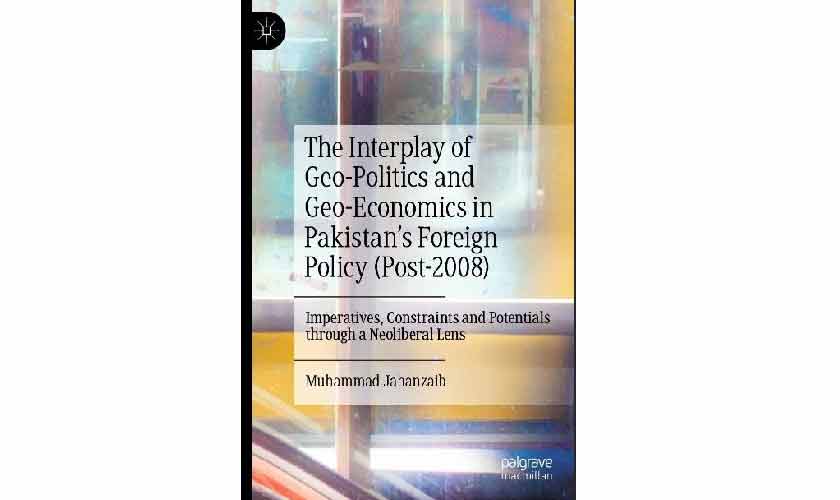
In an era marked by the deepening entanglement of economic statecraft and geopolitical competition, the study of how states recalibrate their foreign policies in response to shifting global structures remains a matter of pressing scholarly concern. Muhammad Jahanzaib’s book, published by Palgrave Macmillan, makes a timely and valuable contribution to this field by examining Pakistan’s evolving foreign policy through the dual prism of geo-politics and geo-economics. Rooted in neoliberal theory and drawing on a qualitative case study methodology, the work offers a comprehensive mapping of Pakistan’s strategic transition from security-dominated diplomacy to an increasingly economic-oriented engagement with the world.
The book is divided into seven chapters. The first serves as an extended introduction, situating the research within the existing literature, elaborating the theoretical framework and outlining the methodological design. Chapter two offers a historical panorama of Pakistani foreign policy from independence in 1947 to 2008, tracing the predominance of geopolitical and geostrategic imperatives across the Cold War, the Soviet-Afghan conflict, and the post-9/11 War on Terror era. Chapter three shifts to the conceptual terrain of geo-economic reorientation, examining the theoretical and strategic logic underpinning Pakistan’s turn towards economic diplomacy. Meanwhile, Chapters four and five constitute the analytical core of the book: the former examines the interplay of geo-politics and geo-economics in Pakistan’s bilateral relations with major powers, neighbouring states and Muslim-majority countries in the post-2008 period while the latter assesses the concrete implications of the country’s intended transition from geopolitics to geo-economics after 2015. Chapter six presents a structured analysis of Pakistan’s national imperatives, constraints and potentials within this evolving strategic landscape. Chapter seven concludes the study with policy recommendations.
The central argument advanced by Jahanzaib is that post-2008, Pakistan has undergone a discernible, albeit incomplete, foreign policy reorientation. The traditional predominance of geopolitical and geostrategic concerns—shaped by the Kashmir dispute; the India-Pakistan rivalry; alignments with major powers; and counter-terrorism commitments—has gradually given way to a heightened emphasis on economic diplomacy, regional connectivity and geo-economic statecraft. Important initiatives such as the China-Pakistan Economic Corridor under the Belt and Road Initiative; the National Security Policy of 2022; and institutional mechanisms such as the Special Investment Facilitation Council are presented as evidence of this transition.
The work is grounded in the ideas of Robert Keohane and Joseph Nye, particularly their notions of complex interdependence and liberal institutionalism, as it interprets these developments through the lens of economic cooperation, multilateral diplomacy and institutional engagement. It argues that neoliberalism provides a coherent explanatory perspective for understanding Pakistan’s engagement with international institutions, economic alliances and multilateral diplomacy in the contemporary period.
The book’s empirical contributions are among its most impressive features. Chapters four and five assemble an extensive range of primary and secondary sources, tracing Pakistan’s bilateral engagements with the United States, China, Russia, India, Afghanistan, Iran, Saudi Arabia, Turkey, the Gulf Cooperation Council states, the Central Asian Republics and African Muslim countries in considerable detail. In addition, the inclusion of economic indicators—including trade volumes, bilateral investment figures, agreements under CPEC, Free Trade Agreement frameworks and remittance flows—gives the analysis a degree of empirical concreteness often missing in existing literature on Pakistan’s foreign policy.
The treatment of the China-Pakistan relationship is particularly instructive. The author traces the evolution of the partnership from its Cold War-era geostrategic foundations, rooted in shared concerns regarding India and the facilitation of US-China rapprochement in the early 1970s to the contemporary phase defined by CPEC-related infrastructure investments, energy cooperation and the emerging Digital Silk Road. Moreover, his discussion of debt sustainability concerns, the geopolitical implications of China’s expanding regional footprint and the triangular dynamics involving India reflects a nuanced understanding of how geo-economic cooperation and geopolitical alignment remain simultaneously interconnected and evolving.
The book’s engagement with Pakistan’s relations with Muslim-majority states constitutes another area of considerable scholarly value. The examination of Saudi Arabia-Pakistan relations—encompassing labour migration and remittances, energy supply, defence cooperation and the pressures generated by the Saudi-Iran rivalry—offers a sophisticated mapping of the intersection between religious, economic and strategic variables in bilateral relations.
Similarly, the discussion of Turkey, Malaysia, Indonesia and the Central Asian Republics demonstrates an appreciation of the multidimensional character of Pakistan’s engagement with the broader Muslim world, moving beyond the familiar security-centric binaries that frequently dominate the literature.
The study draws extensively on official government documents, multilateral institutional sources and a series of primary interviews conducted with diplomats, military officers, politicians, academics, bankers and policy practitioners in Pakistan. These interviews add immediacy and contextual grounding that purely textual analysis would not have achieved.
Furthermore, one of the book’s most significant strengths lies in its temporal and spatial comprehensiveness. Few previous studies have attempted to map Pakistan’s geo-economic transition across such a broad spectrum of bilateral and multilateral relationships within a single analytical framework. Consequently, the work serves as a valuable reference for scholars and practitioners seeking a panoramic account of Pakistan’s foreign economic diplomacy in the post-2008 period.
The author’s identification of the triadic tension between national imperatives (economic development, regional connectivity and security), constraints (political instability, fiscal vulnerability, a hostile regional environment and debt dependency) and potentials (geostrategic location, a young labour force, emerging trade partnerships and the digital economy) offers a particularly useful analytical scaffold for policymakers and researchers alike. His recommendation that Pakistan pursue diversified economic partnerships, deepen engagement with regional institutions such as the SCO and ECO and activate diaspora networks as instruments of economic diplomacy reflects a pragmatic and forward-looking reading of the country’s structural position within the international system. Importantly, these recommendations emerge from detailed empirical analysis rather than abstract prescription, thereby enhancing their practical relevance.
Finally, the book’s documentation of the post-2015 acceleration of Pakistan’s geo-economic engagement—from the formalisation of CPEC to the SIFC’s efforts to attract Gulf investment during 2023 and 2024—provides empirical material that future scholars of Pakistan’s foreign policy will find indispensable. The study joins a growing body of scholarship arguing that Pakistan’s engagement with the world cannot be understood solely through a security-centric lens and that the economic dimensions of foreign policy deserve sustained scholarly attention.
Thus, The Interplay of Geo-Politics and Geo-Economics in Pakistan’s Foreign Policy (Post-2008) is a substantial, empirically rich and policy-relevant contribution that will be of considerable interest to scholars of South Asian politics, international relations and the emerging field of geo-economics. As a comprehensive mapping of Pakistan’s foreign policy transition over nearly two decades, the work represents a serious and commendable scholarly endeavour that meaningfully advances our understanding of how a state situated at the crossroads of South Asia, Central Asia and the Middle East is navigating the complex imperatives of the 21 Century international order. The study also helps understand Pakistan’s mediatory role in the broader Iran-related regional crisis. It highlights Islamabad’s diplomatic efforts to keep communication channels open between the US and Iran, while simultaneously maintaining strategic coordination with Saudi Arabia under the existing mutual defence agreement. At the same time, Pakistan’s continued engagement with China is significant in facilitating backchannel diplomacy aimed at de-escalation, given Beijing’s interest in regional stability under the BRI. This balancing diplomacy reflects Islamabad’s attempt to manage intensifying regional tensions that carry direct geo-economic consequences, particularly rising energy costs and fuel price in Pakistan and beyond.
Finally, the book is highly recommended for graduate students, policy researchers, diplomats and practitioners engaged with Pakistan’s foreign policy, regional connectivity and the broader question of how geo-economics is reshaping contemporary regional and global politics.
The writer has a PhD in political science from Heidelberg University and a postdoc from University of California, Berkeley. He is a DAAD and Fulbright fellow and an associate professor. He can be reached at [email protected].