Print Story
X




In villages, livestock is more than a source of food; it represents savings for rural families
| S |
alma, a mother of three, says her husband buys a two-year-old calf nearly ten months before Eid-ul Azha every year. After raising and fattening the animal, they sell it during the Eid season for profit.
Last year, the family used the earnings to install a mini solar power system at home. This year, they hope the income from cattle sales will help meet another household expense that cannot be covered through their regular monthly budget.
Speaking to The News on Sunday, Salma recalls how one of their cows fell ill in April, just weeks before Eid. “I was deeply worried because Eid was approaching and the cow had stopped eating. It became very weak,” she says. “Weak animals attract fewer buyers and are sold at lower prices. The cow eventually recovered after treatment,” she says “but I think it lost a significant amount of weight.”
She urged her husband to call a veterinary doctor but their area has no government veterinary facility. Like many villagers, they initially tried traditional remedies commonly used in rural communities for treating livestock diseases.
In rural parts of Khyber Pakhtunkhwa, almost every household keeps livestock. Families commonly rear cows, buffaloes and goats—animals often described as “emergency cash” because they can be sold whenever money is urgently needed.
The word maal, commonly used for livestock in the province, originates from Arabic and is also widely used in Persian, Urdu and Pashto. Literally meaning “wealth,” the term reflects the central role animals play in the rural economy.
Farmers in the province combine crop farming with livestock rearing. Apart from generating income, animals provide families with milk, yogurt, butter and desi ghee—staples considered nutritional essentials in village households.
Livestock also acts as a financial cushion. Families often sell animals during periods of financial hardship or to purchase expensive household items.
The type of animal that people rear depends largely on their financial means. Middle-income families usually raise local breeds of cows and goats. Wealthier farmers invest in imported breeds known for high milk production.
Jersey and Friesian cows are among the most popular imported breeds. Although they produce larger quantities of milk, they are expensive to maintain because of high feed and care costs.
Livestock markets are a regular feature in major cities of Khyber Pakhtunkhwa, where weekly cattle fairs are held on Tuesday, Wednesdays and Sundays. Buyers visit these markets to purchase animals for milk, meat or breeding.
While local markets mainly offer cows and goats, many farmers travel to Gondal, a well-known livestock market in the Attock district of the Punjab, to buy buffaloes.
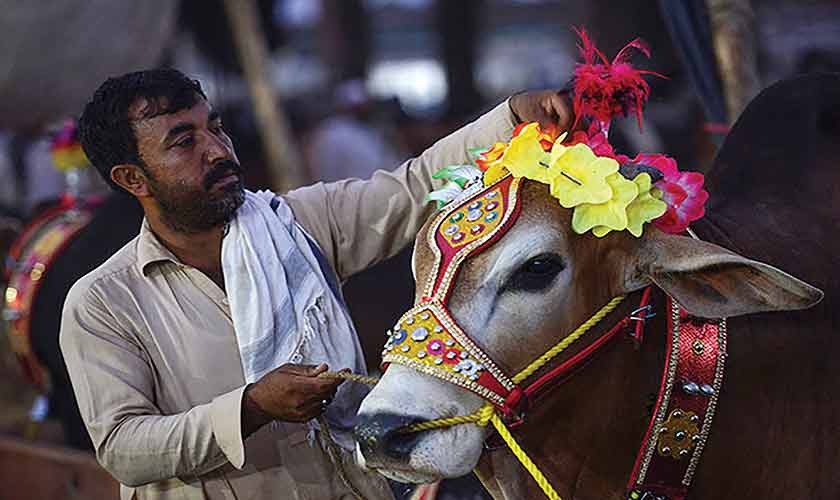
As Eid-ul Azha approaches, traders set up roadside camps and temporary cattle markets across the province. The seasonal business generates significant profits for traders and farmers alike.
In central Khyber Pakhtunkhwa, many families prefer collective sacrifice, where several people contribute to purchase a large animal, often brought from the Punjab.
Thirty-one-year-old Sangeen Khan is a resident of Charsadda. He works both as a farmer and a daily-wage employee at the local municipal committee. Despite earning around Rs 40,000 a month, he says buying gold for his marriage remains beyond his financial reach.
A year ago, he purchased a calf and raised it for the Eid season. “The money I earn from selling the animal this Eid will help me buy gold jewels for my wedding,” he says.
Jan Alam Khan says his family has been engaged in livestock farming for more than three decades. Every Monday, he visits the Gondal livestock market in Attock, where traders from across the region gather to buy and sell buffaloes, cows and goats.
“This market offers many breeds for both meat and dairy purposes,” he says. “As Eid approaches, traders from Khyber Pakhtunkhwa increasingly head to Gondal for business.”
According to Jan Alam Khan, a 600 kg buffalo currently costs around Rs 300,000. Prices of cows vary depending on breed and quality. Sahiwal cows are considered valuable for meat production; some imported breeds can cost up to Rs 500,000.
“Imported breeds produce a lot of milk but few people can afford their feed and maintenance costs,” he says. “Friesian and Jersey cows require special care, especially during the summer season.” Imported cattle, he says, are not resilient to local temperatures.
Alam says the biggest challenge in livestock farming is feeding the cattle. Buying oilseed cakes (khal) and commercial feeds (wanda) is expensive. There are limited fields of green fodder in Khyber Pakhtunkhwa.
For rural families, livestock remains one of the few dependable financial assets in uncertain economic conditions.
“If all your animals survive, you remain in profit,” Jan Alam Khan says. “It is like having money in a bank. You can withdraw it when needed. For livestock owners, the death of an animal is a big setback. Sometimes a single animal’s death can ruin a livestock farmer.”
The writer is a researcher.