Print Story
X




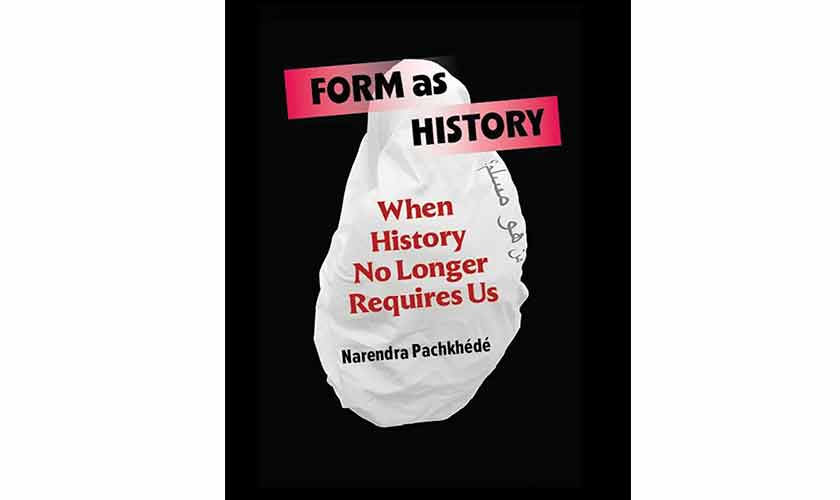
In Form as History, Narendra Pachkhédé examines how modern systems of power have become detached from ethical responsibility
| N |
arendra Pachkhédé’s Form as History: When History No Longer Requires Us first caught my attention with the possibility of its engagement with a pressing concern of our time: the unsettling truth that forms of systemic brutality and oppressive governance are not simply historical phenomena, but unfortunately continue to persist, more explicitly and unapologetically, within the contemporary world. Narendra Pachkhédé is a writer, essayist, journalist, critic and curator working at the intersection of literature, cinema, political theory, anthropology and global intellectual history. His work examines the cultural and historical conditions through which power, normativity, and moral responsibility are articulated in the modern world.
The book challenges conventional understandings of history by moving beyond the idea of history as a sequence of events, dates, or narratives. Instead, Pachkhédé argues that history now operates as form: a structure that continues to organise political and social life even as it becomes detached from ethical responsibility. The book’s central concern is not whether history has ended, but how it has changed. In Pachkhédé’s view, history persists, though no longer in ways that require accountability to the human subjects living through it.
Right from the beginning, the opening chapters establish this argument with clarity. Pachkhédé suggests that history continues “with the appearance of normality,” despite withdrawing from any meaningful obligation to address human concerns. This idea is particularly relevant to contemporary governance, where legal, economic, and political systems often appear efficient and functional while remaining increasingly distant from the realities they shape. Institutions continue to produce policies, regulate populations, and manage crises, yet these processes do not always appear grounded in moral or social responsibility.
Pachkhédé’s distinction between loss and abandonment is central to this argument. Whereas loss belongs to a familiar historical framework, abandonment describes a more unsettling condition and can be narrated, mourned, and contested. Systems continue to function, but without requiring those they govern to matter. As a result, the issue is no longer one of invisibility. Suffering is documented, circulated, and made publicly visible; however, visibility alone no longer guarantees a response. In this sense, the book reframes indifference as a structural condition rather than a failure of awareness.
To develop this idea further, Pachkhédé turns to the figure of the Muselmann, drawn from Primo Levi’s testimony. Rather than using the Muselmann as a symbolic representation of suffering, the text positions this figure as a diagnostic limit: a human reduced to endurance, existing at the threshold where suffering no longer requires explanation. Through this reading, Pachkhédé demonstrates how history can reach a point where oppression need not justify itself, nor even name itself as oppression.
The writer engages with Boris Groys’s thought to strengthen this discussion. Groys proposes that history becomes form once narrative collapses. Pachkhédé, however, pushes this further by suggesting that history now exists directly as form. In other words, history no longer relies on narrative continuity or significant events to operate. Instead, it persists through systems, structures, and repeated modes of organisation. This shift from event to structure is one of the book’s most significant contributions, as it relocates history from the realm of representation into the conditions of everyday life.
Systems continue to function, but without requiring those they govern to matter.
Building on this framework, the collapse of form emerges as a major concern throughout the text. Pachkhédé suggests that this collapse is not accidental, but politically useful. Where form is sustained, actions require explanation, justification, and accountability. By contrast, when form weakens or disappears, systems can continue functioning without being answerable for their consequences. This is where the book becomes particularly compelling: it links abstract philosophical concerns to material political realities, arguing that the erosion of form allows indifference to become normalised within functioning institutions.
To illustrate this point, the book references multiple historical and contemporary examples in which structures, rights, and systems of obligation have been repeatedly violated. Although these examples are not developed as extended case studies, they serve an important comparative function. They allow readers to consider what history looks like when form is present, when accountability and obligation remain intact, and when these structures erode.
What becomes of history when it no longer requires struggle, meaning, or even us, yet continues efficiently all the same?
Alongside this, Pachkhédé offers a critique of how modern systems treat the human subject. While systems continue to produce history through people, these individuals are no longer treated as active agents. Instead, they are increasingly categorised, administered, and managed as objects. Their existence becomes secondary to the smooth functioning of larger structures. Consequently, decision-making begins to resemble technical or procedural intervention rather than an ethically grounded process. Policies are implemented with precision, but without sufficient consideration of their human implications.
Another strength of the text lies in its engagement with a wide range of scholars. By drawing on multiple thinkers across philosophy, political theory, and history, Pachkhédé situates his argument within a broader intellectual tradition. These references demonstrate that concerns surrounding power, accountability, and historical form have been explored in different ways across disciplines. At the same time, this intertextuality contributes to the density of the work, making it a demanding read for those unfamiliar with the field.
Similarly, the book’s engagement with religion adds another dimension to its critique. Pachkhédé resists simplistic associations, particularly by locating the Muselmann within European modernity rather than Islamic thought. At the same time, the text suggests that systems of belief which emphasise obligation and accountability may sit uneasily alongside modern structures that increasingly avoid justification.
Despite the originality of its argument, the book is not without limitations. As the text progresses, the prose becomes increasingly dense and repetitive. While this repetition appears intentional, mirroring the circularity of the condition being analysed, it can also make the argument difficult to follow. In addition, the absence of more sustained case studies occasionally leaves the work at a high level of abstraction.
Nevertheless, Form as History remains a thought-provoking contribution to debates on history, governance, and political accountability. It tends to offer a framework for understanding how indifference can be produced and sustained not through institutional failure but through their continued success.
Form as History
When History No Longer Requires Us
Author: Narendra Pachkhédé
Publisher: Daraja Press, 2026
Pages: 72
The reviewer is currently pursuing her postgraduate studies in Secondary English Education at the University of Sussex, UK.