Print Story
X




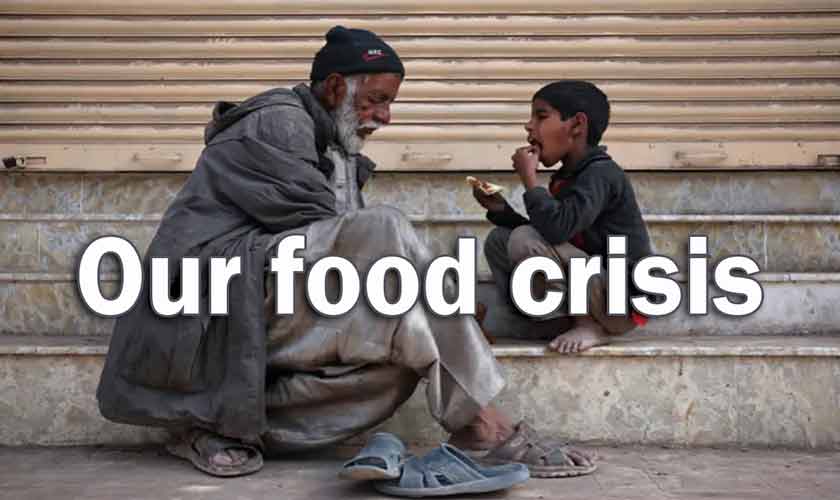
Pakistan ranks among the ten worst-affected countries for acute food insecurity. What does this deprivation mean for its people?
| I |
n a cramped two-room house in which she lives with her husband and four children in Karachi’s Korangi neighbourhood, Nasreen Bibi calculates her household spending—as she does every morning. Based on it, she decides which meal to skip; which vegetable to replace with more roti; and whether the week’s budget for milk would stretch to the weekend. Her youngest is a three-year-old boy.
“Daal used to cost us Rs 150 per kg a few years back,” she says. “Now I can barely afford it at Rs 380. We eat less so that the children can eat more.”
Nasreen is one of roughly 11 million Pakistanis the 2026 Global Report on Food Crises identifies as unable to access sufficient food without urgent external support. Her story plays out in countless variations across the country that theoretically grows enough food to feed itself.
Released in April by an international alliance led by the Global Network Against Food Crises, the report’s tenth edition shows that acute hunger has doubled over the past decade, with two famines declared last year for the first time in the report’s history. In total, 266 million people across 47 countries experienced high levels of acute food insecurity in 2025, reflecting a deepening and persistent global hunger crisis.
The scale of the catastrophe is stark at its extreme end. Famine was confirmed in Gaza and parts of Sudan in 2025 by the Integrated Food Security Phase Classification system. This marked the first time since the GRFC began reporting that famine had been confirmed in two separate contexts in the same year. It was driven primarily by conflict and restricted humanitarian access. Globally, 1.4 million people across six countries fell under the most severe classification, involving starvation, death and extreme malnutrition—more than nine times higher than in 2016.
Pakistan sits uncomfortably near the centre of this crisis.
Ten countries, including Pakistan, account for two-thirds of all people facing high levels of acute hunger. The others are Afghanistan, Bangladesh, the Democratic Republic of Congo, Myanmar, Nigeria, South Sudan, Sudan, Syria and Yemen.
Dr Abid Qaiyum Suleri, the Sustainable Development Policy Institute’s executive director, calls Pakistan’s inclusion in the list a serious policy warning but one that requires careful reading.
“The problem is not only food availability,” he says. “Pakistan usually produces enough food to avoid outright scarcity. The deeper problem is access.”
He argues that when wheat flour, pulses, milk, vegetables, transport and energy all become expensive simultaneously, poor households respond rationally but dangerously: they protect calorie intake by sacrificing nutrition.
“Children and women pay the highest price,” he says.
The GRFC identifies four primary drivers of food crises globally: conflict, climate change, economic shocks and a collapse in humanitarian financing. Dr Suleri says all four converge in Pakistan with unusual severity.
“Climate change has become a consistent pattern where storms and rain begin just as wheat is nearing harvest,” he says. “Rain occurs when it is not required and is absent when it is most needed.”
In total, 266 million people across 47 countries experienced high levels of acute food insecurity in 2025, reflecting a deepening and persistent global hunger crisis.
The report’s projections for 2026 show no improvement in sight. At the time projections were made, the impact of conflict escalation in the Middle East had gone mostly unaccounted. Dr Suleri points directly to the regional fallout. He warns that if Pakistan does not receive LNG from Qatar, the availability of urea fertiliser would be endangered for the upcoming Kharif crop, affecting both price and supply. For phosphatic fertilisers, he says, the ingredients—phosphorus and sulphur—were sourced from refineries now caught in regional disruptions.
“I foresee an impending fertiliser crisis,” he says.
He also flags a structural failure that predates the current crisis. “We have not been able to modernise our agricultural policy. We are still focusing on basic agronomic practices while the rest of the world has shifted to climate-smart agriculture.”
He says India’s unilateral disruption of the Indus Waters Treaty, reducing water flows in the Chenab River and threatening rice and cotton sowing in the coming season is compounding matters.
“It is a vicious cycle that starts with energy and the economy and results in food insecurity,” he says. “This is exactly what this year’s report is highlighting.”
Aftab Alam Khan, an Islamabad-based expert on climate change and food security, places Pakistan’s situation within the broad architecture of the report’s findings. He notes that the country ranks eighth globally for the largest number of people facing acute food insecurity. Climate shocks, notably the catastrophic floods of 2022 and 2025, he says, have deepened vulnerability across millions of households. Gobal energy shocks have further squeezed the purchasing power.
He insists, however, that food security cannot be reduced to crop yields alone. “Food security must be understood beyond agricultural production,” he explains. “It means reliable access to safe, nutritious and balanced diets, plus clean water, sanitation, hygiene and essential health services.”
The GRFC warns that ongoing conflicts, climate variability and global economic uncertainty are likely to sustain or worsen conditions in many countries in the year ahead. Khan says the convergence of El Niño-driven weather disruptions and sustained geopolitical instability have created immediate risks to crops and food supplies that Pakistan’s policy framework is not equipped to absorb.
He also makes an observation that cuts the narrative of scarcity alone. Although Pakistan ranks among the world’s ten worst-affected countries for acute food insecurity, it is also among the top five globally for food waste. Redirecting that surplus, particularly through digital platforms to match donors with recipients, he argues, could provide immediate relief to millions while strengthening longer-term resilience.
Khan reserves particular concern for rural women, urging mass awareness campaigns on diet and health. He says Pakistan needs a two-tier response: urgent targeted action to save lives; and strategic long-term reforms to address structural weaknesses.
The GRFC’s tenth edition confirms the warning in its previous nine editions: the crises are increasingly concentrated, predictable and the result of political, fiscal and strategic choices rather than misfortune alone.
For 266 million people, including 11 million Pakistanis, those choices have consequences measured in missed meals, stunted children and lives quietly diminished. For Nasreen, the arithmetic is simple and merciless: the food is out there, somewhere in the supply chain. It just costs more than she can afford.
The writer is a senior financial correspondent at The News. He holds Alfred Friendly, Daniel Pearl and Geo Journalism fellowships. He can be reached at [email protected].