Print Story
X




Pakistan’s food security challenges largely stem from internal policies. That, however, does not make it immune from disruptions due to wars
| L |
ow and stable global agricultural commodity prices are a prerequisite for maintaining food security around the world. Two phenomena—climate change-induced disasters and regional conflicts—create a perfect storm, eroding the ability of institutions such as markets to stabilise the availability of food, which in turn results in highly volatile prices leading to raising food insecurity. The Russia-Ukraine war pushed global food prices to an all-time high in 2022, delaying the recovery of agriculture markets from shocks begotten by the Covid-19 pandemic in 2020. This resulted in an increase in food prices in many countries around the world, driving the cost of staple and nutritious foods out of reach of the poor.
However, as the world was coming to terms with the challenges to food security due to the Russia-Ukraine war, prices for food commodities started easing in 2025. Unfortunately, the relief was short-lived, as in February 2026 the US-Israel war on Iran erupted. The war is affecting food security at multiple levels. The dynamics of this war are quite different from the Russia-Ukraine war. Russia and Ukraine manage to export surplus food despite some disruptions. But, in the US war on Iran, movement of all kind of goods is at a standstill. This includes food and inputs for sustaining agriculture.
Energy prices are shooting up to historic levels due to perceived and actual supply disruptions. The same holds for fertiliser and food commodities. The region currently under siege is responsible for 30 percent of globally traded fertiliser. The 20 percent of liquefied natural gas that it produces and exports is a key component in manufacturing fertiliser and cooking oil. The 15 percent GCC share in global oil output helps to fuel agricultural machinery on farms and distribute food to markets.
Currently, 2 million tonnes of fertiliser is loaded onto ships waiting for the opening of the Strait of Hormuz. This is 12 percent of all fertiliser transported through the strait in 2024. The UN’s World Food Programme has warned that if the strait remains blocked by June, another 45 million people will join the millions who already struggle to feed themselves every day.
The World Bank has predicted a 16 percent increase in overall agri-commodity prices for 2026. It has projected that fertiliser costs will climb 31 percent, largely driven by a humongous jump in urea prices. This surge is attributed to supply disruptions as a result of the conflict in the Middle East and high natural gas costs.
The bank has also warned that if fertiliser affordability weakens, it will lead to reduced crop yields and food inflation. This is particularly critical for nitrogen-heavy crops like wheat.
Pakistan is in a fairly good position due to higher wheat yield this year and availability of stocks of fertiliser for the upcoming rice and cotton crops. Thus, prices of fertilisers have not witnessed much effect due to the conflict as yet; however, if the conflict prolongs, it will put huge pressure on the next wheat crop and in turn, on the precarious food security situation in the country. Already, food prices are going up due to an increase in fuel prices.
The shorter-term sensitive price indicator (SPI), which tracks 51 essential commodities weekly, paints a sharper picture. It hit 10.9 percent year-on-year in April 2026 compared to 7.3 percent in March, and only 0.3 percent in April last year, with the basket dragged up almost entirely by energy and food. This is because every rupee added at the pump or to a cylinder feeds into trucking, bakery and wholesale margins, which then translates into higher prices for the staples on which poorer households spend most of their income.
It is important to understand that Pakistan’s food security challenges stem largely from internal policies though it’s not completely immune from external shocks such as supply disruption due to wars (for example, the wheat import during early days of the Russia-Ukraine war). Poor capacity to manage recurrent floods and droughts, plus marginal investment in agricultural research and development, have contributed to the crisis which has placed the country among those facing the worst acute food security conditions. Law and order issues, and displacement due to security concerns or disasters, also demand policymakers’ attention.
Improving trade relations with neighbouring countries can strengthen food security and reduce rural poverty. Opening trade routes with Iran is a positive step. There is hope that relations with Afghanistan will also improve soon, as it has long been a key export destination for Pakistani agricultural commodities.
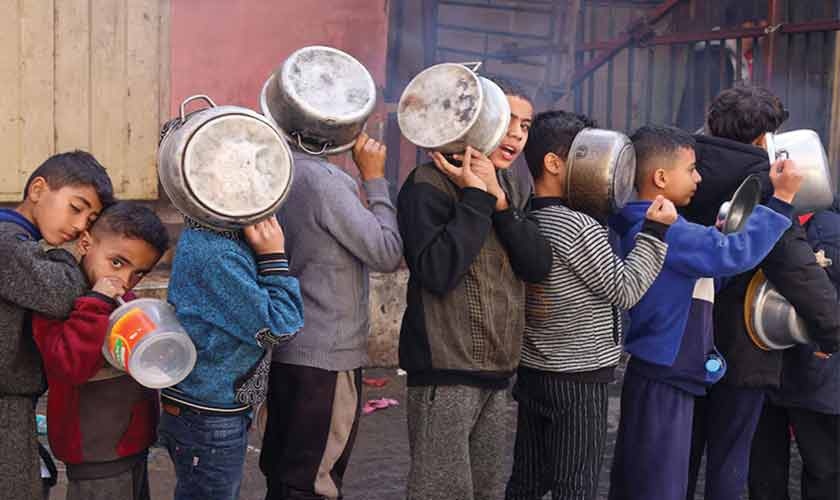
For a country where 24.4 percent of households are food-insecure; where around 45 percent of the population lives below the poverty line; where 16.5 percent face extreme poverty; and where securing even a meal a day becomes a primary concern, preserving peace, both domestically and regionally, reshaping policies to prioritise the wellbeing of the most marginalised is the only way forward.
The writer is deputy executive director at Sustainable Development Policy Institute, Islamabad and heads Systems Research Group. The views expressed are his own and do not necessarily reflect the organisation’s official stance.