Print Story
X




Disappointing performance serves as a stark reminder that high financial investment does not always guarantee success in franchise cricket.
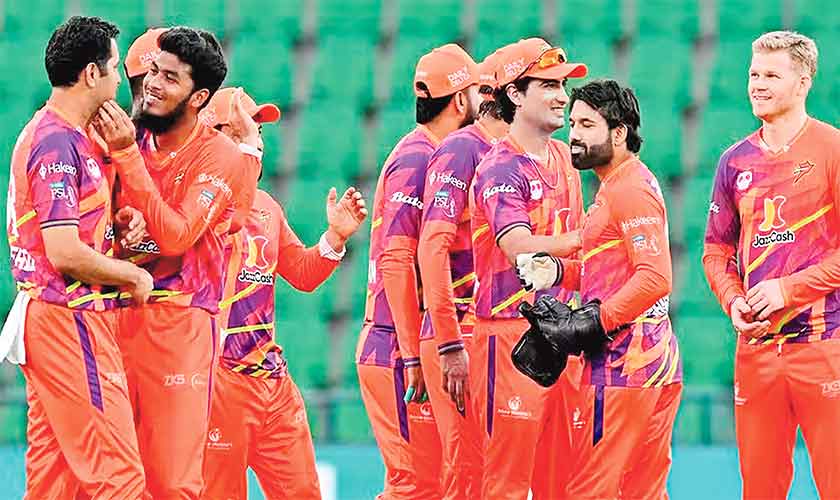
The final of the Pakistan Super League (PSL-11) is being played on Sunday (May 3) in Lahore, bringing the curtain down on another thrilling season of Pakistan’s premier T20 competition.
Peshawar Zalmi, Islamabad United, Multan Sultans and newcomers Hyderabad Kingsmen secured their places in the playoff round after impressive performances in the league stage.
Peshawar Zalmi qualified for the final of this mega event defeating No 2 Islamabad United in the first qualifier and Multan Sultans lost their eliminator to Hyderabad Kingsmen. The good news for cricket fans was that Prime Minister Shehbaz Sharif approved spectator attendance for the entire playoff stage, extending the earlier permission that had only covered the final. The decision ensured fans could witness all the high-stakes knockout matches live from the stands.
Spectators had initially been barred from attending matches under the government’s fuel conservation measures as a result, the entire league stage of this season was played behind closed doors.
The Hyderabad Kingsmen qualified for the playoffs in their debut season in spectacular fashion, exceeding expectations with a combination of aggressive batting and disciplined bowling throughout the league stage.
Their consistency under pressure and ability to close out tight matches made them one of the standout teams of the tournament.
In contrast, defending champions Lahore Qalandars endured a disappointing campaign, struggling to find form and momentum.
Former winners Karachi Kings and Quetta Gladiators also failed to qualify for the playoffs, as inconsistent performances and lack of cohesion ultimately cost them crucial points in the competition.
In PSL-11, the auction table produced fireworks before the players even walked out to bat.
Steve Smith was listed at Rs140 million, Saim Ayub at Rs126 million, Naseem Shah at Rs86.5 million, Faheem Ashraf at Rs85 million, Daryl Mitchell at Rs80.5 million, Fakhar Zaman at Rs79.5 million, David Warner at Rs79 million, Haris Rauf at Rs76 million and Mark Chapman at Rs70 million.
The first-ever PSL auction replaced the old draft system, and franchises clearly paid for reputation, role value and star pull.
The Hyderabad are owned by the FKS Group, a US-based consortium led by Fawad Sarwar. The team became the first in PSL history to avoid first-round elimination after losing their opening four fixtures.
After losing their first four matches, the team turned their season around to make the top four.
They secured their spot by defeating RawalPindiz by 108 runs in a must-win final league match,where they needed to win by over 85 runs to secure qualification.
Glenn Maxwell (70 off 37) and Usman Khan (54* off 26) starred with the bat to set a 244-run total, while bowlers Hunain Shah (4-22) and Akif Javed (3-38) dismantled the opposition.
The most expensive team in PSL 11, Rawalpindiz, suffered a catastrophic campaign, finishing at the bottom of the table.
The RawalPindiz (formerly Pindiz) are owned by Walee Technologies, a tech-based consortium led by CEO Ahsan Tahir.
They purchased the franchise rights for a record PKR 2.45 billion (approx. $8.7 million), making it the most expensive team in PSL history.
The group originally acquired the Multan Sultans franchise and relocated/rebranded it as the Rawalpindi-based team for PSL 11.
Despite their record-breaking price tag and star-studded roster, the team failed to find any rhythm or cohesion on the field. In ten appearances, they managed to lose eight matches, leaving fans and management stunned by the lack of results.
Former Multan Sultan skipper, Mohammad Rizwan who leads the Rawalpindeiz failed to deliver. Apart from his team performance, his own performance was under par. In 10 matches, Rizwan managed only 204 runs, averaging 20.4 and strike rate of 116.57.
Their season was marred by inconsistent batting and a bowling attack that struggled to defend even competitive totals.
This disappointing performance serves as a stark reminder that high financial investment does not always guarantee success in the high-pressure environment of franchise cricket.
But cricket, being cricket, does not always respect invoices. By the late league stage, the scorecards showed a sharp split between expensive names who justified the hype and expensive names still searching for a headline. Kusal Mendis, Babar Azam and Fakhar Zaman led the batting charts, while Steve Smith also reached 367 runs with a century. That made the quieter premium signings look even louder by comparison.
The clearest case was Saim Ayub. At Rs126 million, he was one of the costliest players of the season, yet his return stood at only 151 runs from 10 innings, with a highest score of 35, an average of 15.10 and a strike rate of 121.77. For a top-order batter bought to shape power-plays, those numbers were thin. Even his bowling produced just four wickets at an average of 66.00.
Naseem Shah’s season was even more painful statistically. Bought for Rs86.5 million, he managed only three matches, 8.2 overs, two wickets, an average of 43.00 and an economy rate of 10.32. A premium fast bowler is expected to win powerplay or death-over passages; Naseem’s numbers instead became a reminder that availability is also a performance metric.
Faheem Ashraf was not disastrous, but he was not dominant either. Islamabad United spent Rs85 million on him, yet his bowling return stood at seven wickets from nine matches, with a best of 2 for 22. His economy of 7.91 was respectable, but the wicket column did not scream “match-winner.”
In a tournament where Sufiyan Muqeem had 19 wickets and Shaheen Afridi had 16, Faheem’s impact looked moderate rather than marquee.
Daryl Mitchell’s case was more nuanced. His 255 runs at an average of 36.43 were serviceable but his strike rate of 125.00 lagged behind the tournament’s sharper middle-order hitters. With the ball, he took four wickets but leaked runs at 10.47 per over. For an Rs80.5 million all-rounder, that is not a collapse, but it is not box-office value either.
Haris Rauf also sat in the grey zone. He took 12 wickets in nine matches, which looks healthy but his economy rate of 9.80 kept the debate alive. In T20 cricket, wicket-taking pace is gold, yet expensive death overs can turn gold into glitter.
Salman Agha, Pakistan’s T20 captain, endured a disappointing league phase, managing just 112 runs in 10 matches at an average of 12.44 and a strike rate of 119.14.
In contrast, Test captain Shan Masood delivered a relatively strong performance. The lesson from PSL-11 is simple: auctions buy possibility, not performance. Some big cheques turned into big innings. Others turned into statistical headaches. And in a league where young bowlers and cheaper batters kept stealing the spotlight, several expensive stars discovered the oldest truth of franchise cricket: the scoreboard has no respect for salary slips.