Print Story
X

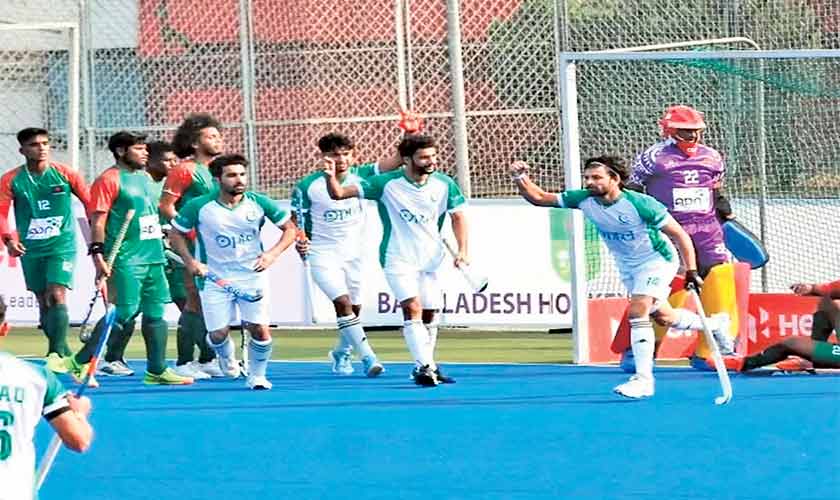
Pakistan hockey’s glorious past—four World Cups, three Olympic gold medals and a legacy that once inspired nations — has become a burden around the sport’s neck. In 2026, the Greenshirts find themselves trapped in a twilight zone: flashes of competitive promise stuck against administrative dysfunction, crumbling infrastructure and a coaching apparatus that remains decades behind the modern game.
While the Pakistan Hockey Federation’s (PHF) recent restructuring under an ad-hoc president has generated headlines, a deeper examination reveals that cosmetic changes to personnel cannot solve systemic rot. This critical analysis diagnoses the fundamental crises plaguing Pakistan hockey and proposes actionable solutions.
Where talent goes waste
Pakistan currently operates approximately 12 to 18 operational artificial hockey turfs—a staggeringly inadequate number for a nation of 240 million people with hockey in its blood. A 2009 report documented 18 PSB-funded turfs across major cities, but maintenance has been catastrophic. The National Hockey Stadium in Lahore (capacity 45,000), Abdul Sattar Edhi Hockey Stadium in Karachi (30,000) and Faisalabad Hockey Stadium (25,000) all remain under rehabilitation, effectively unavailable for regular training. Smaller venues in Gojra, Bahawalpur and Rawalpindi exist but lack international standard specifications.
The contrast with regional rivals is devastating. India boasts over 100 FIH-certified turfs, with state-of-the-art facilities in every major city. Even Bangladesh and Malaysia have surpassed Pakistan in infrastructure investment. When young Pakistani players cannot access artificial surfaces—the non-negotiable foundation of modern hockey—they enter international competition already disadvantaged.
The game played on grass, which most of Pakistan’s current coaches grew up on, bears almost no resemblance to the universally dominated hockey of 2026.
As a first step to its solution, FIH Project Pakistan needed to be accelerated. The PHF must urgently leverage the FIH’s “Project Pakistan” initiative to fast-track the installation of 20 additional synthetic turfs by 2028. Priority should be given to hockey-rich regions of Punjab (Sialkot, Sheikhupura), KPK (Abbottabad, Swat), and Sindh (Hyderabad, Sukkur).
Secondly, there is an urgent need of Public-Private Partnership Model. The government’s PKR 5 crore annual hockey budget is laughably insufficient. The PHF must establish a Hockey Infrastructure Development Fund, targeting corporate sponsors to adopt specific turfs. Each corporate-adopted pitch should bear naming rights, ensuring maintenance accountability.
Thirdly, there should be turf rehabilitation mandate. Within 90 days, the PHF should publish a transparent audit of all existing turfs, classifying them as “operational,” “requires minor repair,” or “requires complete replacement.”
A dedicated rehabilitation cell with quarterly progress reports must be established.
And finally multi-sport utility with hockey priority. New turfs should be designed dual-purpose (hockey and football - futsal), maximising utility while ensuring hockey-specific markings and dimensions remain non-negotiable.
Grass-roots in an
artificial era
The April 2026 coaching appointments, while politically expedient, reveal a deeply troubling pattern. Olympians Manzoor-ul-Hassan (senior team head coach), Ayaz Mahmood (junior team head coach), and Qamar Ibrahim (U-18 head coach) are legendary figures from Pakistan’s golden era. Their passion and commitment are unquestionable. However, nearly all of them developed their skills on grass surfaces, playing a dribble-heavy, slow-possession style that modern hockey has rendered obsolete.
Artificial turf hockey demands aerials and overhead passes (barely practiced in Pakistan’s coaching curriculum), 3D pressing systems (unknown to most local coaches), video analysis and data-driven tactics (virtually absent), specialized penalty corner drills (Pakistan’s conversion rate hovers below par) and fitness benchmarks (European teams run 10-12 km per match; Pakistan averages 7-8 km).
The ad-hoc president’s decision to appoint “stalwarts carrying big mouths” appears designed to insulate the federation from criticism. Meanwhile, Pakistan remains without a foreign head coach—a position promised months ago but still unfilled due to “global commitments.”
Stay-forward FIH
coaching
Certification should be mandatory. Within 12 months, every national, junior, and Under-18 coach must obtain FIH Level 2 or Level 3 certification. The PHF should allocate PKR 2 crore for international coaching courses and exchanges.
A Foreign Technical Director is also the need for overall coaches. Appoint an experienced European or Australian coach (e.g. former Netherlands or Germany assistant) as Technical Director, reporting directly to PHF. This individual would design training curricula, introduce video analysis systems, and modernize tactical approaches while respecting local coaches’ institutional knowledge.
A coach exchange programme with Netherlands/Germany can be initiated. At least 5 or 6 Pakistani coaches may be sent annually to European hockey academies for 3-month immersion programmes.
The FIH should be approached for fully funded fellowships given Pakistan’s historical status.
There may be Introduction of performance-based coach contracts. All head coaches should be placed on 18-month performance contracts with clear KPIs (Key Performance Indicators).
There should be a dedicated video analyst position and there should be a full-time video analyst role within the team’s setup.
Ad-hoc rule cannot be permanent
PHF’s ad-hoc arrangement, while presented as a reform measure, has created a leadership vacuum. The ad-hoc president appointed all hockey stalwarts to key positions—a classic co-option strategy that ensures no dissenting voices.
The promised 2026 elections remain unscheduled. Meanwhile, the 2026 Australia tour collapsed over unpaid dues; players revolted against captain Ammad Shakeel Butt, alleging neglect; and no national league has been held since 2019.
The selection committee, headed by Samiullah Khan and featuring Naeem Akhtar, Kashif Jawad, Mohammad Khalid, Nasir Ali, and Atif Bashir, comprises distinguished names.
However the same criticism applies: What is their modern selection criteria? Are they using data analytics? Fitness benchmarks? Or are they selecting based on “experience” and “potential” observed from the stands?
As said earlier PHF’s budget of approximately PKR 5 crore is laughable. Corporate sponsorship remains hesitant due to governance complexity. Political interference, with sports budgets drain off to cricket, compounds the crisis.
The PHF elections should be held within 6 months. The ad-hoc arrangement must have a concrete sunset clause.
Transparent elections, overseen by FIH observers, should be conducted by October 2026. Candidates should declare their funding sources and development plans publicly.
A forensic audit of PHF finances from 2020-2026 should be commissioned and published. There should be check over sponsorship money. Why are players unpaid for months.
There should be organisation od franchise-based hockey league by 2027. Without a domestic league, talent pipelines remain choked. The PHF must launch a 6-team franchise league (Lahore, Karachi, Islamabad, Peshawar, Quetta, Faisalabad) with mandatory U-21 player quotas.
The league should be scheduled in a November-December window, avoiding conflict with international tours.
Transparent player contracts and insurance should be arranged. All national team players should receive standardised contracts with guaranteed monthly retainers, match fees, and comprehensive medical insurance. No player should represent Pakistan without signed documentation.
The PHF board should include independent members from corporate sector and athlete representatives, elected by players.
Pakistan possesses genuine young talent: Sufyan Khan (FIH Rising Star nominee), Hanan Shahid (16 goals in 41 caps), Rana Waheed Ashraf, and Muneeb ur Rehman have shown they can compete at Nations Cup level.
However, the transition from junior promise to senior consistency is failing. No national league means no regular high-intensity competition. Foreign club opportunities are rare. Fitness standards lag European counterparts by 2-3 km per match. Whereas, the women’s programme remains virtually invisible.
Fitness should be a benchmark as selection criteria. No player should be selected for national duty without meeting minimum fitness standards.
The PHF should also allocate sufficient funds from its budget for women’s hockey.
Most importantly, is school hockey integration. The IBCC-PHF School Revival Programme (2026-29) is a positive step but must be expanded to equipment subsidies, coach training for physical education teachers, and inter-school tournaments with national level finals.
And finally, Pakistan hockey does not lack talent, passion or history. What it lacks is the courage to confront uncomfortable truths.
The outdated coaches may buy short-term political peace, but it will not win World Cup matches. The crumbling turfs will not repair themselves. The young players watching from villages will not magically appear in national kits without grassroots systems.
The 2026 World Cup qualifiers offer a lifeline. But tournaments are won not on the day of the final but with the years of preparation beforehand—on training pitches, in coach education classrooms.
Pakistan hockey’s heartbeat still pulses. The question is whether those entrusted with its care will listen before it falls silent forever.