Print Story
X




With the release of its “20 Years of Global Listening” list, the audio streaming giant offers a closer look at the artists who define music on an international stage today and those who are quietly slipping out of view.

| L |
et’s be honest. When Spotify released its “20 Years of Global Listening” list, some of us clicked on it with a very specific energy, somewhere between curiosity and caution because we already knew what we were going to find. And well, we were right.
The list was meant to be a celebration. Two decades of streaming, of music crossing borders it never could before, of strangers on opposite ends of the world somehow ending up with the same song stuck in their heads. And in some ways, it is exactly that. But it also cracked open a conversation that a lot of people had feelings about, not just about who’s at the top of this dataset, but who’s missing entirely.
“What stood out the most was not who made the Spotify Global list but who did not. Some of the most beloved, genre-defining artists in music history are either missing from this list or barely there. From Pakistan, Nusrat Fateh Ali Khan and Nazia Hassan, two artists who genuinely carried the country’s music to global audiences before the emergence of Coke Studio and others, didn’t make the cut. Globally, the gaps are just as shocking. Adele, Ella Fitzgerald, Whitney Houston, Frank Sinatra, Amy Winehouse, Bob Dylan, Dr. Dre, 2Pac, Chris Cornell, Linkin Park and The Smiths were not featured either.”
The artists who run the streaming world
Here’s the thing about the names dominating Spotify’s data: they make complete sense when you think about how the platform actually works. Streaming rewards consistency. It loves artists who drop music regularly, who collaborate, who somehow always have a song sitting inside the right playlist at the right moment. The artists at the top of this list didn’t just get lucky, they grew up inside the system, understood it early and worked with it rather than against it.
Compare that to artists whose greatest years came before any of this existed and the gap becomes obvious. Not because those artists matter less, but because the platform simply wasn’t there to count them when it would have mattered most.
So, what we end up with feels less like a 20-year archive of music history and more like a really detailed snapshot of the last 10 to 15 years of listening. Which is fine as long as we’re honest about what it is.
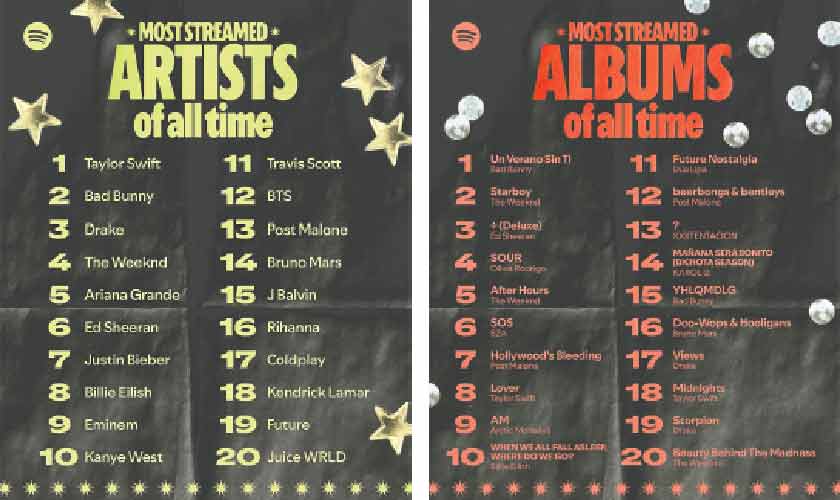
The names we
expected to see
What stood out the most was not who made the list but who did not.
Some of the most beloved, genre-defining artists in music history are either missing from this list or barely there. From Pakistan, Nusrat Fateh Ali Khan and Nazia Hassan, two artists who genuinely carried the country’s music to global reach before the emergence of Coke Studio and others, didn’t make the cut.
Globally, the gaps are just as striking. Adele, Ella Fitzgerald, Whitney Houston, Frank Sinatra, Amy Winehouse, Bob Dylan, Dr. Dre, 2Pac, Chris Cornell, Linkin Park and The Smiths. These aren’t niche names. These are people who helped build the musical language that the artists on this list grew up speaking.

According to streaming analysts, “global listening” on a streaming platform doesn’t measure cultural importance. It measures sustained listening within the platform’s lifetime. And a huge chunk of what made Whitney Houston or Bob Dylan extraordinary happened long before anyone had a Spotify account.
There’s also something a little uncomfortable baked into the structure of it all: the further back an artist’s peak, the less visible they become in streaming data, no matter how much they still mean to people. Patti Smith isn’t on this list either. She is, by almost any cultural measure, a towering figure. The algorithm just can’t quite see her from where it’s standing.
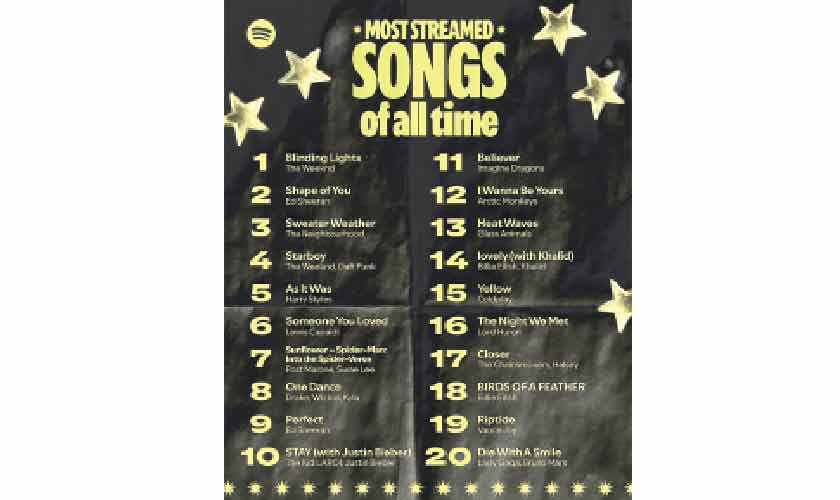
It’s not just about who’s great. It’s about who keeps getting played
Take Amy Winehouse. She is still referenced in interviews, covered by newer artists, studied in music schools, mourned in ways that don’t simply fade. But her catalogue is small. Three studio albums, a life cut short. In a streaming world that constantly pushes new releases into circulation, she simply can’t generate the numbers that an artist like Taylor Swift can, with her years of releases, re-releases or deluxe releases (with varied iconography) and high-profile re-recordings of past albums.
That’s not a criticism of Taylor Swift. It’s just how the math works.
Or think about Kendrick Lamar, the only rapper in history to win a Nobel Prize, whose influence on music, race and culture runs extraordinarily deep. That influence is real and widely acknowledged. But influence doesn’t always translate into the kind of consistent, high-volume streaming that moves a needle on a 20-year dataset.

What you get, then, isn’t really a record of greatness. It’s a record of habit. What people kept coming back to, again and again, inside one specific platform. Which is interesting data, genuinely, but it’s a very different thing from a cultural canon.
The generational shift is real
There’s another layer worth sitting with: streaming has genuinely changed who gets to shape global music culture. Younger audiences now have more influence over global charts than any generation before them, because the old gatekeepers: radio programmers, music journalists, label executives deciding what gets pushed, have largely been replaced by playlists and algorithms and whatever’s trending on short-form video this week.
“Take Amy Winehouse. She is still referenced in interviews, covered by newer artists, studied in music schools, mourned in ways that don’t simply fade. But her catalogue is small. Three studio albums, a life cut short. In a streaming world that constantly pushes new releases into circulation, she simply can’t generate the numbers that an artist like Taylor Swift can, with her years of releases, re-releases or deluxe releases (with varied iconography) and high-profile re-recordings of past albums. That’s not a criticism of Taylor Swift. It’s just how the math works.”
That’s not inherently bad. It’s just different. And it means the question being asked has quietly changed from “who is the greatest artist of this era?” to “who does a global digital system replay most often?” Those two questions don’t always have the same answer, and it’s worth knowing which one we’re actually getting.
It’s not a complete loss
Here’s the thing though, the list isn’t only a story of what got left behind.
If you zoom out, it actually reflects something kind of remarkable: music listening has genuinely opened up. Artists who might never have found audiences outside their home countries now have listeners everywhere.
Female artists in particular sit at the centre of streaming culture in a way that feels earned, built on real listener loyalty and emotional connection that translates directly into the kind of repeat plays that move data.
And then there’s the fact that podcasts and audiobooks have quietly settled into the same space as music. Listening has expanded as a concept. We’re not just talking about songs anymore, we’re talking about conversations, stories, ideas, all living in the same app, all competing for the same hour of someone’s commute.
The access is real. That matters.
What’s the list
actually saying?
Spotify’s 20-year global listening list is not a measure of greatest hits of music history. It’s a snapshot, a specific, data-driven, platform-shaped snapshot of what people have been pressing play on over roughly the last decade and a half.
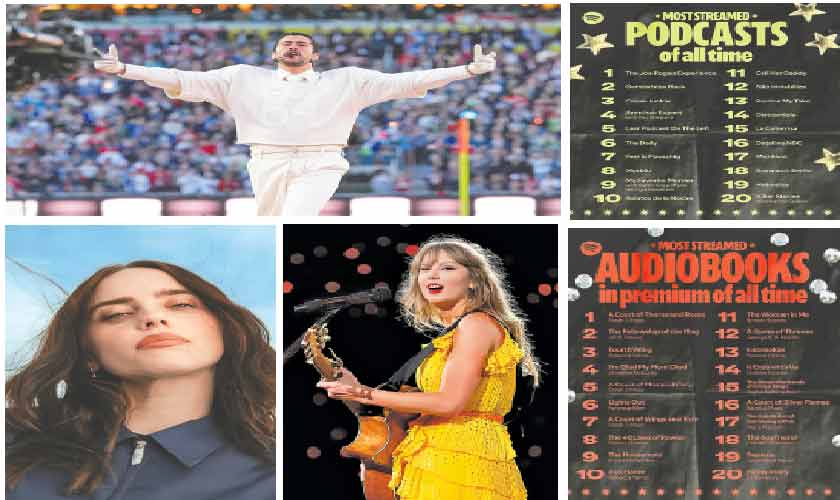
When a beloved artist doesn’t appear where you’d expect them, it’s almost never because they’ve been forgotten. It’s because the system doing the measuring was built for a different moment than the one when they mattered most.
Maybe the most interesting thing this list reveals isn’t about any individual artist. It’s about us, about how we consume music now, how we remember it and how we decide what survives. We’re not just passively inheriting music history anymore. We’re actively shaping it, one stream at a time, one skipped track at a time, one playlist at a time. And in that process, the record is being rewritten, sometimes beautifully, sometimes with real losses.
Spotify’s list, in the end, says less about who matters most and more about who the platform can still see. The rest of the story is still out there. It’s just not in the data.