Print Story
X




Since 2021, when a major audio streaming platform launched in the country, the way Pakistanis listen to music has shifted significantly.
| F |
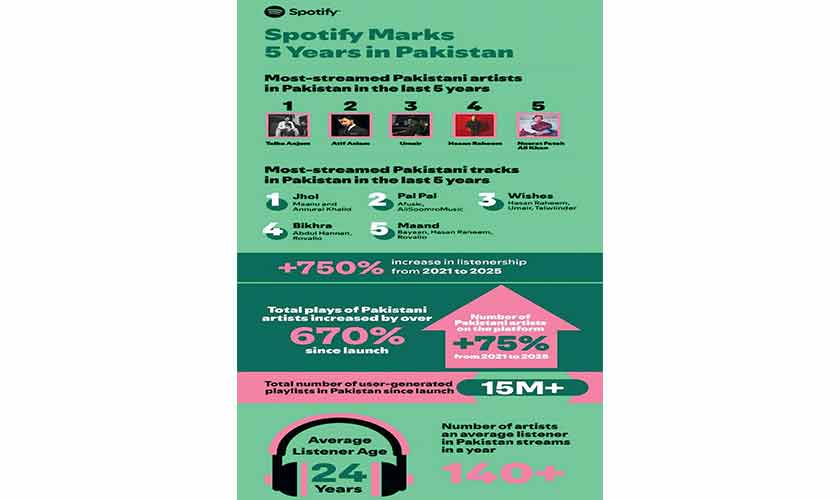
ive years ago, Spotify quietly landed in Pakistan. Today, it’s hard to imagine the country’s music scene without it. Since its arrival, the way Pakistanis listen to music has shifted in ways that feel both gradual and, when you step back, genuinely remarkable. Listenership is up more than 750%. Over 15 million playlists have been created not by the platform, but by users them-selves, people who are not just hitting play but actively building their own little musical worlds.
This isn’t just a platform metric, it reflects something simpler and more human.
Then there is the variety. The average listener in Pakistan now streams more than 140 different artists a year.
This is not someone sticking to a comfort zone, it is someone exploring. Discovery, it seems, has quietly become the default way Pakistanis listen to music, not something that happens by accident.
The genres reflect this too. Pakistani hip hop, pop, qawwali, regional sounds, fusion experi-ments; the lines have blurred.
The old radio-era loyalties, the idea that you were either a classical listener or a pop list-ener, feel increasingly outdated. Algorithms and editorial playlists have had a hand in that, but so has genuine curiosity.
Perhaps the most telling number: streams of Pakistani artists have grown more than sevenfold since 2021. Listeners are gravitating towards music that feels like home. You can see it in who’s topping the charts. Talha Anjum and Hasan Raheem sit comfortably alongside Atif Aslam and Nusrat Fateh Ali Khan. New releases and decades-old recordings coexist in the same listening session, often in the same playlist.
There is a fluidity to it that feels distinctly modern and distinctly Pakistani. Tracks like ‘Jhol’ by Maanu and Annural Khalid and ‘Pal Pal’ by Afusic and AliSoomroMusic have become part of a shared cultural soundtrack, the kind of songs that end up in everyone’s play-lists, not because an algorithm forced them there, but because they genuinely connected.
Spotify has also been deliberate about shaping this space editorially. Playlists like Pakka Hit Hai are increasingly becoming a pathway into the mainstream, while ICON Pakistan does something more thoughtful: it brings streaming-era favourites and legacy artists into the same space, letting them sit side by side instead of treating them as separate worlds.
The number of Pakistani artists on the platform has grown by nearly 75% since launch, which speaks to a widening creator base. Initiatives like RADAR Pakistan, EQUAL Pakistan and Fresh Finds Pakistan are part of Spotify’s effort to give that growth some structure, helping artists move from early discovery to something more sustained.
“Music has always been at the heart of culture in Pakistan, but what we are seeing now is a new level of connection.
Listeners are exploring more, discovering faster and showing up for homegrown artists in a way that feels increasingly significant,” said Rutaba Yaqub, Spotify’s Artist & Label Partner-ships Manager for Pakistan & UAE. “From emerging voices to iconic legends, there is real momentum behind Pakistani music today and it is exciting to see how that continues to grow.”
Five years in, this is not just a growth story, it is a recalibration. The question is no longer whether Pakistani listeners are open to discovering new music. Clearly, they are.
The more interesting question is whether the ecosystem: artists, platforms and audiences toge-ther can sustain this level of momentum as the space gets more crowded.
For now, the numbers point to a listening culture that is still expanding its boundaries.
Most-streamed Pakistani artists in Pakistan (last 5 years)
1. Talha Anjum
2. Atif Aslam
3. Umair
4. Hasan Raheem
5. Nusrat Fateh Ali Khan
Most-streamed Pakistani tracks in Pakistan (last 5 years)
1. ‘Jhol’ — Maanu, Annural Khalid
2. ‘Pal Pal’ — Afusic, AliSoomroMusic
3. ‘Wishes’ — Hasan Raheem, Umair, Talwiinder
4. ‘Bikhra’ — Abdul Hannan, Rovalio
5. ‘Maand’ — Bayaan, Hasan Raheem, Rovalio