Print Story
X




The third edition of the Diriyah Contemporary Art Biennale 2026 reveals how artists reshape time
| T |
ime is such an integral component of a community that without it, human interaction is impossible. We plan to meet at a certain hour; invite guests to weddings at a specific time of the day; and live by a routine framed within a timetable. People of a nation speak different languages, with variations in dialects and accents; follow multiple faiths; support opposite political parties; prefer a range of fashions; vary in the shades of their eyes, skin, hair and anatomy. But the community cannot operate without its consensus on this single entity: time, or it would be paralysed.
Time, the most agreeable element amongst a nation, actually is a human fabrication. Its feeble structure crumbles once you confront it physically. It happened to us while travelling to India. Every one of us joined the group near the Pakistani border at a sharp hour, and then started to cross the narrow white stripe that separates the twin countries. It was an eye-opening experience that, a moment before, our watches were displaying 11:35 am, and a second later, we had to fix them at 12:05 pm. Likewise, a person from Beirut says hello at 12:00 to their friend in Bogota, the answer comes immediately, but at 6:00 am Colombian local time.
Time is not only spread horizontally, but according to human beliefs, it advances in a linear sequence, too. The entire idea of history is based and calculated on a calendar, which encompasses nanoseconds, seconds, minutes, days, weeks, months, years, decades, centuries and millennia. This edifice of time is caged in a domestic device called a watch, a necessary invention for ‘civilisation.’ It is challenged by communities residing outside of this concept of history, like an unknown tribe from the Amazon, or from a remote Polynesian island, or an undiscovered tiny group from Africa. In holy texts, folklore, and popular imagination, time is adjusted in divergent formats. Chapter Al-Kahf (18.9-26) of the Qur’an describes the parable of some men and their dog, who withdrew inside a cave to sleep. Once they woke up and went to the town, they discovered that an undetermined length of time (a hundred years?) had passed.
Time is also dismantled in the practice of creative individuals, including writers, visual artists and film-makers, etc. Jorge Luis Borges, in his short story The Secret Miracle, creates a Jewish playwright, Jaromir Hladik from Prague, who is captured by the Nazis and is to be executed the next dawn. Hladik requests God to grant him a year to complete his play. The prayer is accepted. So the moment the firing squad shoots, time ceases to move and Hladik finishes his draft. Only once the text is finally edited and revised, the shadow of the fly shifts and the bullet enters his brain.
Fluctuating time is manifested in the installation of Raqs Media Collective (Jeebesh Bagchi, Monica Narula, Shuddhabrata Sengupta), Something Rare to Lose, 2026. The work is part of the 3rd edition of the Diriyah Contemporary Art Biennale 2026. Titled Fil hil wal terhal (In Interludes and Transition), the biennale, curated by Nora Razian and Sabih Ahmed, was held from January 30 to May 2, at the JAX District, Riyadh.
Raqs Media Collective’s installation is an immersive arena consisting of a hospital bed, a mattress with a pump, carpet, video on LED net mesh and stereo sound. It projects and overlaps details of the body, cells, hence fields of human cognition and “recognition of other bodies, in pain, in fading, in grief, in laughter, in love, that gather within consciousness itself.” Embodied “around a convalescence bed in a care facility,” beneath a mattress that expands and contracts, containing hand-blown glass lungs under a bell jar. Inspired by a dialogue between two Islamic polymaths, philosophers and medical theorists Ibn Sina (c.980-1037) and Al Beruni (c.973-1050), the Raqs Media Collective documents (or perhaps conjectures up) a conversation that has continued to our age; beyond the traces or restrictions of time.
Several other artists, part of the biennale, presented multiple versions, variations and possibilities of time. Hussein Nassereddine, in Years of the Shining Face: Time Objects (2026), retracts links of the present to the legacy of the past, or possibly a remote future, especially of the region which shares a common mode of communication, Arabic. Built as a stage-type setting with fibreglass, wood, LED lights and textile, the installation looks like a luminous dais for actors long disappeared in the drapes of the distant past. The viewer stares at a sculpted face, reminiscent of the Lady of Uruk – Mask of Warka, dating from 3100 BCE, possibly representing Inanna, the Mesopotamian deity of love, war and renewal. The haunting platform invites visitors to participate in a play that has been enacted in everyone’s life, in every situation, in every mind across continents.
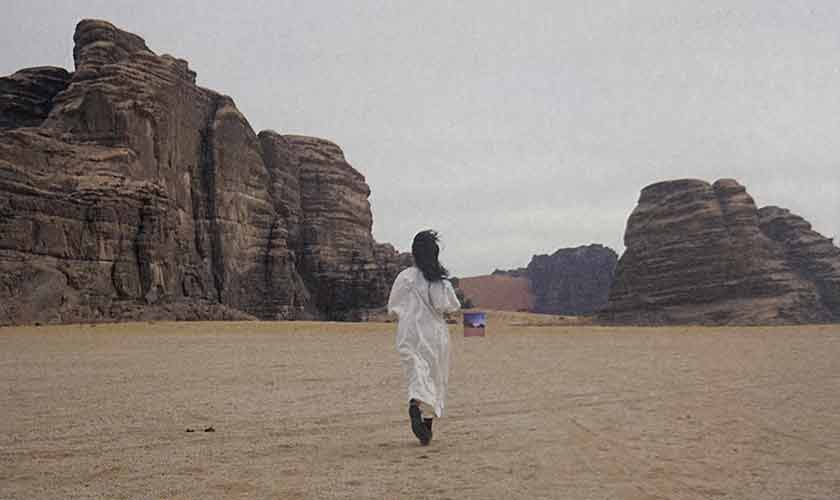
Suspension of time is also evident in Ahaad Alamoudi’s The Run (2025, video, colour, sound), in which a girl is running towards, rather inside, the sandy hills of Neom (the future city) of Saudi Arabia. The image of this sprinting woman is superimposed upon the static banner comprising the identical scene. Thus emanating a never-ending endeavour in a silent, unfamiliar and unidentifiable terrain – representing the futility of fate. In its appearance and sensitivity, the work is not dissimilar to the entry of another Saudi artist, Abdelkarem Qassem’s The Final Scene. This black and white video from 2017 maps a journey within the windscreen of a moving car. Though its duration is merely 1 minute and 14 seconds, gazing at it seems prolonged, besides sensing a loss, first manifested in diminishing details of the highway and later feeling of emptiness that everyone associates with. (Perhaps it is important to access the work knowing that, besides being an artist, Qassem is a psychologist serving in the Saudi Arabian Armed Forces.
The disappearance of a protagonist detected in the work of Alamoudi and Qassem resurfaces through a distinct, rather direct strategy. Ayman Yousry Daydban revisits Arab cinema posters, mainly from the mid-Twentieth Century, a genre comparable to the diction of neighbouring Bollywood and the Pakistani film posters. Those of us who encountered the sad years of forced virtuousness in Pakistan can recall the attitude of men acting in the name of faith, morality and tradition, hence attaining immense satisfaction by defacing the features of actors, particularly the female stars. (A hateful custom that resulted in throwing acid on the faces of females by some extremists) Another aspect of this censorship is vanquishing the voices of women, usually treated as vulnerable targets in a patriarchal society. Often, the hate towards them is unleashed through progressive rhetoric, political correctness and by pronouncing self-righteous judgments.
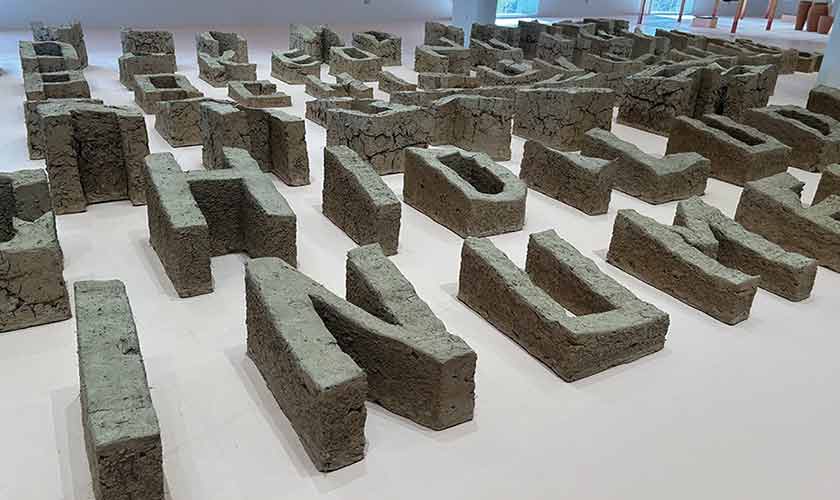
The attempt to suppress a section of society is not the story of one gender, place or period. It often happens systematically by other means too. One is aware of diminishing tongues every day and of marginalised people from unnamed territories around the world. Pio Abad, born in Manila, in his installation Vanwa, 2023-2026 (drawn from his Ivatan heritage), has constructed alphabets of the language of an indigenous group belonging to the Batanes Islands of the northern Philippines. The “floor installation of ninety-nine handcrafted sculptures of mud brick. Embodying vernacular building technique” all letters put together, spell out a traditional Ivatan poem, translated as: Bury me under your fingernails,/ that I may be eaten along with every food you eat,/ that I may be drunk along with a cup of water you drink.
These verses may be converted into the languages of all “those who,” borrowing a phrase from Pankaj Mishra, “uprooted from their old ways of being, must languish eternally in the waiting room of history.”
(Concludes)
The writer is a visual artist, an art critic, a curator and a professor at the School of Visual Arts and Design, Beaconhouse National University, Lahore. He can be contacted at [email protected].