Print Story
X




Quddus Mirza brings abstract expressionism into the world of language
| “T |
ell the rain/ not to tap on my windowpane/ with such savage fingers/ ... my soul is hushed at last/ my eyes are shut/ like battered petals, after a night of storm”
– Arpana Caur
The brutality of existing in a world that transforms its causes into a great farce is what Quddus Mirza reveals to the viewer in a suite of oil paintings on canvas and board, titled New Works, shown at Canvas Gallery in Karachi. He comes to this show with a change – a change that dissolves an object of art into a much harsher reality. Here, the painted and drawn forms are secondary to the disaster before you. Entering, you are within two parallel concepts of time, where space dissolves into the environment of the living dead.
The ontological intervention by means of presenting human beings as factual fragments of the human situation demands further elaboration. Mirza wants to fence every advance of the viewer with the idea that he is entering a work of art. Instead, he wants one to be thrown into the problem that threatens the wholeness of life. Perhaps it is due to such a conviction that Mirza avoids every touch of the magical nature of art when the two orders of objects - live and painted - are put together. Any kind of synchronic balance is totally disseminated. The objects - such as pieces of clothing and furnishings - exist separately, as carriers of powerful ideological impressions.
One may insist on reading the paintings as an aggregate of formally disjointed and disorganised forms. However, the objects are put together metaphorically to suggest their social/ domestic function in quotidian life; a kind of reconstruction of inherent relations, balances and imbalances interwoven in the memory of human culture.
Art is a creative bridge between our imaginative vision, which tends to recreate the primal human condition and instinct and our current artistic sensibility, which responds to the existential paradoxes ingrained in the human psyche. There is a powerful dynamism behind the frozen immobility of a work of art. Any work, thus, is a tryst between the past and the present, which in turn, points prophetically to a future. Long ago, Baudelaire exalted the painter’s savagery in the most lyrical terms. Savagery remains the key point only in a segmented world of humans where the struggle for existence and survival is limited to physical prowess. Even in the esoteric universe of the mythical pantheon, the setting is as human as we can imagine it to be. There are struggles, wars, hostilities and confrontations. These may well be equated with the human situation in the terrestrial world, which conjures up similar images of conflict.
Childhood depicts a world of fantasy, dependence and, in part, the desire to emulate. Fantasy is the child’s creative response in terms of images and feelings to the environment and situations in which the child happens to be drawn, by some irony of fate. How does a child respond to growing up in a war zone, displaced, shelterless, famished? What kind of images invade his psychological landscape when he witnesses corpses, blood, missiles, drones, mourning and warplanes hovering above his head? One recalls the War Rugs woven in Afghanistan by Baloch and Turkmen tribes-people and their children during the Soviet invasion, replete with naïve representations of helicopters, F-16s, Kalashnikovs, guns, tanks and maps.
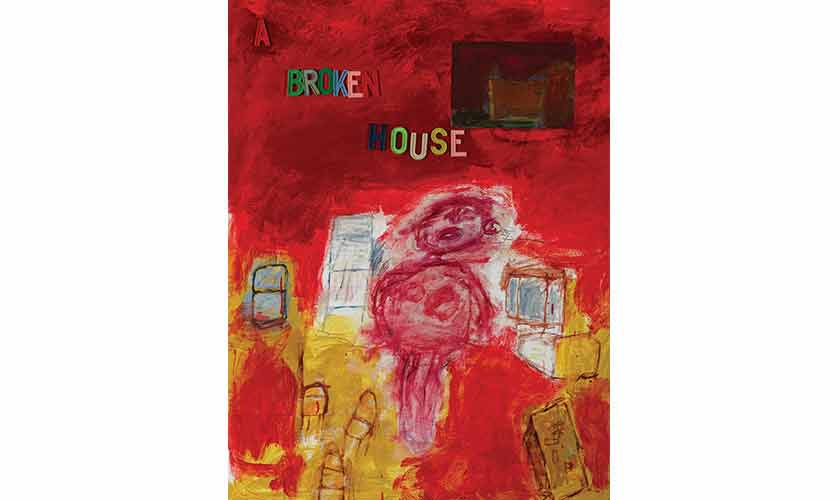
With its spurts and scrawls and gougings and scribbles, Mirza’s is an act of desecration and vandalisation, of bringing the language of abstract expressionism out of the realm of personal expression and into the world of writing and language. The signs in question are ones that would be familiar to any playground doodler: ejaculations of paint, the crude violence and the obsessional formulation of bodily parts. Over the surface of his paintings appear so many wounds and scorings, so many tatters played over that its body can never be reconstituted, whole. A number of these works consist of little other than an inscription. Mirza writes as if he were seeking out the meaning of the poetic words through the physical act of producing their graphic signs. A word, as disembodied sign, becomes the word as embodied mark, imbued with the spirit of a gesture and located within a particular place and time.
Around it teem all sorts of little images, sketch pads, colour pencils, just as we might draw them for simple recognition by children. Writing is mutating into drawing, drawing into doodling and back to writing in a free-floating panorama. The marks give a pure and primitive pleasure; the canvas itself feels airy. On occasions, the artist seems to be reflecting on the artist himself in a scattered domestic interior with material, drawers, shelves, mugs, an ironing table, a plugged-in heater and other paraphernalia strewn around.
Tides of bottomless green, raspberry ripple, crimson lake seeping into the canvas. What makes Mirza’s paintings so distinctive is the way they steer their improvisations into outright chaos that is not susceptible to much analysis. His marks, hesitant, agile, subtle, quick-tempered, awkward, work together to give off a mood and a message. In this respect, the experience of seeing them is deep but wordless. Even as they mount up in scarlet whirls, they appear to be dying away. The action is something like a fountain, rising even as it falls, yet that doesn’t explain the full effect. They are, like the show itself, running a fine line between happening and grief. Someone described Quddus Mirza’s work as ‘pictorial journalism.’ The action in his work is topical enough in that it reflects the preponderance of recent atrocities, but he is not a chronicler. Even a work like Black Birds with history so uncomfortably close behind it is not journalism.
Into this wilful chaos, the artist brings scrawled references to half-finished drawings and barely legible quotations, all of which signify magpie imagination. Like Roland Barthes remarked that Cy Twombly’s scrawled words aren’t really writing but an idea of writing. The words here don’t want to be read: they want to be experienced.
The writer is an art critic based in Islamabad