Print Story
X




Wars do more than kill people and cause destruction. They also push climate and development goals further out of reach
| I |
n his 1994 book Pale Blue Dot, Carl Sagan, reflecting on Voyager 1’s 1990 image of Earth from deep space, wrote: “Look again at that dot. That’s here. That’s home. That’s us.” He went on to remind readers that on that tiny speck live “everyone you love, everyone you know, everyone you ever heard of, every human being who ever was,” and that the image should deepen our responsibility “to deal more kindly with one another and to preserve and cherish the pale blue dot, the only home we’ve ever known.”
As Earth Day 2026 approaches, that message feels urgent.
The world speaks often about sustainability, climate action and the sustainable development goals. Yet, the same world continues to accept war, occupation and military coercion as normal instruments of power. That gap between stated commitments and actual conduct sits at the heart of the present crisis.
The reason is clear enough.
Global power still rests heavily on military reach, political influence and unequal control over territory, resources and institutions. Weaker societies continue to bear the heaviest burden. They absorb the destruction, the displacement, the polluted air and water and the long reconstruction that follows. They also lose years of development while stronger states continue to speak the language of order, security and stability.
The climate cost of war is no longer hidden.
Russia’s invasion of Ukraine has generated an estimated 311 million tonnes of carbon dioxide equivalent since February 2022. Those emissions come from military operations, damaged energy systems, fires, displacement and reconstruction. The number is staggering, but the underlying point matters more. Modern war produces emissions at every stage. It burns fuel during combat, releases pollution through destruction and locks in further carbon through rebuilding.
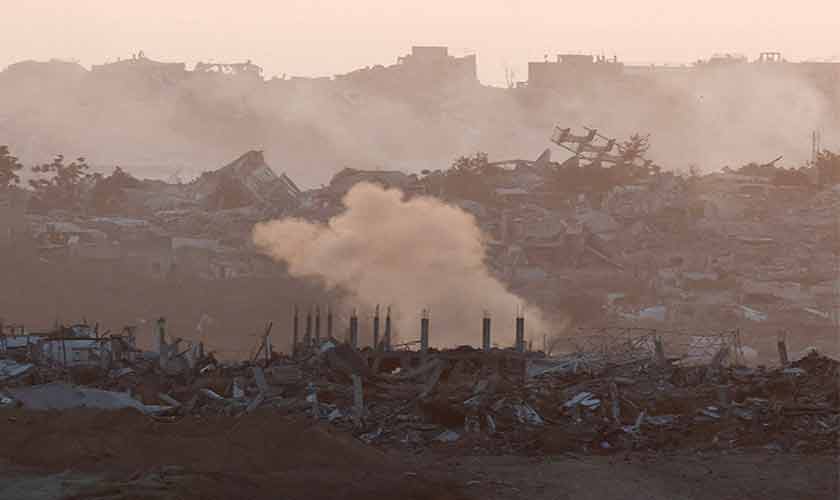
Israel’s war on Gaza has shown the same pattern in a smaller and far more devastated territory. Gaza is occupied territory. The scale of force used there has produced widespread destruction. Research has estimated that the first year of the war on Gaza generated around 33 million tonnes of carbon dioxide equivalent, roughly comparable to the annual emissions of Jordan. That figure reflects bombardment, fuel use, debris, emergency operations and the reconstruction that will follow. It also points to something larger. Climate damage in Gaza cannot be separated from the political reality of occupation and the unequal conditions under which Palestinians live and die.
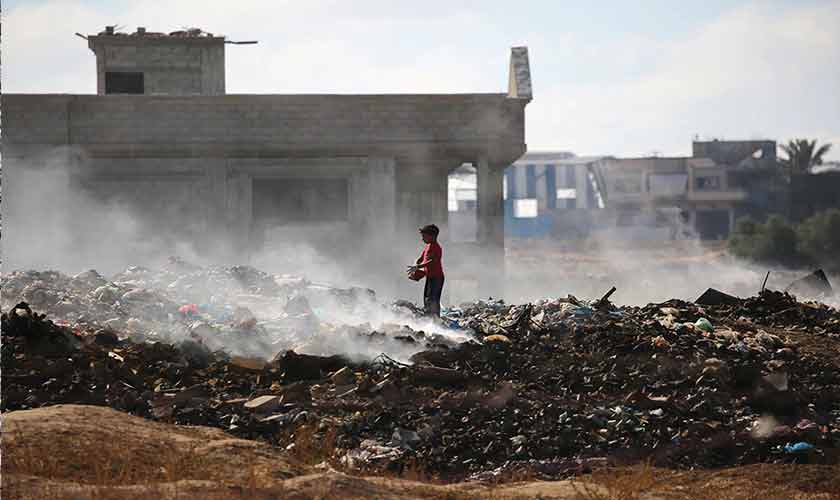
The war on Iran has underlined another aspect of the problem. When oil depots, energy installations and industrial facilities come under attack, the environmental damage spreads quickly. Toxic smoke fills the air. Public health comes under strain. Essential services are disrupted. Emissions rise further. The effects do not remain confined to military sites. They spread into civilian life and surrounding ecosystems, often with lasting consequences.
Wars like these do more than kill people and destroy cities. They also push climate and development goals further out of reach. The sustainable development goals were meant to guide action on poverty, health, education, water, inequality and climate by 2030. In conflict zones, these goals become a mirage. Schools are damaged or closed. Hospitals are overwhelmed or destroyed. Water and sanitation networks break down. Food systems are disrupted. Public institutions shift from long-term planning to emergency survival.
Reconstruction adds to the problem. While rebuilding after war is necessary, it comes with a heavy cost. Funds that could have gone to poverty reduction, public health, climate adaptation, renewable energy or better education are redirected toward replacing what bombing has destroyed. Repairing a hospital is not the same as expanding healthcare. Replacing a school is not the same as improving education. Restoring power lines is not the same as investing in a cleaner energy system.
Reconstruction restores part of what was lost. It also delays the future.
This is where the wider international order enters the picture. Recovery in weaker or occupied territories rarely depends on local need alone. It is shaped by the same power structures that failed to prevent destruction in the first place. Aid is delayed, limited, politicised or attached to strategic interests. Some populations are rebuilt quickly. Others are left in protracted ruin. The result is a world in which the right to recover is also unevenly distributed.
The Marshall Plan remains useful here as a historical reference. It was not a perfect model and it cannot simply be copied into the present, but it recognised an important principle: societies shattered by war need more than temporary relief. They need long-term investment, functioning institutions and a path to social and economic recovery. That principle still matters. Children growing up in bombed-out societies should not face permanently diminished life chances because they were born in places exposed to the violence of stronger powers. Recovery should be built around equal human worth, not geopolitical convenience.
The same imbalance appears in climate governance. Military emissions remain poorly counted, only partly reported and largely outside serious public scrutiny. This gap reflects political protection for powerful states and their armed institutions. Governments ask households, industries and cities to measure and reduce emissions, while one of the most carbon-intensive parts of modern state activity still escapes full accountability. A climate agenda that ignores militarised power leaves out a major part of the problem.
The policy lessons go beyond counting emissions. Military emissions need to be fully counted, independently verified and brought within national climate obligations. Even that will fall short if military spending continues to rise and the destruction of weaker societies remains politically tolerable. Civilian water, health and energy infrastructure requires stronger protection in law and much stricter enforcement in practice. Reconstruction should be used to build cleaner, more resilient and more equitable systems, not simply to restore pre-war fragility. Climate and development policy, in short, has to engage with militarised power itself. Without that, sustainability will remain an aspiration constrained by the very structures that keep fostering war.
The contrast in human capability and ambition is striking. The Artemis mission around the moon, which took place as strikes on Iran intensified, showed that long-term planning, scientific cooperation and collective ambition remain possible. Humanity still knows how to organise knowledge, money and political will around difficult goals. Yet, those same capacities are not being brought to the work of peace with anything close to equal seriousness.
As Earth Day approaches, the issue is larger than the familiar claim that war is destructive. Stronger states still project force, sustain occupations and set terms that weaker societies are expected to endure. The human cost, the environmental damage and the lost development fall most heavily on those with the least power over the decisions that shape their lives. A serious commitment to sustainability has to confront that structure directly. Without that, the language of climate action and global development will continue to sound better than the world it describes.
The writer works on the intersection of climate, water, ecology and society. He can be reached at [email protected].