Print Story
X




To reduce vulnerability, local communities rely on their own resolve and efforts, not central climate policies
| S |
ea level rise is climate change in slow motion. One might ignore its advance—measured in centimetres—but it redraws shorelines, contaminates drinking water and weakens local economies. The IPCC says global mean sea level rose by 0.20 metres between 1901 and 2018, and that the pace has accelerated recently. Even with promised cuts in greenhouse gas emissions, sea levels will continue to rise for centuries because the oceans and ice sheets respond slowly.
In Pakistan, we usually talk about climate risk in terms of floods, heatwaves and glacial melt. Our coasts often get neglected in this conversation. In the Indus delta, sea level rise combines with a man-made squeeze on freshwater and sediment. The World Bank notes that reduced downstream environmental flows have weakened delta fisheries. The cost of environmental damage to the delta is estimated at $1-2 billion a year. In effect, climate change is being amplified by weak water governance and social inequality.
Fortunately, local communities do not wait for water governance or social inequality to improve. They rely on their own resolve and efforts to reduce their vulnerability.
Case in point, Keti Bandar.
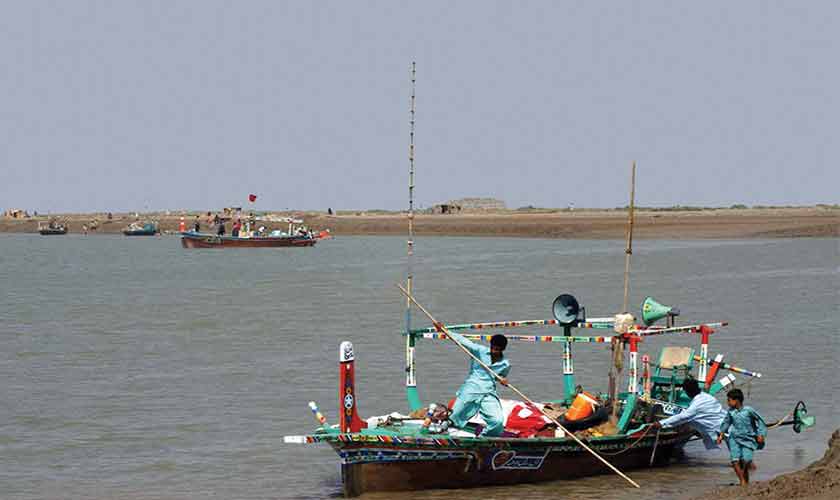
This coastal town in Thatta district once lived off the bargains struck between river and sea. Land erosion, rising sea levels and a severe lack of freshwater for agriculture were affecting all aspects of life. Livelihoods still depended on fishing, crab farming, jellyfish and what remained of farming and livestock rearing. Most young adults worked in farming, fishing or animal rearing. Most said it was difficult to earn enough to feed a family.
Climate change exposure has been aggravated by an economic trap. Some fishermen are caught in debt cycles under leasing arrangements and fear leaving Keti Bandar because of the risks it could pose to their loved ones. They are now tied to the global fisheries market, which pushes local fishers to spend more on equipment and working capital and leaves them more exposed to brokers. Climate shocks hit harder when households are already bound by debt, weak bargaining power and poor infrastructure.
Keti Bandar also shows the limits of the language Pakistan often uses about climate migration. The picture is not one of a single outward march. The town has been receiving people from nearby islands that became uninhabitable because of rising sea levels. At the same time, there is out migration. Poor communities on the climate edge do not always ask to be moved. Many ask for the means to remain in place with dignity and safety.
Local agency is visible.
There are mangrove nurseries, an improved system for the delivery of safe drinking water and reliance on new livelihoods as adaptive measures that have helped the community continue living in the area. Access to electricity through solar panels has also improved conditions.
Vulnerable communities should not be treated as passive recipients of relief. They should be treated as governing partners in adaptation.
The solar panels were installed by the community on its own, not provided by the state. For this community, adaptation begins not with official design but with citizens rising to the occasion.
The strongest local response in the delta is ecological and economic at once. They are trying to increase the mangrove cover. Mangroves protect coasts from erosion and sea intrusion, support fish and shrimp breeding grounds and provide material value to poor households.
A 2025 study of the Indus delta found that mangrove cover increased from about 50,973 hectares in 1990 to 101,446 hectares in 2023, with lower fragmentation and stronger connectivity across the landscape. The WWF reported last year that officials and conservation groups credited these gains to collaboration among public agencies and local communities. Pakistan already has evidence that damaged ecosystems can recover when restoration is tied to local effort.
Mangroves do not survive on plantation drives alone. They survive when coastal households have a stake in them.
The WWF’s village development initiative in Keti Bunder argued years ago that women needed a greater role in natural resource management and local development. Women’s groups have trained in mangrove plantation, nursery raising and monitoring. Participatory fisheries management and alternative livelihoods were needed because fish resources were depleting rapidly. The National Climate Change Policy says much the same. It calls for adaptation measures based on local and indigenous knowledge and for the empowerment of women’s groups and networks.
That is the policy lesson from Keti Bandar. Vulnerable communities should not be treated as passive recipients of relief. They should be treated as governing partners in adaptation. In practice, this means secure access to fresh water; support for community stewardship of mangroves and fisheries; credit that does not deepen debt bondage; local energy systems; and women’s economic mobility beyond unpaid care and casual labour. It also means district level planning that begins with those who know the ecology because they live inside it. Adaptation is most durable when it protects livelihoods and natural systems together.
This argument extends beyond the town.
Pakistan should resist a climate policy that is too centralised, too project-driven or too eager to speak in the language of ‘resilience’ while leaving frontline communities short of assets and authority. The country does not lack local wisdom. It lacks a habit of financing it. Small adaptation grants for community organisations; locally managed restoration funds; women led producer groups; and stronger local government will do more for climate security than another cycle of announcements from above. The state should provide capital, public services and legal backing. Communities should help shape the priorities and hold institutions to account.
Sea level rise will continue whether Pakistan pays attention to it or not. Community-led adaptation can become a way of defending both livelihoods and the living world in which those livelihoods thrive.
The writer is a research fellow at the ECOLOG Institute, Germany.