Print Story
X




In Knife of the Tide, Adrian A Husain returns to the sonnet to examine how the past survives in the present
| T |
he turn to the sonnet form began with Italian Window, Adrian A Husain’s 2017 collection. A conversation with his close friend and fellow poet Jeeva Haroun brought up the Italian coastline. With that chance remark, he recalls, memory came rushing back and the poems instinctively took shape in the sonnet form. Italian Window marked the beginning of an exploration of memory: a return to a period in the poet’s early life spent in Rome – a time of luxury and decadence but also of betrayal and trauma linked to his father’s infidelity.
Prior to this, Husain’s poetry had consisted of short lines and compressed images, in which scenes of nature or the urban world often carried a prescient, ominous undertow. In these poems, the voice is almost impersonal and detached.
You are tricked into it –/ an early autumn scene/ with a covert allure.
Leaves rustling/ almost artfully/ a copse displays
rare vibrancies of/ colour/ livid grades of green.
…
Here you come/ unknowing perhaps/ not
exactly sure
to be trussed/ on the
ground/ in a row…
— Srebrenica Video, shown at the International Court
at The Hague
In this latest, late-life collection of sonnets – divided into four sections that loosely map the passage of time – Husain probes memory as it is refracted through the present and set against the past. Through scenes recalled from childhood and adulthood and through ‘portraits’ of family members and friends, memory emerges as something at once concrete, shifting and uncertain. These deeply personal poems, in which the poet’s voice is fully present, also place him firmly within time and history.
With a classical education at Oxford, Husain studied Shakespeare and absorbed both the literary tradition and the work of modern poets, in the spirit of TS Eliot’s essay Tradition and the Individual Talent. Eliot argues for the necessity of engaging with the historical body of literature before reshaping it into an individual voice. Although Husain works within the Shakespearean sonnet form – “I keep within the rhythm and structure of the form; the song element must remain” – he makes of it something distinctly modern. There is a jewel-like quality to his evocations of colour, sound and light; it is through recollection, often set against the present moment, that he reanimates experience.
Subject to intense flashbacks and moments of heightened, almost visionary perception – for him, “the world is always already past” – each poem recreates a scene or place, often setting it against the present or using the flashback to interrogate both past and present. In Egg, from the first section, and Severing, which references the Partition, he recalls an early childhood memory:
For a reader familiar with Husain’s work over the years, this is a masterful collection in every sense.
Past images return… / …when I sat / with Grandfather in the forecourt – … / watching him at / breakfast and an egg, the yolk, tapped / open – a sacrilege waited for – and lost / in its flow, sunset spilt across a plate.
In Gstaad – Slalom, from the third section, What images return, O my daughter, Husain notes that the final six lines came to him in a dream at 5:30 am, which he quickly jotted down so as not to lose them. The poem begins:
Those were days of snow – and light – and trees
–and lordliness and
decadence –when I went
to the mountains with the school…
It concludes with those
dreamt lines:
I still recall the pleasure
on the slopes,
the abandon of the skiers,
the dance,
the oneness with the medium, fate
and chance mingling.
If canine, there was still
hope in the sight.
Trapped halfway down,
I saw
the light, hesitant,
catching in the snow.
In the final sonnet, Rose, from the section titled Post res perditas, Husain is both visionary and philosopher, wondering:
…where our memories live / or come from… / …do they wander in and, bee-like, find stems / to settle on, neglected flowers, hives / to make honey? … / A flower appears, yellow, in full bloom, and, though just images, begets a storm in the head, returning in a rush a forgotten fragrance… / I ask myself: is the world – sky, cloud – / merely a thing recalled, an elevated revenant… / and the sights… / all there but as a trick of memory.
For a reader familiar with Husain’s work over the years, this is a masterful collection in every sense: in its re-engagement with form, in its layered exploration of memory and in its evocation of personal and historical experience, including the lingering trauma of Partition. Each poem creates a scene, the images flowing and interweaving with quiet assurance. After the music has been absorbed, the reader is left with a heightened sense of history and a searching awareness of what makes us who we are – and, ultimately, with a lingering sense of the mind’s fragility.
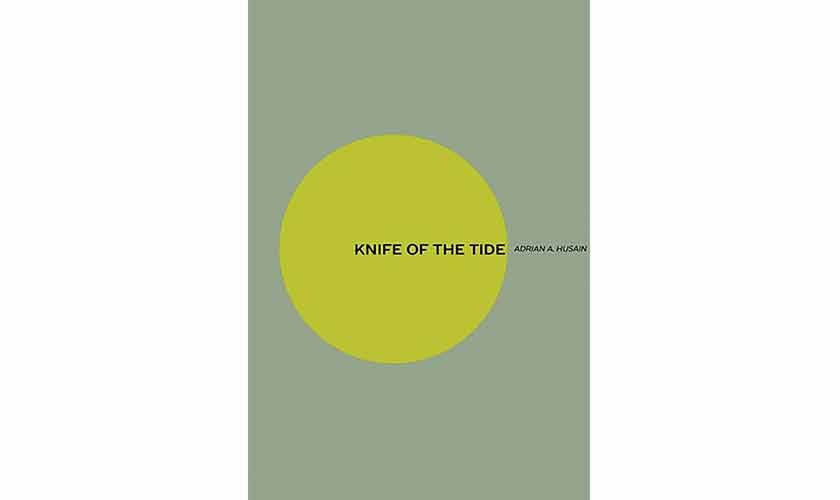
Knife of the Tide
By Adrian A Husain
Publisher: The Peepul Press, 2025
Pages: 102
The reviewer is a poet and editor, working for The Aleph Review. She has recently co-edited an anthology of poetry for Alhamra Publishing.