Print Story
X




Ghalib reshaped poetry by turning emotion into thought and metaphor into inquiry
| O |
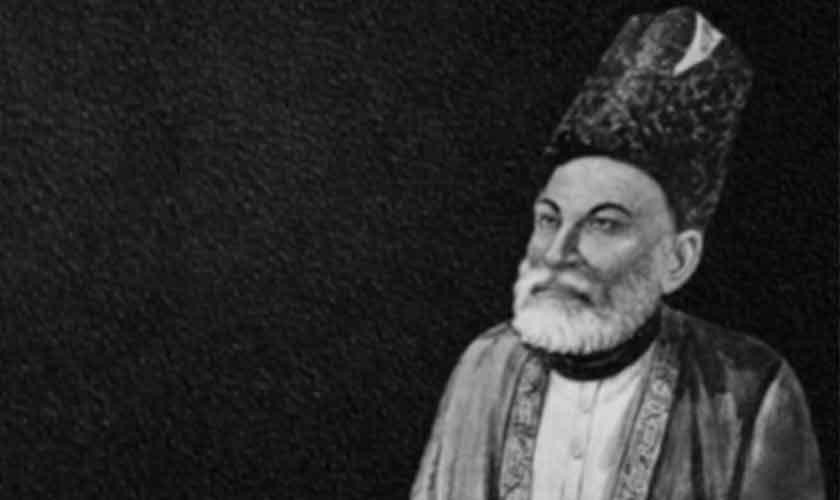
ne of the reasons for Ghalib’s enduring importance is that he radically transformed the very concept of poetry. In classical Urdu and Persian poetry, metaphors, themes and emotional frameworks were largely predetermined; Ghalib’s great achievement lies in that he thoroughly destabilised the semantic foundations of these fixed structures. As a result, love in his poetry ceases to be merely an inner emotional experience and becomes an intellectual problem. Consequently, the beloved sheds its purely metaphorical status and turns into a philosophical question. This interrogative quality enables Ghalib’s personal experience to emerge as a source of universal meaning. In this way, Ghalib’s poetry anticipates modern consciousness, a consciousness in which poetry appears not merely as a mode of expression but also as a medium of reflection:
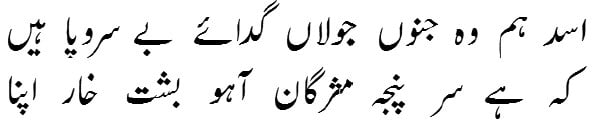
In the first line, the poet establishes an aura of self-address by catalysing his pen name. That is, restlessness refers to a state in which the boundaries of reason and social norms collapse, as a result of which a person becomes restless in the pursuit of love or truth. Therefore, the word ( beggar) here, despite its literal sense of financial poverty, appears as a symbol of existential and intellectual helplessness. Similarly, the poet’s act of going barefoot points to his social powerlessness. Perhaps for this very reason, Ghalib presents himself here as a kind of ecstatic figure who is completely indifferent to worldly ranks and hierarchies.
The second line of the verse appears to be entirely metaphorical. Here it scarcely needs to be stated that in Urdu and Persian poetry the deer is regarded as a symbol of beauty, gentleness and delicacy, and that the eyelashes signify this very fragility. We also know that (grip) is generally understood as a symbol of power and control, but in Ghalib’s usage, this grip seems to rest upon something as delicate as the eyelashes of a deer. Therefore, through the image of something as hard and painful as a thorn, Ghalib conveys the meaning that his reliance does not lie on a strong arm, but is instead founded upon a grip as weak as the eyelashes of a deer.
More or less the same hypothetical repudiation of power is evident in William Blake’s poem The Tyger, where, on the surface, the tiger is made a symbol of strength, awe and fear. In other words, the intellectual core of the poem rests on the question of who created this terrifying power and what kind of moral complexity lies behind it. Thus, in Blake’s poem, power, rather than being a simple form of superiority, itself becomes a question. By contrast, in the aforesaid couplet by Ghalib, a clear denial of power is visible. Therefore, the poet unequivocally declares himself to be a helpless, barefoot beggar. His support does not rest on a steel-like arm or political force, but rather on something as dainty as the eyelashes of a deer. In short, where Blake questions power, Ghalib rejects it altogether and turns weakness into his existential identity.
Reading Ghalib is also essential because he repeatedly raises some of the most complex questions of metaphysics. A study of his poetry reveals that his concept of God is not confined to doctrinal belief or traditional mysticism. Hence, he both converses with God and voices complaints against Him. For this very reason, in Ghalib’s poetry, the boundaries between faith and denial, at a certain level, almost dissolve. As a result, a mental state comes into being in which neither certainty can be fully achieved nor does doubt remain meaningless:
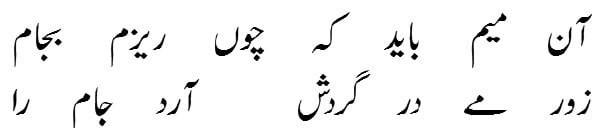
In the aforementioned verse by Ghalib, wine and goblet may appear, on the surface, to be conventional metaphors of Sufi poetry, but on a metaphysical level, their meaning is not confined merely to wine and the cup. Rather, here wine becomes a symbol of the absolute essence or the very substance of being. For this reason, the goblet likewise comes to signify the realm of possibility or human consciousness. The poet’s point is that the wine should be of such a nature that when it is poured into the goblet, the goblet does not remain a passive vessel but is instead fully set in motion by the very force of that wine itself.
Love in his poetry ceases to be merely an inner emotional experience and becomes an intellectual problem.
Thus, underlying this conception is the clear idea that when the primal essence of being manifests itself in a form, that form acquires activity and self-awareness from within. This notion appears to be closely aligned with Ibne ’Arabi’s doctrine of wahdat al-wuj d (the unity of being), according to which real existence, through its self-disclosure, sets the realm of possibilities into motion without any external intervention.
This verse essentially clarifies the metaphysical principle that the true motive force lies not in the vessel but in the essence. Here, the rotation of the goblet symbolises the idea that when a human being is graced by the Absolute Reality, their existence does not remain inert; rather, it becomes suffused with consciousness and creative energy. The poet gestures toward that stage of in which the ego dissolves so completely that all existential movements of the individual are no longer their own, but instead become manifestations of the absolute reality. For this reason, the rotation of the goblet in the verse gives rise to the meaning of a “dance of existence,” a movement generated not by any external compulsion, but by the force of inner truth.
This verse renders the relationship between cause and effect, and between existence and possibility, in an exceptionally subtle and meaningful manner, where the true excellence lies not in the goblet but in the wine that sets even the goblet into motion. A similar condition is articulated in John Donne’s poem Ecstasy:
Love’s mysteries in souls do grow,
But yet the body is his book.
Just as, in Ghalib’s verse, the wine causes the goblet to revolve, so too in Donne’s poetry, spiritual love endows bodily existence with meaning. That is to say, the body does not move or signify on its own; rather, it becomes animated and meaningful through the force of the soul:
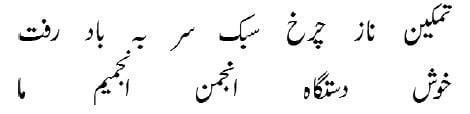
In the first line of the verse, the reckless wheel symbolises the ancient astronomical conception according to which the heavens were believed to be in a state of constant restlessness and rotation. Thus, the meaning of headstrong here is not merely rapid movement, but a form of unstable, directionless motion in which no enduring centre or stillness remains. Against this backdrop, the poet states that our (existential calm and inner stability (has been completely trampled by this celestial rotation. On a metaphysical level, this feeling points to the reality that the cosmic motions of the phenomenal world strip human beings of all outward support upon which they base the stability of their existence. In this way, the restless rotation of the universe deprives human beings of their apparent certainties and confronts them with a profound existential anxiety.
In the second line, the poet introduces a meaningful and unexpected reversal. He presents himself as the master of the realm of the celestial assembly, that is, the assembly of stars, where an instrument of power becomes a symbol of authority, rank and centrality. Through this claim, the poet establishes an inner heaven in opposition to the external sky. The implication is that although the material and celestial order has shattered our outward composure and calm, at the level of inward reflection, our existence still retains dignity, meaning and a central position.
An extremely significant metaphysical point emerges here: in contrast to the instability and constant flux of the universe, there exists within the human interior an ontological centre that transcends the revolutions of the heavens. Perhaps this is why, in Sufi thought, the Perfect Man has been described as a microcosm, that is, a being who encompasses within its inner structure the spiritual and metaphysical values of the macrocosm.
The verse generates the meaning that although the revolutions of the heavens may disrupt a person’s outward order, they can never annihilate his inner centre. It follows that the true essence of the human being stands far above the superficial transformations of time and space.
The writer is a poet and a critic. He is an assistant professor of Urdu at Chhatrapati Shahuji Maharaj University in Kanpur, India, and the author of three books.