Print Story
X




From Mughal workshops to AI tools, the question of authorship in art has never been simple
| R |
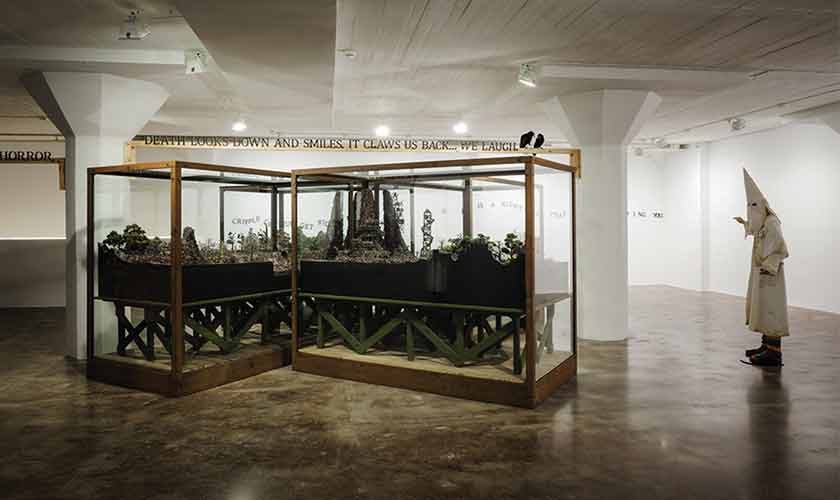
ecently I set my eyes on a work from 1994. This photographic print comprised a clip from a Pakistani romantic film. The artist selected a specific sequence that illustrated the power and impact of popular cinema. The picture is enclosed in a converging rectangular frame, containing randomly composed low reliefs of tiny domestic toy objects that were available in Karachi markets during the last decade of the past century. The frame was cast by a contemporary artist, a sculptor whose practice involved exploring the language of popular pictorial practices.
The work of two artists, one employing the central image to narrate a piece of content that was in harmony with the diction of the second artist, since both focused on transforming ‘low art’ into ‘high art,’ was an attempt to represent that significant chapter now called Karachi Pop. The movement included other artists too. To an extent it still survives in the aesthetics of its original exponents and followers.
What I saw with a dealer had been sent for evaluation, leading to its sale by the current owner, a fellow painter of the maker of the piece, who bought or acquired it in exchange for his canvas. Compared to a more compelling issue, it is hardly important what value was assessed for the work: who was the sole author of the work? Of course, artworks from a similar series and the same phase shown elsewhere are labelled with the artist’s name, understandably without acknowledging the contribution of the person who constructed an essential component of the work, the frame.
For those from that era of Pakistani art, the situation is not a simple one. Is it the creation of a single individual, or of two, or a collaboration between them? In the case of the last two conjectures, how are roles, positions and contributions divided? The question does not merely deal with posterity. It also concerns hard cash, which may sprout a further dispute between the two artists who have long parted ways.
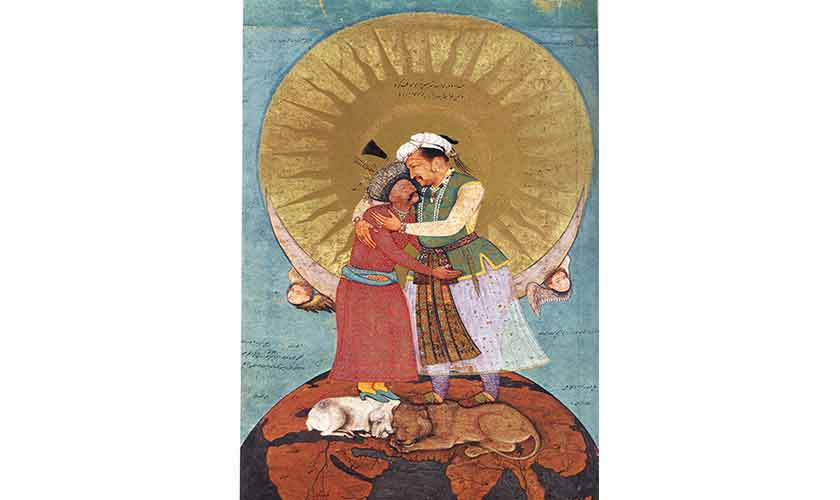
There exist several such examples in the history of art: for instance, miniature paintings produced during the Mughal period. A majority of these contain thematic views within exquisite borders, illustrating outlines of animals, spreads of flowers, arrangements of patterns and the insertion of calligraphy. All are forms of art in their independent aspects, yet in the few works signed by painters, such as Bitchitr, Abul Hasan and Manohar, the names of border makers are missing.
The atelier for making miniatures was called a karkhana (workshop), essentially a place for multiple artists busy assembling a work of art; a tradition not dissimilar to the studios of Renaissance painters and sculptors, where pupils prepared initial layouts, chromatic schemes, necessary details and the division of background, ready for the master to add his strokes, finish it and bestow his identity and authenticity on a work born out of many pairs of hands.
In our age, completing monumental paintings, huge sculptures and complex installations is not imaginable without involving studio assistants, often struggling professionals, young graduates and eager students, as well as technical help and expertise. Some of them later become artists of stature. Contemporary British artists Jake Chapman and Dinos Chapman, the Chapman brothers, spent several years after their studies as studio assistants for Gilbert and George. Today they are recognised as major representatives of contemporary British art.
A small number of Pakistani artists have also engaged their former students as studio help. Paid or voluntary, this kind of job was perceived as an extension of formal training after art school. A leading modern artist invited one of his students to delineate initial geometry, shapes and structure, further to be developed by the genius. Another major artist of our times asked his students to do basic, though paid, work to execute a number of commissioned painting projects, besides hiring them to draw preliminary visuals thoroughly mapped by the artist on his canvases, subsequently included in his one-person exhibition. The list continues with former students finalising hard-edge paintings as devised by well-known artists, or artisans jointly manufacturing large-scale imagery on layouts provided by successful artists.
This practice can be compared with architecture. An architect sketches a building, its mechanical drawings are realised in their office, and it is built by contractors, masons and labourers. Yet the building is known by the name of the architect, who occasionally receives an award for the creative achievement. However, there is a difference because a piece of architecture never requires the architect’s physical presence to materialis, but a painting, sculpture, print or miniature conventionally bears the imprint of the human hand (unless it is machine-made or produced by a team of trained individuals).
These days, a young painter who hails from the Hazara community of Quetta is a highly sought-after person, since he holds immaculate skill and incredible speed in putting the first stages of painting on any surface. He is repeatedly summoned by other artists to exploit his exceptional talent. Due to his efficiency, perfection and precision, the young painter serves as a human device for established artists in place of some mechanical apparatus to reproduce the required substance. The aspiring artist often confides and complains of being in search of a subject for his own work.
One wonders how emerging painters attain the ideas, subjects and themes to stimulate their practice. What is the way out, and why is it necessary? Where do ideas come from? And in a work of art, if split on the basis of various partners, what is the equation of rights, ownership and royalties between the collaborators fabricating a work of art? Interestingly, while using a tool such as AI, the money matter is eclipsed by the ethical concerns. What level of participation or reliance makes an artist the author?
Perhaps the only way out is not a straight but a labyrinthine passage. Irrespective of whether one uses a team of superb assistants or a highly sophisticated gadget, only the artist who has the capacity, capability and room to make mistakes, to utilise any shortcomings, instead of following the initial and original plan and to introduce new elements in the middle of the process, is the author - interventions that are usually sudden, miscalculated, irrational and shocking to the common, mechanical brain, but which demonstrate the maker’s supremacy over their creations. This recalls Pablo Picasso’s comment: “How often have I found that wanting to use blue, I didn’t have it; so I used red instead of the blue.”
The writer is a visual artist, an art critic, a curator and a professor at the School of Visual Arts and Design, Beaconhouse National University, Lahore. He may be reached at [email protected].