Print Story
X




In his latest exhibition, Quddus Mirza abandons refinement for the honesty of a child’s gaze turned on a troubled world
“O Rose thou art sick./ The invisible worm,/ That flies in the night/ In the howling storm,
Has found out thy bed/ Of crimson joy;/ And his dark secret love/ Does thy life destroy.”
— William Blake
| I |
did not completely understand the innocence of a child’s drawing or painting until my three-year-old started painting and I had an opportunity to look closely at the process. I could gaze at her work for hours and observe the startling loudness of her art; the clarity and honesty of thought, the unconscious use of colour and the development of her art language without hesitation or doubt.
This often left me thinking how I must have painted in my childhood, explaining the art without holding any doubts about it before learning and awareness intervened. This memory becomes critical when one sees a widely acclaimed artist, educator and art critic Quddus Mirza choose to challenge his boundaries – to unlearn his craft and choose to paint like a child.
Mirza, in his recent exhibition titled New Works at Canvas Gallery, Karachi, showcased an array of artworks debating the current situation of the world. He exhibited a collection of twelve paintings, all of those equally striking.
Mirza drew his inspiration from child-like imagery to explore how a child would perceive the world. What may come across as careless and simple is actually a deliberate act of unlearning and shedding layers of academic discipline, a conscious return to a state of exploration where errors, honesty and blunt expressions have room; where these expressions can breathe.
Mirza’s work reminded me of Pablo Picasso’s quote, “It took me four years to paint like Raphael and a lifetime to paint like a child.” The artist’s recent work is not merely about goal or contemporary explanation. It is about process, purity and an innocent voice; a child’s voice that may often be stifled or interrupted by awareness, discipline and rigid technique.
The colour red dominates these canvases, which signify a state of urgency and danger at the same time: revolution and bloodshed. Its aggressive use in the paintings amplifies the message of the artist and attracts attention to the message rather than allowing passive observation.
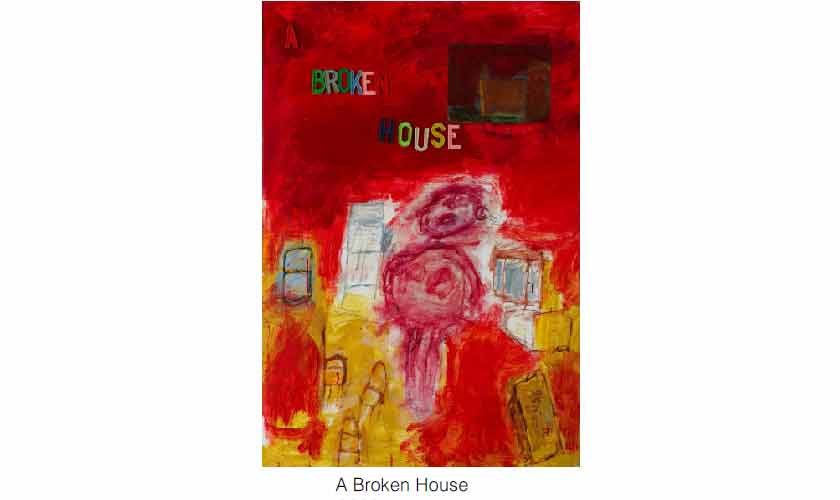
In A Broken House, the red is so tightly held that it begins to suffocate the surface. The title of the painting is not what Mirza is showing; it is what he makes you feel; the brokenness is expressed in the deception and unrest in the work. A distorted childlike image appearing in the centre, surrounded by domestic objects like chairs, a window and a table, hints at the physiological chaos of a child. Playful colours and the writing of the title seem unresolved and intensify tension.
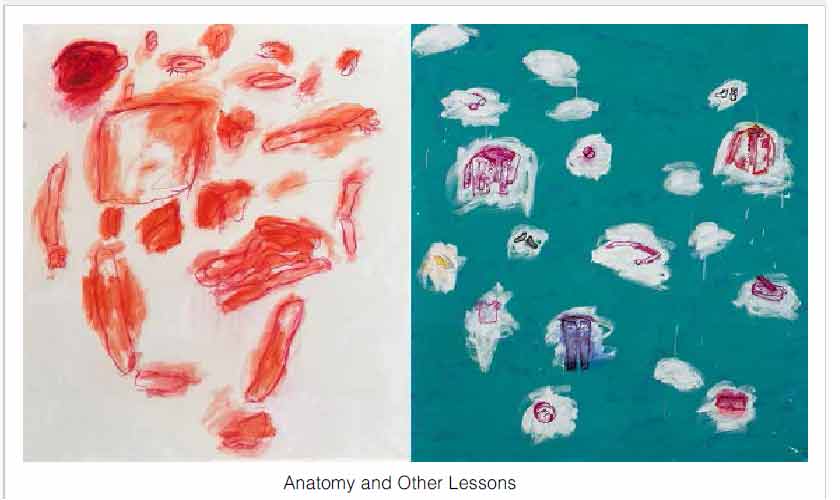
Anatomy and other lessons, another work placed right on the front wall of the gallery; comes across as a visual breather. The work is split across two panels, each reading the human anatomy and social parameters side by side in the most direct manner. The left panel looks like it has been thought out before it was drawn. The body organs, painted in red against a white background, are dismantled. The flesh is almost raw in its intensity, like an exposed nerve. The right panel showcases the items that belong and become one’s identity; decorative and necessary - jacket, belt, watch, food, shoes, etc. The rawness of the left panel has been intensified with the use of red. The immediate shift to teal on the right-hand panel cools down its heaviness. Through this work, Quddus Mirza raises the question: what are humans? What defines their identity: their flesh or their belongings?
The paintings may at first look simple and easy to decipher; however, upon closer inspection one starts noticing layers meaning.
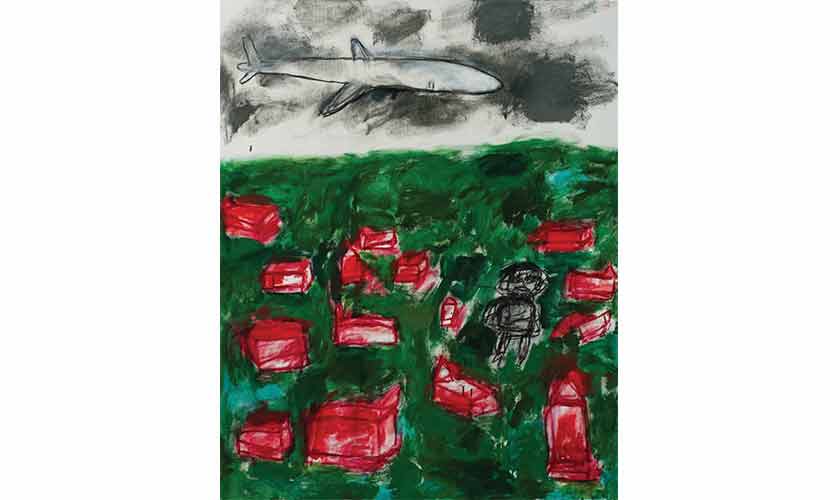
A Stained Landscape is the work that best justifies the depth of comprehension. A vast green field spreads across the canvas. A childlike figure is shown standing in the right corner. It is surrounded by red objects. The child appears bewildered with the present and perplexed about the future. The red objects resembling houses but also forming shapes of graves and an aircraft hovering above the field, create a tense scenario.
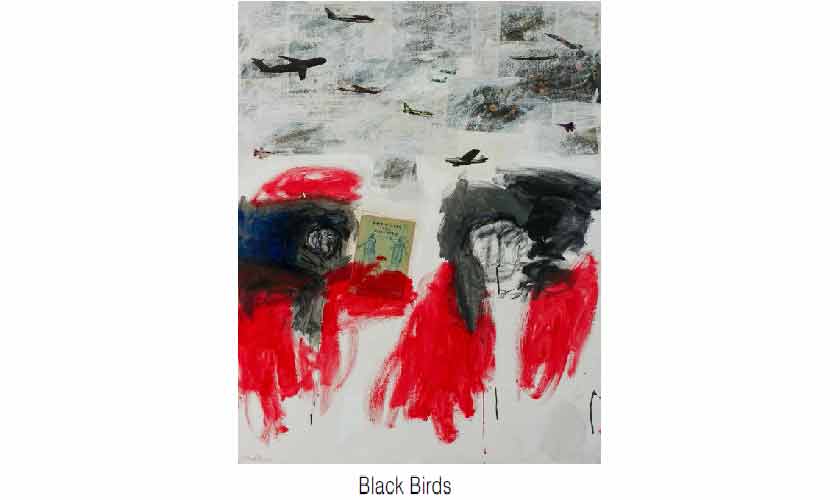
This Blazing Black of Sky and Black Birds project the same tension, taking a sharper political point of view. The titles and the depiction are a clear commentary on the current political situation. The use of dark hues and the aircraft flying above evoke a sense of unrest. Mirza deliberately uses the gestures of innocence and the colour red, which doesn’t sit quietly but shows an explosion of anger and emotions.
The canvases are a culmination of juxtaposed emotions: sadness, conflict, grief, loss and questioning. These are remarkably handled and remind the viewer of Quddus Mirza’s mastery of technique and concept.
An unsettled being, destruction within and unseen disturbance may look unorthodox in a way Mirza has portrayed them, but he has weaved them together to form a narrative that is natural and instinctive. A Man and a Woman, In Between and In the Heat of the Making are loud expressions of inner conflict and unresolved tension. In these works rationality takes a back seat as emotions take over. Where red signifies urgency and flesh, it also hints at life, which is pulsating. It is exposed and screaming to be noticed. The scattered fragments, random lines, alphabets, chairs and other domestic objects depict the world, yet nothing is entirely contained.
Mirza’s work insists on being understood in the most authentic way of a childlike drawing. It do not offer closure, critical elaboration or intellectual ornamentation. Instead, it stands for openness, presence and patience. It asks for attention to the flaws and its rawness. It demands patience to be read and indulged. Like an incomplete chapter in a book, it appears to want to be left unresolved.
The writer is an art and entertainment journalist. She may be reached at [email protected].