Print Story
X




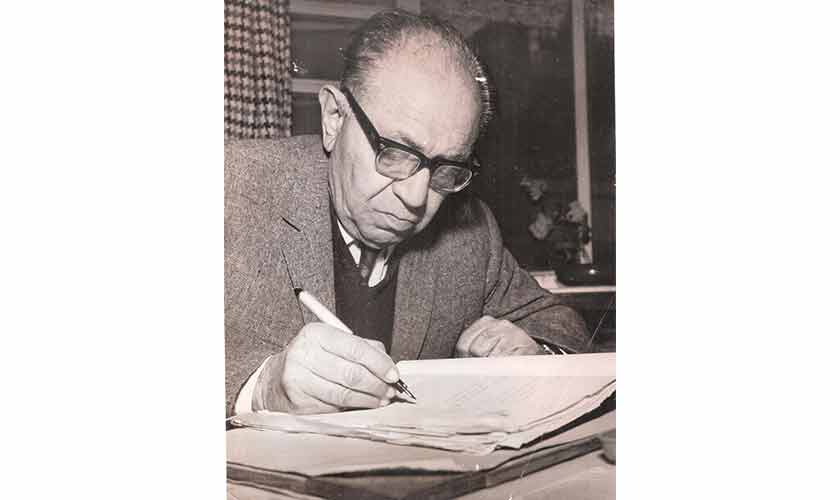
Imtiaz Ali Taj is often described as a person who altered the direction of modern Urdu theatre
| I |
mtiaz Ali Taj is often described as the father of modern Urdu theatre in the Subcontinent, a writer who altered its direction at a time when performance was still shaped by older conventions.
His well-known play Anarkali marked a shift away from the long-standing practice of writing plays in verse. That tradition had been sustained by playwrights such as Agha Hashr Kashmiri, whose work remained closely tied to the musical and performative expectations of the stage. Earlier still, in the mid-19th Century, Amanat Lakhnavi’s Indar Sabha set a precedent for theatre that was meant to be sung and danced. These productions followed established principles of dramaturgy associated with the Natyashastra, attributed to Bharata Muni, where performance relied on a combination of music, gesture and spectacle.
By the early 20th Century, this mode of theatre had developed into what was widely known as Parsi theatre. Before the arrival of sound cinema, it remained the primary form of public entertainment. Performances were expansive, often shaped by audience response. Songs were extended if they were well received, sometimes continuing for long durations; dances followed a similar pattern. The script was not always central to these productions. Many scripts were not preserved.
Taj’s work reflects an awareness of this history, even as he moved in a different direction. His interest in realism introduced a different emphasis, yet he remained engaged with the theatrical forms that had preceded him. Over the years, he collected and worked towards publishing texts from earlier theatre, recognising their importance in understanding how the stage had functioned. This effort contributed to the documentation of material that might otherwise have remained scattered or unavailable.
His well-known play Anarkali marked a shift away from the long-standing practice of writing plays in verse.
His career extended beyond playwriting. He was involved in broadcasting, acted on stage, wrote for film and worked in cultural administration. At Government College, Lahore, he had collaborated with Patras Bokhari, performing at the Dramatic Club, a space for performance and discussion. He was also associated with the early development of radio in the Subcontinent, at a time when it was beginning to shape new forms of communication.
The context in which he was raised is also relevant. His parents were among those who supported social reform, particularly in relation to women’s education. They published Tahzeeb-i-Niswan, a magazine aimed at women, at a time when such initiatives faced resistance. Concerns about women’s visibility in public life were widespread. Even reformers such as Syed Ahmad Khan proceeded with caution after encountering opposition to educational initiatives. Efforts to establish institutions for women developed gradually and were often contested.
This engagement with cultural and social questions continued in the family. Taj’s daughter, Yasmin Tahir, worked for radio and theatre, contributing to programming and performance. Her husband, Naeem Tahir, was involved in the early years of television in Pakistan and participated in its development as a medium.
Taj’s place in Urdu theatre rests on his role in a period of transition. His writing moved away from conventions associated with earlier performances while his archival efforts acknowledged their presence. His work did not reject what came before it; rather, it engaged with it in a different way, allowing for changes in both writing and production.
The writer is a culture critic based in Lahore.