Print Story
X




In Punj-AB: A Sublime Terrain, Faiza Butt uses textiles and paintings to trace histories of migration
| A |
mong the several canals for which Venice is famous, five are more widely known: the Grand Canal, the Giudecca Canal, the Cannaregio Canal, the Venetian Lagoon and the Canal of Saint Peter. Thus, the title and concept of Faiza Butt’s project for the Pakistan Pavilion at the 61st Venice Biennale appear appropriate. The Islamic Republic’s second official pavilion, after Naiza Khan’s participation in the 58th edition of the Venice Biennale in 2019, is called Punj-AB: A Sublime Terrain. Curated by Beatriz Cifuentes Feliciano, with Dr Yaqoob Khan Bangash appointed country commissioner by Pakistan’s Ministry of National Heritage and Culture, alongside Syeda Maimanat Mohsin as cultural editor, it is being held from 9 May to 22 November 2026 at Ex Farmacia Solveni, and reviewed, from afar, for these pages.
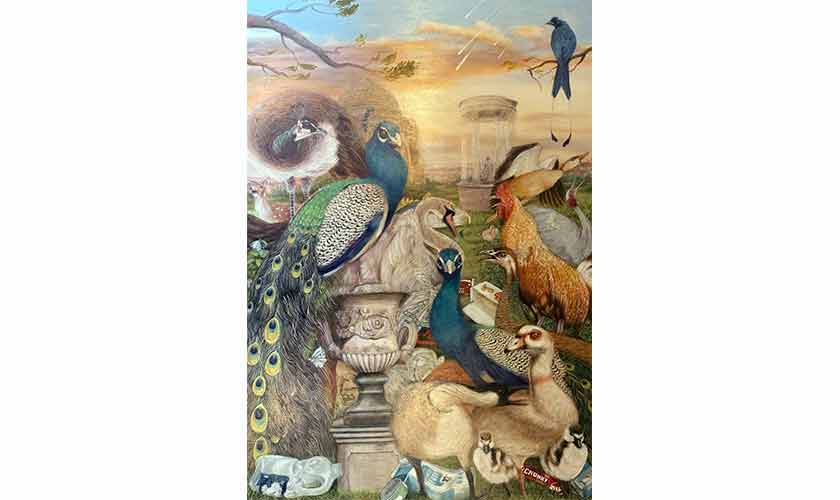
What connects Faiza Butt’s work for the pavilion to the diverse displays at various sites across the city is the current biennale’s theme, “In Minor Keys”. The Pakistan Pavilion incorporates large wall-hanging tapestries, paintings, sculpture and a video installation. Her two paintings, with interwoven images drawn from a range of pictorial genealogies, contain the convictions and conditions of our times, shaped by European contact, a phenomenon that culminated in the colonisation of the Orient. Today, however, we survive in a disoriented world, where influences, information, technologies and trends travel through trade, not always in equilibrium, but between former predators and the exploited. This process historically began with civilisational curiosity, later transforming into varying forms of possession, of unfamiliar tracts of land, untasted fruits, unknown fowl and strange vegetation.
Butt’s two paintings reveal this passage through history, where cultures converse, occasionally coexist harmoniously and merge into new entities, though often in conflict. She archives a world that considers exotic birds and aquatic species symbols of wealth, acquisitive power and the accumulation of rare artefacts, a practice that parallels today’s desire for art collecting. Her paintings are filled with peacocks, cockerels, cranes, geese, swans, macaws and larks, alongside reminiscences of historic structures that denote the presence of diverse faiths, customs and legacies.
At the bottom of both canvases lie chocolate-bar wrappers, crumpled milk cartons, Coke cans, glass bottles, food tins and other waste. Faiza Butt amalgamates these wide-ranging visuals within an atmosphere of phantasmagoria. Both paintings reaffirm her ease with the conventional language of picture-making, though she refrains from limiting herself to familiar and well-tested territory.
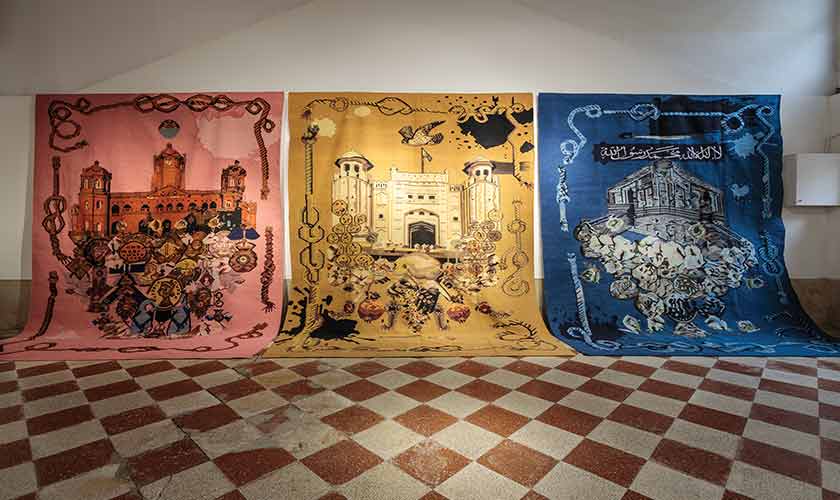
Thus, the visitor is confronted with seven textile-based works — suspended tapestries, dhurries, embroideries and patchworks, all revolving around Punjab, the land of five rivers. The array of methods may be new for the artist, but they reflect Butt’s interwoven imagery of disparate elements joined through her familiar style, a visual language that, in previous works, reinforced links between diverse, even opposing, worlds, such as Afghan extremists and the West’s hip generation. In the woven works for Venice, produced in Pakistan as a result of exchanges between the artist and artisans, emerges a commentary on displacement, transmigration and layers of history.
These “tapestries transform traditional floor-based weaving practice into immersive visual fields. Combining dhurrie weaving, ikat, Jacquard and hand-spun cotton, the works are unified through symbolic colour, architectural motifs and intricate compositions that map the rise and fall of civilisations”. Some of these monumental pieces were produced by women weavers from Havelicrafts, a set-up founded in 2010 by Jugnu Mohsin and Moni Mohsin “in a restored 300-year-old haveli in their ancestral village”, empowering village women to become independent breadwinners. Jugnu Mohsin has also made significant efforts towards “reviving the cultivation of the Indus Valley’s ancient cotton (Gossypium arboreum)” on her farm in Shergarh. For various reasons, not all the works created by women from Shergarh were included in the final scheme of the exhibition.
The surfaces appear even more painterly than the controlled constructions visible in Butt’s paintings.
The other textile hangings were produced through collaborations with Attiya Javed, Aiman Gillani and Murtaza Ali, among others, since collaboration itself is “central to the project”. Faiza Butt’s visuals were “produced in partnership with Punjabi artisans whose inherited craft traditions, particularly textile weaving, form the foundation of the exhibition”. The very act of involving individuals who “had never woven tapestries before” in the making of 12-by-9-foot pieces, employing skills now nearly lost within the scale of globalised manufacturing and marketing, resonates with the biennale’s theme, “In Minor Keys”, conceived by the late Cameroonian-Swiss curator Koyo Kouoh, who died unexpectedly in May 2025.
The Pakistan Pavilion also pays homage to the heroes of minor keys through a series of intimate portraits of men and women in acrylic on steel. It is a distinctive gesture, since unnamed workers are rarely acknowledged so prominently in the wall text of a large-scale international exhibition such as the Pakistan Pavilion. Butt further bridges two sites of production in her video installation by juxtaposing footage of village women in the haveli with overhead shots of weaving units in Lahore’s Johar Town. “While one aspect captures the everyday and ceremonial life of a small town, another shifts to a factory, tracing the journey of textile production for local use and global export.”
This blending of different histories and influences is profoundly visible in her tapestries. One of them presents a perspectival view of the tomb of Jugnu Mohsin’s ancestor, Hazrat Daud Bandagi, built in 1565. With references to vernacular cotton flowers, coins at the base, and a sword with the first Kalima above, the composition evokes a distinctly South Asian Muslim iconography, one shaped by centuries of migration, settlement and cultural absorption across the subcontinent.
In two other tapestries, produced by the women of Havelicrafts, Faiza Butt traces another route through history, recalling a region where Buddhist art encountered Hellenistic imagery in the aftermath of Alexander the Great’s expeditions, giving rise to what later became known as Gandharan art. The central figures in both tapestries, Relic Dreams I and Relic Dreams II, depict a Buddha and a Bodhisattva, based on sculptures from the collection of Musée Guimet. Butt has added radiating circles around the figures, perhaps alluding to the moment of illumination in the life of Gautama Buddha.
Her other tapestries invoke a more recent past that still lingers in the present. One depicts an old Punjabi building layered with birds, butterflies, coins of Sikh rulers and medals. Another tapestry, featuring the front of the General Post Office, Lahore, is surrounded by British coins bearing the images of Queen Victoria and George VI, with their denominations on the reverse, along with medals and a pair of flip-flops below. A further tapestry portrays Lahore Fort with Pakistan’s flag fluttering above it and an eagle in flight overhead. This historic seat of power is interwoven with paisley patterns, traditional jewellery and a sword resting on the ground.
The most notable aspect of these woven works, apart from their close engagement with history, is the artist’s success in transforming a programmed method into loose and lucid imagery. The surfaces appear even more painterly than the controlled constructions visible in Butt’s paintings. The flow of marks, stains and strokes, along with the introduction of rope, tied or loose, near the borders of the tapestries, signals how a creative practitioner can discover new dimensions within a conventional technique.
This approach reaches its fullest expression in the large patchwork hanging at the pavilion. Divided into two identical rectangular sections, one half is filled with traditional patterns from southern Punjab, rendered through laser-cut motifs on the white reverse side of denim cloth. The other comprises cranes in flight above woven currents of water, or swirls of rough white marks against a rich, deep-blue background, particularly suited to a location constantly surrounded by the sights and sounds of water.
These two visual components are enclosed within an indigo pattern. Significantly, a few birds appear to move beyond the confines of the pictorial frame. It is a small detail, yet an important key to understanding Faiza Butt’s works at the Venice Biennale, since they strongly convey the artist’s desire to move beyond boundaries of every kind.
The writer is a visual artist, art critic, curator, and professor at the School of Visual Arts and Design, Beaconhouse National University, Lahore, and can be contacted at [email protected].