Print Story
X




The controversy surrounding this year’s Eurovision Song Contest shows how culture can’t be separated from politics
| T |
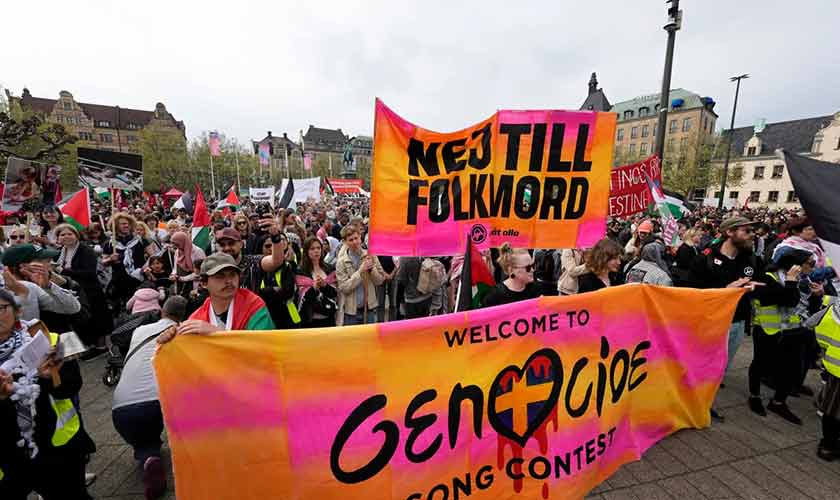
he Eurovision Song Contest has always claimed to celebrate unity through music. This year, however, the contest was overshadowed by protests over the participation of Israel during the continuing war in Gaza.
Outside the venue, demonstrators called for Israel to be excluded because of the mounting civilian deaths in the Palestinian territories. Several participating countries also faced growing public pressure at home. The controversy quickly moved beyond music itself and became a wider argument about political consistency.
For many critics, the comparison with Russia was unavoidable. Russia was banned from Eurovision after its invasion of Ukraine in 2022. Yet calls to apply the same principle in the case of Gaza were rejected. To some observers, this reflected a clear double standard. Others insisted that cultural events should not become instruments of political punishment in the first place.
What Eurovision revealed was not simply disagreement over one war. It exposed how deeply politics now shapes international cultural life.
There was a time when sport and culture were described as spaces that could rise above political conflict. Concerts, festivals and sporting tournaments were often presented as opportunities for nations to meet without violence. Rivalries existed, but they were expected to remain symbolic.
That idea now feels increasingly fragile.
International competitions have become sites where nations assert moral authority and political legitimacy. Participation itself is treated as an endorsement or condemnation. Organisers face pressure from governments, activists and audiences. Cultural institutions are expected to take positions that once belonged mainly to diplomats.
The rivalry between India and Pakistan shows how thoroughly politics can shape even the atmosphere around sport. Cricket matches between the two sides are no longer viewed simply as games. They are loaded with national expectations before the first ball is bowled.
Arguments over venues frequently dominate the discussion. Neutral grounds such as Dubai are often preferred because direct tours become politically difficult. Even routine interactions between players attract scrutiny. A handshake after the toss or a brief exchange on the field can become the subject of endless commentary.
The pressure extends beyond the players themselves. Captains are often celebrated for appearing confrontational, while gestures of restraint are interpreted as weakness. Public discourse transforms ordinary sporting behaviour into political theatre.
History offers many examples of this overlap between sport and conflict. The brief war between Honduras and El Salvador in 1969 became permanently associated with a football rivalry that intensified existing tensions. During apartheid, South Africa faced international sporting isolation because of its racial policies.
Culture once offered the possibility of seeing beyond borders, at least briefly. Sport allowed nations to compete without destruction.
What once appeared exceptional now seems increasingly normal.
Culture has become equally vulnerable to political pressure. Artists are expected to publicly declare loyalties. Silence is treated with suspicion. Institutions that once defended artistic independence often find themselves responding to ideological demands from all sides.
This creates a particularly uncomfortable contradiction in societies that describe themselves as open and democratic. Art has traditionally been valued because it allows ambiguity and dissent. Writers, musicians and filmmakers were expected to challenge prevailing narratives rather than repeat them. Yet public space for uncertainty appears to be shrinking.
Increasingly, cultural expression is judged less by artistic merit than by political alignment.
The pressure is intensified by the speed of public reaction. Social media campaigns can quickly turn festivals, exhibitions or performances into political flashpoints. Organisers fear accusations of bias whichever decision they make. The result is a climate where institutions appear permanently defensive.
What is striking is not that politics has entered culture. Politics has always been present in some form. The deeper concern is that culture no longer seems capable of softening political hostility. Instead, it often reproduces it.
The same can be said of sport. It was once common to describe sport as a substitute for conflict, a controlled space where rivalry could be expressed without violence. Today, the emotional temperature surrounding many events suggests something quite different. National victories are treated as ideological triumphs. Defeats acquire political meaning far beyond the scoreboard.
This atmosphere reflects a wider change in the global mood. Countries increasingly speak the language of moral certainty while accusing rivals of hypocrisy. International institutions are judged less by universal principles than by whether they appear politically consistent. Every decision becomes part of a larger struggle over legitimacy.
The consequence is a growing sense that no arena remains untouched by confrontation.
Eurovision may appear trivial compared with war itself. It is, after all, a music competition built around spectacle and performance. Yet the intensity of the argument surrounding it points to something larger. Even entertainment is now expected to carry political meaning.
Culture once offered the possibility of seeing beyond borders, at least briefly. Sport allowed nations to compete without destruction. Those ideals were never perfect, but they mattered because they suggested another way of relating to one another.
That space is narrowing.
Increasingly, the world appears unable to separate rivalry from hostility. Every stage, stadium and screen risks becoming another extension of political conflict.
The writer is a culture critic based in Lahore.