Print Story
X




Iftikhar H Malik’s novel focuses on colonial legacy through post-colonial memory
| P |
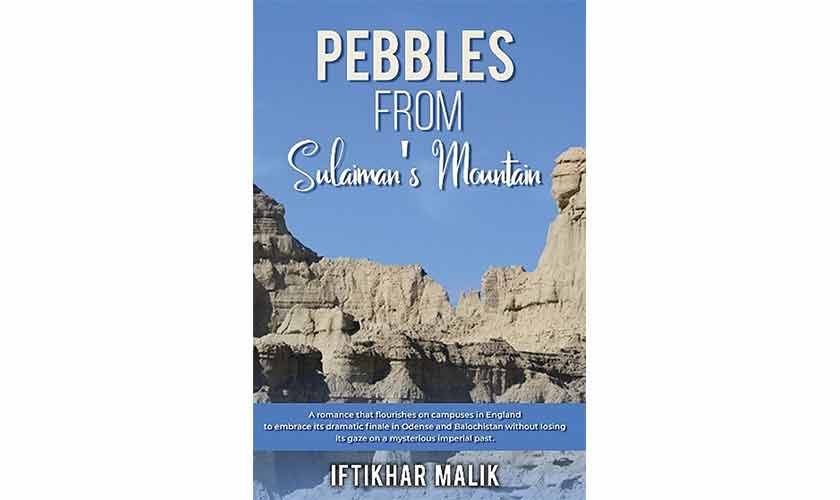
Pebbles From Sulaiman’s Mountain is a novel by Iftikhar H Malik, an acclaimed historian and esteemed scholar based in Oxford, UK. It tells a rich, multi-layered story in which the narrative moves from Balochistan to Britain and beyond. It also addresses themes of identity, colonial history, intercultural relationships and the challenges of transnational human relations. Malik uses both narrative and intellectual analysis to give readers a view of the social, political and cultural landscape of places rarely mentioned in mainstream literature.
Having aced her civil services examination, Zeenat, a young Sheedi woman from Turbat, is already challenging the stereotypes of Pakistani society. Her achievements not only raise the bar in her community but also dismantle entrenched biases among other people.
Malik also discusses the Zikris, a faith group that has received little recognition within the Baloch community. He focuses on their problems, stereotypes and misunderstandings of some extremist groups. The novel discusses both groups and their importance in the grand scheme of things in the society.
The narrative starts in Turbat. Anne Sandeman, a British woman with ties to the area dating back to colonial times, is the first character introduced. Her great-grandfather had worked for the British government in the Nineteenth Century. The main story is told as a dialogue between the past and the present; the colonial and post-colonial worlds; and Western and South Asian points of view. The conversation starts with a meeting between Anne and Gul, the main Baloch character.
From the first scene, Malik takes the reader to the dramatic landscape of Balochistan. There are some vivid description of rough hills, coastal geography and desert landscape. The physical setting symbolises an enduring history and an enduring culture. The author uses the setting to introduce the Baloch people as unique and different from all their neighbours and how they relate to the land and their traditions.
The story then moves to other places including Bath and Bristol, besides some other parts of Europe. These changes in geography mirror the characters’ own journeys, shaped by travel, studies abroad, and interactions across various countries. The novel is composed of short stories that are all connected like ‘pebbles’ that come together to form a big picture.
Cultural encounters are among the novel’s main themes. The relationship between Gul and Anne represents the intersection of two historical realms: the former represents the colonised world and the latter a former colonial power. However, Malik does not rely on simplistic dichotomies. Instead he talks of relationships as places where people can be curious and learn from each other, rather than fighting over or dwell on the past.
Gul’s experience shows how complicated the Baloch society is on the inside. An account of Anne’s trip to Balochistan allows the author to show how people from outside the Baloch society view them. There are nuanced conversations about migration, modernisation, tribal customs and economic issues. The way the characters talk shows how traditional social systems and modern global influences can clash.
The novel also deals with diversity of Baloch cultures. Malik introduces groups such as the Sheedis, who are of African descent and live along the Arabian Sea coast. Their presence is a sign of the long history of people moving and interacting in the Indian Ocean region.
The novel also invokes the history of colonialism and how its impact is still felt today. The author uses Anne’s family history in Balochistan as a narrative device to explore the legacy of British rule in the area. Names of places, family histories and histories of places all contain memories of colonial administrators, military campaigns and imperial policies.
Malik presents these historical themes in a balanced manner. He does, however, carefully map out some less well known parts of colonial history. It is not a simple story of oppression or romantic adventure. There is a critical examination of the interactions, alliances and cultural exchanges between colonial officials and indigenous tribes during the colonial period. The systematic approach reflects the author’s own background as a historian and political scholar from South Asia.
The novel raises questions about historical memory by prompting us to consider how societies remember the past, in particular how people deal with historical ties to the empire. Anne’s trip to Balochistan is, therefore, a metaphorical way for her to deal with these problems.
Malik frequently references political, philosophical and literary texts. There are discussions on writers, travelogues and historical works, showing how the author has engaged with a wide range of intellectual traditions.
The story gets better when it talks about the academic world, especially British universities. The characters’ experiences at universities like Bristol and Oxford show that modern scholarship is global, with students from all over the world sharing and learning from each other. The academic settings also frame the cultural conflicts and discussions that are important to modern intellectual discourse.
Malik’s writing style is graceful. It often combines story telling with critical analysis. The novel alternates between being a travelogue, a historical essay and a philosophical meditation. This gives the fiction a unique personality.
The people in the novel are smart. They often talk about politics, culture and history. Gul, the narrator, represents both local customs and global experiences. Anne, on the other hand, is a Western tourist trying to learn more about her family history in South Asia.
Family members, scholars and locals are among the supporting characters, who make the story more interesting. They argue from different point of view about issues such as political conflict in Balochistan, social hierarchy and education. Malik uses these characters to show a society that is slowly changing yet remains rooted in its traditions.
One of the best things about the novel is its lyrical language. Malik writes about cities, landscapes and cultural customs in a way that is both vivid and moving. His descriptions of small towns, coastal highways and Balochistan’s deserts make you feel like you are there.
The fact that the author can mix historical commentary with personal narrative also makes the story better. The novel stands out in modern travel writing for its blend of memoir and deep thought.
Some readers may find the story’s intellectual depth and complexity overwhelming. The story slows at times because it discusses novels, historical eventsand philosophical ideas in depth. The novel may be more thoughtful than exciting for someone who just wants a story or plot.
Pebbles From Sulaiman’s Mountain is an excellent read, examining the culture, history, and identity of people around the world, with a focus on how Balochistan fits into the bigger picture. Iftikhar H Malik asks his readers to consider the long-lasting effects of colonial history, cultural sharing and our shared humanity through stories about characters connected in some way. The novel does a great job of blending history and storytelling, making it a strong addition to both post-colonial literature and modern travel writing. It makes people think about well-known stories and the complex connections among people, places and histories.
Mazhar Abbas, author of The Aftermath of the Bangladesh Liberation War of 1971: Enduring Impact, has a PhD in history from Shanghai University. He is a lecturer at GCU, Faisalabad, and a research fellow at PIDE, Islamabad. He can be contacted at mazharabbasgondal87 @gmail.com. His X-handle is @MazharGondal87.)