Print Story
X




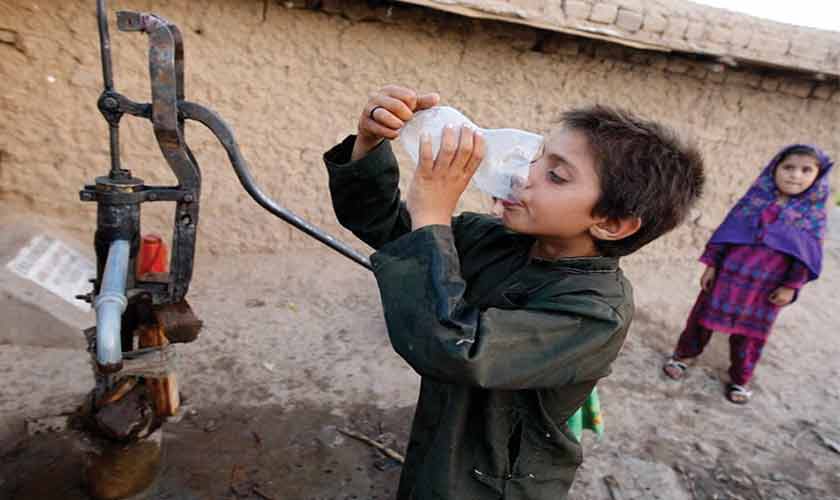
Lack of water management and climate change have aggravated the water crisis in Khyber Pakhtunkhwa
| W |
ater scarcity is fast emerging as a pressing challenge in Khyber Pakhtunkhwa. Here, geography and climate combine to create an erratic cycle of shortage and excess that is becoming increasingly difficult to manage.
Across much of the province, particularly in the mountainous regions, communities rely on natural springs for their daily water needs. In winter, many of these springs dry up, leaving households scrambling for alternatives. In southern (rain-fed) districts, the situation is even more severe, with prolonged dry spells deepening the crisis.
Ironically, the same province faces devastating floods during the monsoon season. Heavy rains and rapid melting of glaciers in northern districts send torrents of water downstream, often overwhelming rivers and triggering floods that destroy homes, infrastructure and livelihoods. These floods frequently result in heavy human and economic losses, highlighting a growing imbalance in water management.
In Parachinar, the scale of this paradox is evident. Located in Kurram district near the Afghan border and close to the Hindu Kush range, the area is surrounded by water resources. Glaciers lie to the north and the Kurram River flows to the south.
Despite this, residents struggle to access clean drinking water.
Adnan Haider, a local resident, says his family has to purchase water delivered by tankers to meet their basic needs. “Our home is in the city. There are some private tube wells nearby; a tanker costs around Rs 1,200,” he says. “There is no other option. In far-away areas, people pay up to Rs 4,000 per tanker.”
Haider adds that although his household also has a community water connection, the supply is too meager to sustain daily use. Like many others in the area, his family buys a tanker-full of water at least once a week.
Public water supply connections exist. These are mostly operated by the Public Health Engineering Department and the Tehsil Municipal Administration. However, rapid population growth and migration to urban centres like Parachinar have placed additional strain on their already limited resources. Officials says that financial constraints make it difficult to expand the water supply infrastructure.
In Kurram, large scale storage of water from glaciers and rivers could offer a long-term solution. However, such projects require substantial investment.
The water crisis is even more acute in southern districts such as Lakki Marwat, Tank and Bannu, where reliance on rainfall makes water availability highly uncertain. Water scarcity is not a provincial issue either. It is a part of a much larger global crisis that needs immediate attention.
In January 2026, the United Nations published a study highlighting that the world has moved into a state of ‘global water bankruptcy.’ The report underscored that many of the world’s water systems can no longer return to their natural baseline and called for better protection of water related natural capital before it’s too late.
The report says that the world is running out of water not suddenly, but steadily, and in ways that are becoming increasingly difficult to reverse. From the melting peaks of mountain glaciers to the silent depletion of underground aquifers, the foundations of global water security are eroding.
Scientists warn that since 1970, more than 30 percent of glacier mass has been lost in several regions. In some mountain ranges, glaciers may disappear entirely within a few decades, threatening rivers that sustain hundreds of millions of people.
Meanwhile, the report says, groundwater, the hidden lifeline beneath the surface supplies about half of domestic water use and more than 40 percent of irrigation worldwide. However, these reserves are being drained faster than they can recharge naturally.
The consequences are already visible across the global breadbaskets.
Around three billion people now live in areas where water storage is declining or unstable. More than half of global food production is concentrated in these vulnerable regions. An estimated 170 million hectares of irrigated farmland, roughly equal to the combined area of France, Spain, Germany and Italy, is under high or very high water stress.
The report says that the crisis is not only environmental or economic, it is deeply social and political as well. Without equitable solutions, the burden of water scarcity is falling disproportionately on farmers, rural communities, indigenous populations, women and other vulnerable groups.
In Peshawar, the government is attempting to address the growing demand for water through large-scale infrastructure projects. Last year, the provincial cabinet approved the construction of an intake structure and tunnel to supply drinking water from the Mohmand Dam.
According to official estimates, the project aims to supply 300 million gallons per day of water that could meet up to 80 percent of the city’s demand by 2048 through a gravity-based system. In Khwazakhela, a sub-division of Swat, work is under way on a Rs 27.8 billion water treatment plant. Once completed, the project is expected to provide clean drinking water to around 55,000 households in Mingora.
The writer is a multimedia producer. His X handle: @daudpasaney.