Print Story
X




In less than a decade, a fortress capital was stripped of its defences and recast as a colonial city
| L |
ahore was once a fortress-capital, a bastion of sovereignty. In 1846, when the East India Company captured the city, they found it encased within thirty-foot-high masonry walls, ringed by a deep ditch and marked by 13 circular bastions. Each gate was angled to resist cavalry charges and to command artillery fire. The city was formidable, its identity shaped by defence: high walls, a protective ditch and a citadel built for war.
Within a decade of Company rule, this martial character was systematically dismantled. Lahore was transformed from the fortified capital of the Sikh Empire into a walled city of the British Raj. This was no accident. It marked a decisive shift from military sovereignty to bureaucratic governance. The city’s very fabric was reshaped to reflect the priorities of its new rulers.
Before annexation, Lahore’s urban form bore the imprint of the Sikh Empire. The city wall rose nearly thirty feet. It was reinforced with bastions and outworks such as fausse brayes, low outer ramparts shielding the base of the wall from artillery fire. A surrounding ditch added further depth to this defensive system. Its thirteen gates, many designed with artillery-defensible approaches, marked not only entry points but also sites of control and display. At the centre, the citadel stood as a formidable stronghold, combining military presence with the symbolic authority of sovereignty. Movement within the city turned inward: roads circulated inside the walls. Ditches and defences curtailed outward expansion. The design reflected a regime focused on defence and the projection of power.
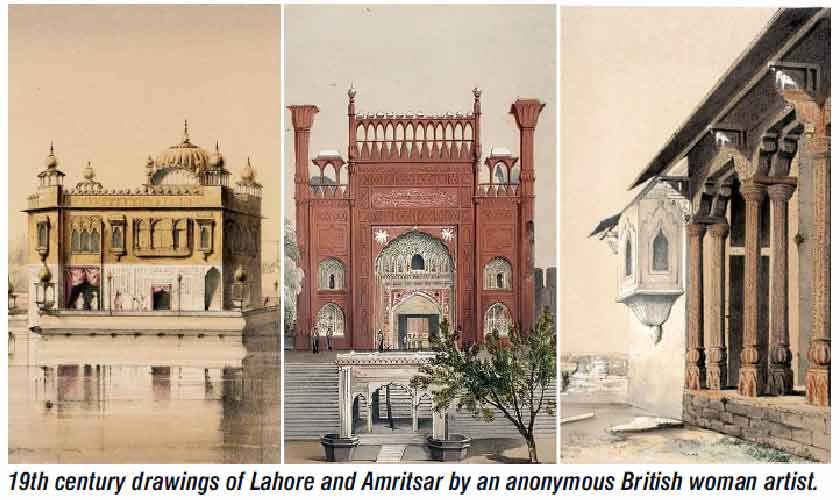
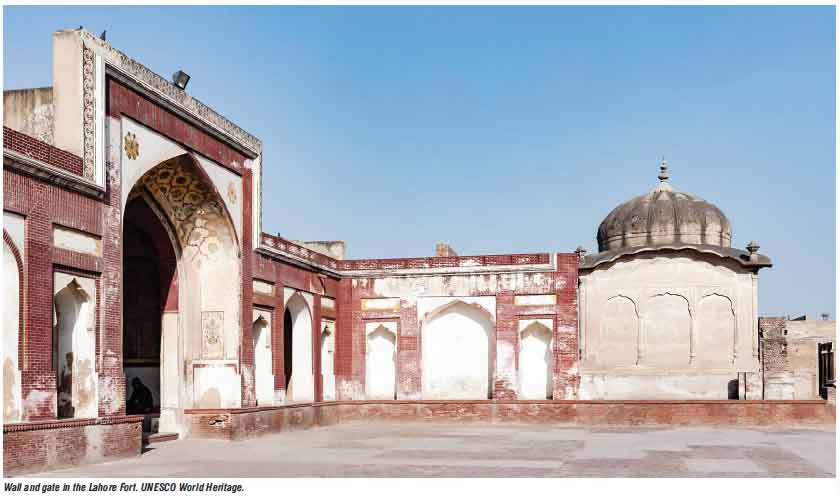
By the mid-1850s, under the East India Company, this landscape had altered dramatically. The once imposing walls were reduced to about twenty feet, their bastions and outworks dismantled. The defensive ditches were levelled and replaced with gardens encircling the old city, a continuous green belt that became known as the Circular Garden, recasting a military barrier as civic ornament. The gates remained, but their defensive role faded into symbolism.
The Lahore Fort still dominated the skyline, but by the 1850s it had lost its strategic value. No longer treated as a fortress, it housed only a small garrison, a few artillerymen, a company of European infantry and a wing of a native regiment, tasked largely with guarding the treasury. Officials acknowledged its vulnerability, noting that surrounding houses rose higher than some sections of its walls. Once a royal seat of power, it had become little more than a storehouse.
The colonial focus had shifted. Rather than fortifying walls, the British invested in roads, drainage and bridges. A wide metalled road was laid around the city’s brick perimeter by the Public Works Department, improving movement while allowing closer surveillance of the urban edge. Bridges over the Ravi and new drainage works signalled new priorities: order, circulation and administration, replacing the older logic of defence and display.

Even as the fort and walls lost their former meaning, the life of the city carried on with undiminished energy. The bazaars remained crowded and animated. Akbari Bazaar bustled with wholesale grain traders; Heera Mandi thrived on its courtesans and musicians; Moti Bazaar and Lohari Bazaar glowed with silk, cotton and household goods. In these bazaars, Lahore’s vitality was unmistakable, even as its physical form was being reshaped under colonial rule.
The Badami Bagh, once a royal orchard, was by 1854 laid out anew under the Agricultural and Horticultural Society of the Punjab, reflecting the Company’s attempt to recast leisure and cultivation along colonial lines. If the old city was being reduced, a new Lahore was taking shape beyond its gates. The Anarkali quarter emerged as a nucleus of colonial order, housing the chief commissioner’s offices, parade grounds, artillery lines and prisons. European bungalows stood apart from the dense lanes within the walls.
The cutting down of Lahore’s walls was not merely an engineering exercise. It was a political act.
Further afield, the Mian Mir Cantonment, established in the early 1850s, became the permanent base of British regiments. European troops lived in airy barracks, deliberately separated from the city’s dense population. Roads linked these new colonial spaces to the walled town, producing a dual geography: the old Lahore of bazaars and shrines, and the new Lahore of cantonments and offices.
By the 1850s, Lahore’s population stood at 94,193, with around 9,829 in Anarkali alone. Of these, 59,215 were Muslims and 35,352 Hindus and Sikhs. Europeans and Eurasians formed a small minority. However, their influence far exceeded their numbers, anchored in administrative control and the cantonment. Policing reflected this shift. The Kotwali, housed in a central building, commanded 100 burkundazes (armed constables) and 256 chowkidars (watchmen). While the chowkidar system predated colonial rule, it was now absorbed into the Company’s bureaucratic framework.
The cutting down of Lahore’s walls was not merely an engineering exercise. It was a political act. By dismantling the defences of the Sikh Empire, the East India Company signalled the end of indigenous sovereignty. The walls remained, but as picturesque markers of the “native city,” no longer as instruments of power. Authority had shifted outward, to Anarkali, to Mian Mir Cantonment and to the offices and barracks of the colonial state. Lahore’s transition from fortified capital to a walled town became the architectural expression of a new order: a city once defined by independence, now reorganised for empire, drained, policed and made legible to governance and trade. Between the enclosed city and its expanding colonial periphery, the outlines of modern Lahore began to emerge.
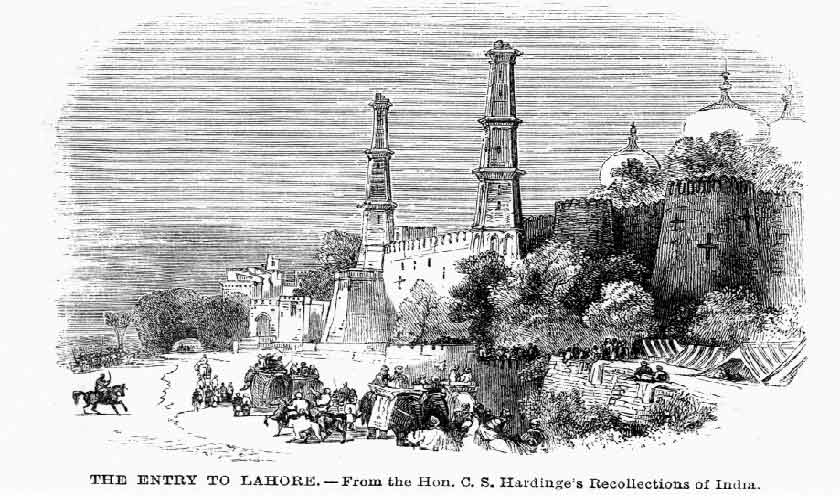
The walls built under Sikh rule had embodied a power alert to external threat and prepared for war. Under the Company rule, security was relocated beyond those, into cantonments. The first site of this shift was Anarkali, once a Sikh chaonee under Ranjit Singh, where horse artillery, field batteries and European officers such as Jean-Baptiste Ventura and Jean-François Allard were stationed. Under the British, its barracks were dismantled or repurposed into civil offices, its bazaar regulated and its tombs and monuments recast as churches or museums. Anarkali ceased to function as a military camp and became the nucleus of the colonial civil station.
The decisive shift came with the establishment of the Mian Mir Cantonment, a few miles outside Lahore. Conceived as part of a wider regional strategy, it served as the headquarters of a division stretching between the Sutlej River and the Beas River. Artillery, cavalry and infantry were stationed in planned, spacious lines. From here, the British could project power across the Punjab, maintain order in Lahore without being constrained by its narrow streets and link the city to a wider chain of cantonments running from Ambala to Peshawar. The dismantling of Lahore’s fortifications was not a sign of security within them, but of a military geography that had expanded beyond them. Lahore was no longer a fortress built to withstand siege, but a provincial hub within a wide imperial grid. Its walls endured only to enclose and regulate; defence had been externalised to cantonments and to the broader logic of colonial strategy.
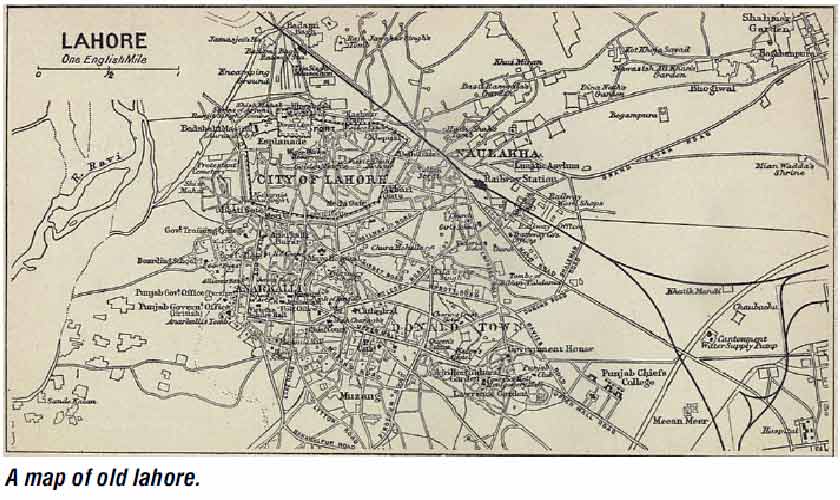
The upheaval of the Indian Mutiny of 1857 vindicated this approach and intensified it. The revolt exposed the danger of fortified cities, with Delhi emerging as a rebel stronghold that took months of brutal fighting to subdue. In its aftermath, British authorities moved systematically to weaken urban defences across north India. Lahore was no exception. Records indicate that sections of the southern city walls, along with parts of the southern defences of the Lahore Fort, were demolished around 1857 — a deliberate measure to ensure the city could not resist in the manner Delhi had. This final act of demolition marked the completion of Lahore’s transition: from a fortified capital to a pacified, regulated city under the East India Company.
The writer is an assistant professor at the Department of Archive Studies at Government College University,Lahore. He is the author of Lahore @ Partition: Violence, Cross-Migration and Regeneration 1947-1961.