Print Story
X




Mata Ji Marhi offers a glimpse into the historic presence of Nath jogis in Sindh
| S |
indh once had many sacred sites associated with Hindu ascetics. These sites - marhis, aahrams, maths andr mandirs - drew large numbers of devotees, who came to pay respect to ascetics from various renunciation traditions.
There are ten orders of Hindu ascetics (popularly known as Dasnamis): Aryana, Asrama, Bharti, Giri, Parvata, Puri, Sarasvati, Sagara, Tirtha and Vana. However, some scholars and oral historians recognise more than sixty-five sects of renouncers. Each renouncer adds their adopted name to one of these ten orders. The name is related to the centre at which they were initiated or the teacher who initiated them.
The most prominent ascetics in Sindh have been Bhartis, Giris, Puris and Naths. Some of the sacred sites have survived and continue to serve as places of worship for Sindh’s Hindu community. This article deals only with the Nath Jogis of Sindh, in general, and of Shikarpur in particular. These sacred spaces were mainly called marhis.
Sindh was once a stronghold of the Nath Jogis. According to George Weston Briggs, author of Gorakhnath and the Kanphata Yogis, the Asapuri at Nagar Thatta, Koteshwar and Pir Arre (Aari) were among the sacred places associated with the Nath Jogis in Sindh. However, Briggs does not mention several other sacred places that belonged to the Nath tradition across Sindh, including the temple of Mata at Ganjo Takar, Hyderabad; the marhi of Ratannath at Taung in Jamshoro district, the Jogi marhi near Islamkot in Tharparkar district; the Dwarkanath marhi and the Thakurnath marhi in Shikarpur.
The Naths were mentioned in several historical accounts written during the Kalhora period (1700-1783) and the Talpur Period (1783-1843). Shah Abdul Latif Bhittai (d. 1752) travelled to their religious places with some of them. He also discussed many of the renouncers who made pilgrimages to sacred places. The list that he provides in his poetry is quite long. Shah Abdul Latif has devoted two whole surs, Ramkali and Khahori, exclusively to the Jogis. There are also some references to them in other surs. Shah Abdul Latif used several titles to refer to the Jogis.
According to American anthropologist Ann Grodzins Gold, in her book A Carnival of Parting: The Tales of King Bharthari and Gopi Chand as Sung and Told by Madhu Natisar Nath of Ghatiyali, Rajasthan, Nath is the “rubric term that may cover any of loosely-organised associations of the Shaivite renouncers, taking Shiva as their first Nath or guru.” The Naths are masters of yogic power. As renouncers, they are celibate ascetics whose tradition must be passed on through recruitment and through guru-disciple transmission.
Two of the earliest Nath marhis in Sindh are located at Taung in Jamshoro district and Rato Kot in Sanghar district. The former is associated with Ratannath, and the latter is to Veernath. Veernath Ji Marhi is one of the earliest and oldest marhis in Sindh. Poet Miyon Shah Inayat also mentioned Veernath in his poetry. The Veernath Ji Marhi is believed to have been founded by Veernath himself in the early Seventeenth Century. This marhi became the main centre for the Nath Jogis of Sindh, who spread the teachings of Veernnath across Sindh and the Punjab.
Over time, this group of Nath Jogis became so powerful that they were involved in the political decisions of the Sodha Rajputs in settling disputes among the various lineages of the tribe. Veernath’s followers played an instrumental role in resolving family disputes among the Sodha Rajputs of Tharparkar. The Sodhas always sought Nath Jogis’ advice during times of crisis and war in Tharparkar.
After Ratannath and Veernath marhis, Jogi Pir Thakurnath Ji Marhi, also known as Mata Ji Marhi in Shikarpur, is perhaps the earliest marhi of kanphata jogis in Sindh. This marhi is located in Shikarpur’s Sukpul neighbourhood. Apart from this marhi, there were a few others that no longer exist. These marhis were not just buildings; they were living symbols of ascetic practices, memory and interfaith cultural exchange.
Sindh once had many sacred sites associated with Hindu ascetics. These sacred sites - marhis, aahrams, maths and mandirs - drew large numbers of devotees, who came to pay respect to ascetics from various renunciation traditions.
It is believed that the first marhi was located around Kot Sultan village. Later, Nath jogis established a marhi near Gol Market in Shikarpur. Finally, they moved to the present location, where samadhis of several Nath kanphar (kanphata) jogis are located. It appears that this marhi was extant before the foundation of Shikarpur in the Seventeenth Century and its rise as an important commercial hub.
Given that Nath jogis traditionally sought out remote terrains and forested landscapes for meditation and austerities, this site likely existed even before the founding of Shikarpur. It once formed part of a secluded woodland retreat where ascetics engaged in rigorous spiritual practices.
Once Shikapur was founded, the place of worship expanded and became a centre of attention. This marhi was the oldest and earliest sacred space associated with kanphar jogis in Upper Sindh. From this marhi, many kanphar jogis spread their Nath tradition in other towns and villages in the Seventeenth, Eighteenth, Eineteenth and Twentieth Centuries.
Some Nath ascetics established a temple in Jacobabad. It was called the Shiva Temple. A few samadhis of Nath jogis are found at the temple of Shiva. One of the most prominent samadhis belongs to Mangal Nath, who was probably associated with Mata Ji Marhi of Shikapur.
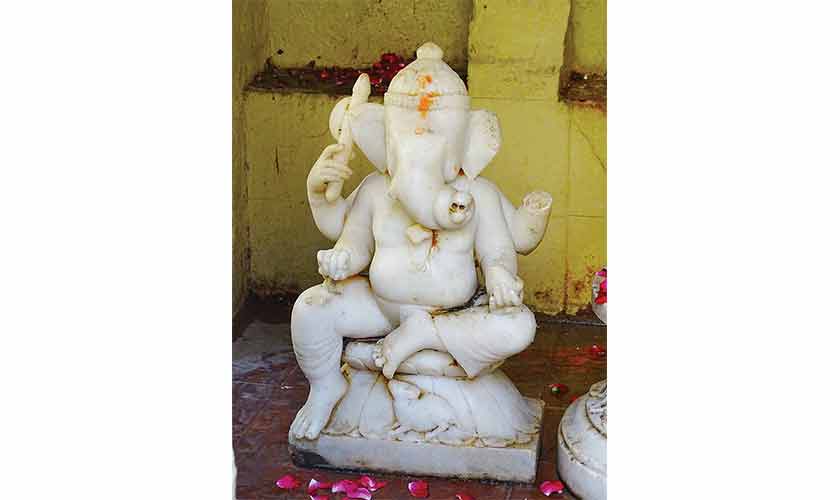
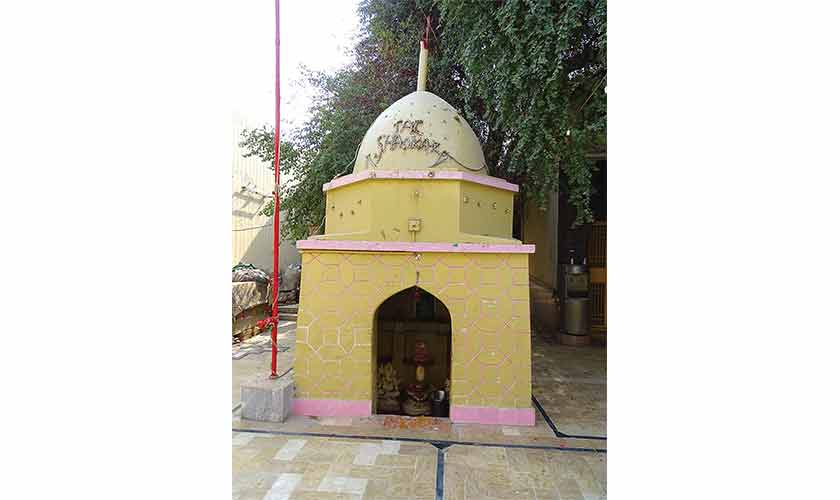
Mata Ji Marhi or Jogi Pir Thakurnath Ji Marhi in Shikarpur’s Sukpul locality has been renovated several times. Today, as one enters the marhi, one first sees the Shiva temple in the courtyard. In the garbhagriha of the temple, there are a lingam and a yoni, flanked by images of Lord Ganpati and Shiva’s mount, Nandi.
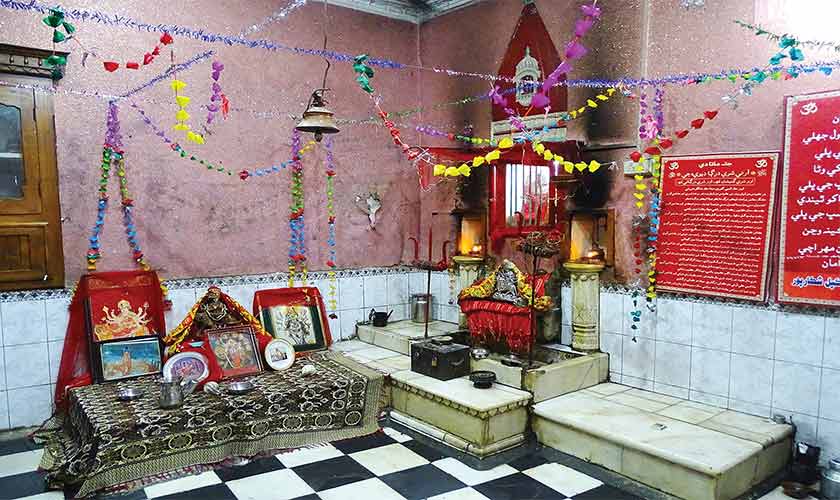
This temple is a small, domed structure. Besides the temple, the marhi contains three halls. In the first hall, called the gadi of Jogi Pir Thakur Nath, there is a platform on which is placed a picture of Jogi Pir Thakurnath. On the right side of the picture there are pictures of Durga Mata.
On a wall of the same hall there is a rectangular niche containing the image of Bheru Bali, venerated in the shrines of Nath jogis. In the same hall, there is a picture of Jogi Sunderdas with a picture of Lord Shiva. One does not know much about Jogi Sunderdas, but he is also venerated by the local Hindu community along with other Nath ascetics. There are also pictures of other Nath jogis placed on a cot in the room.
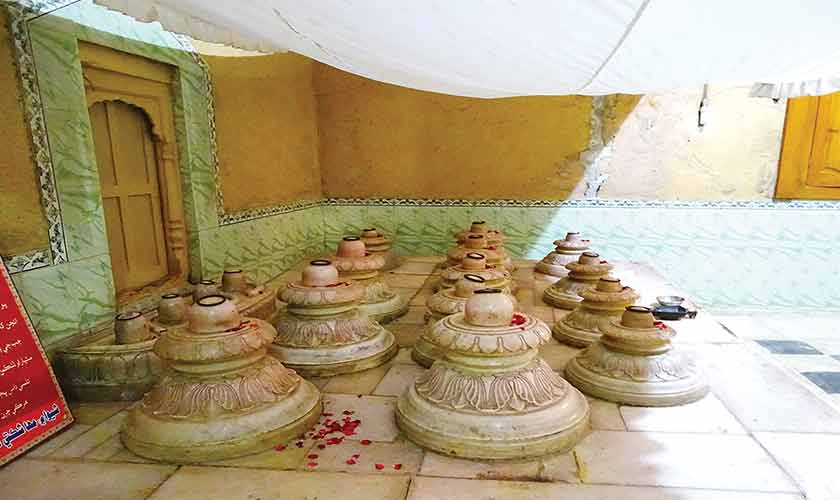
In the second hall of the marhi, there are samadhis of some Nath Jogis. They were kanpar jogis who used to split the cartilage of their ears to wear large earrings (kundal), a distinctive marker of their ascetic identity. There are 17 marble samadhis, all built on a marble platform. No information is available about the names of these jogis, although I interviewed many notables in Shikarpur, including Pawan Sagar, the Shivadari of the marhi.
The marhi gets its name from Jogi Pir Thakurnnath. It is not known when he lived. From Lokram Dodeja’s Munhinjo Watan Munhinja Manhoon, one learns that there was a prominent marhi of Nath jogis in Shikarpur, called Dwarkanath Ji Marhi. Whether he was referring to the Thakurnath Ji Marhi or some other in Shikarpur is not clear. He writes that the last gadisar (custodian) of Dwarkanath Ji Marhi was Raja Pir Chandarnath, who spent some time in Shikarpur and some in Dham (abode, sacred place) in Kunnur in southern India. After Partition, he established a math (religious institution/ religious centre), a branch of Dwarkanath Marhi of Shikarpur, in Ulhasnagar. He died in 1977.
Jogi Pir Thakurnath Marhi, associated with the Nath jogis, represents a significant sacred site of renunciation in Shikarpur. It points to the city’s historical emergence as an important centre of Nath practitioners, alongside a broader spectrum of ascetics, mystics, swamis and sants. The co-existence of diverse spiritual traditions reflects a layered and plural religious landscape, which continues to constitute Shikarpur’s cultural identity.
The writer is an associate professor and anthropologist at the Pakistan Institute of Development Economics, Islamabad. He has authored 18 books on Pakistan’s cultural heritage and anthropology. He tweets @kalhorozulfiqar. He may be contacted at [email protected]
caption
Image of Ganpati in Shiva temple.
Temple of Shiva in Mata Ji Marhi in Shikarpur.
Samadhis of Kanphar Jogis in Mata Ji Marhi, Shikarpur.