Print Story
X




US refusal to extend the Strategic Arms Reduction Treaty, despite a proposal from Russia, has raised the risk of a fresh arms race
| F |
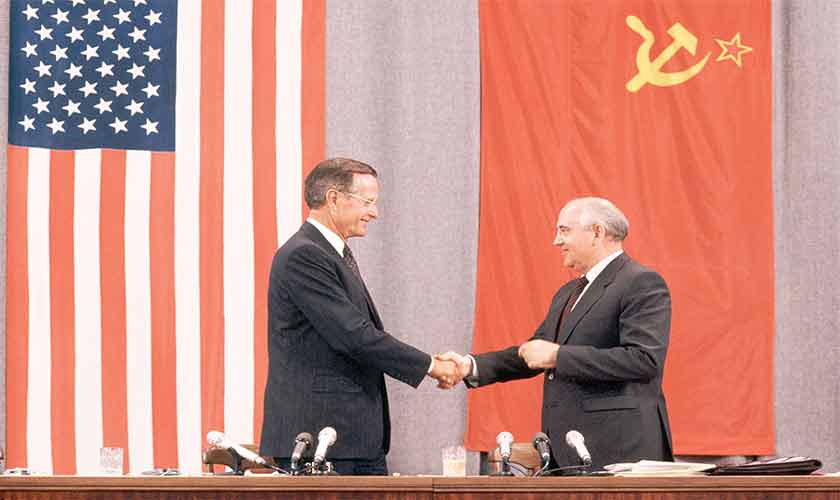
rom Ukraine to the Arctic, from Europe to East Asia, fault lines in global security are widening. The expiry of the New START (Strategic Arms Reduction Treaty) has removed the final guardrail restraining the nuclear rivalry between Washington and Moscow, amplifying risks at a time of deep geopolitical confrontation.
President Donald Trump’s decision not to pursue a further extension, despite a proposal from Russia, marks a definitive end to an era that began with the Strategic Arms Limitation Talks in the early 1970s. The UN secretary general has warned that this is a “grave moment,” increasing the risk of an arms race and heralding a more dangerous world.
Pakistan’s former ambassador to China and EU Naghmana Hashmi says that with the expiry of New START on February 5, the binding, verifiable limits on nuclear arsenals have vanished. “There are no legally binding limits on deployed US and Russian strategic warheads and launchers. This has removed a key constraint on force size and structure.”
The United States has also shut down the system that allowed both sides to share information, carry out inspections and notify each other about changes to their arsenals. Without those checks and exchanges, it will be much harder for the two countries to believe that the other side is keeping its promises. “That is why the end of New START matters not just for US-Russian ties, but also for global security as a whole.” Hashmi says New START’s inspections and data exchanges had reduced uncertainty between the nuclear powers, helping prevent miscalculations. An arms race often begins because reliable information is not forthcoming. “By declining to extend New START again, Trump has accepted a period with no binding limits in pursuit of a broader treaty that carries serious near-term risks.”
Pakistan’s former ambassador to the UN and the Conference on Disarmament, Zamir Akram, says: “The situation has been further aggravated by the Ukraine war, which has kept US-Russia negotiations suspended, adding to earlier setbacks like the US withdrawal from the Intermediate-Range Nuclear Forces Treaty in August 2019 under President Trump’s first term and the Anti-Ballistic Missile Treaty Treaty under former US president George Bush.”
The Ukraine war has also heightened serious risks of a looming nuclear confrontation, for the first time, since the Cuban missiles crisis. The US claimed that Russia was preparing to use tactical nuclear weapons. However, Ambassador Akram says Russia was emphasising that it could consider “all options” if threatened, highlighting nuclear risks without immediate intent.
It is worth noting that Russia has made several nuclear threats since the Ukraine war began, including the deployment of tactical nuclear weapons in Belarus and conducting nuclear drills. However, experts believe that, given the severe consequences and global backlash, the likelihood of Russia using nuclear weapons is low.
Another destabilisation has been set into motion by Trump’s proposed Golden Dome: a missile defence system covering the entire US. This could escalate into another arms race, potentially involving Europe, too. It could also prompt Russia and China to expand their missile and warhead arsenals to counter the move, raising new arms race risks.
The Greenland issue has further exacerbated the US-European differences. Europe will have little reason to rely on US nuclear protection against Russia. This could push them into aggressively pursuing a nuclear umbrella of their own, says Ambassador Akram. “This has led to nuclear countries like France and Britain to consider developing their own nuclear shield for Europe. While Germany lacks nuclear weapons capability at this point, it could also quickly build a nuclear device.” This destabilisation in Europe threatens to extend to East Asia as well raising concerns about the reliability of the American nuclear umbrella for Japan and South Korea. These developments may well trigger both horizontal and vertical nuclear proliferation.
It is worth noting that Russia has made several nuclear threats since the Ukraine war began, including the deployment of tactical nuclear weapons in Belarus and conducting nuclear drills.
The use of emerging technologies, along with the growing militarisation of outer space, is severely destabilising global security. At the same time, the war in Ukraine has clearly shown how rapid advances in AI-powered drone technology are changing modern warfare. Together, these developments are raising the risk of miscalculation at a time of heightened geopolitical confrontation. Ambassador Akram says these developments are likely to have a hugely negative international impact, since negotiations on arms control, non-proliferation and disarmament are already deadlocked in the Conference on Disarmament, the UN General Assembly’s First Committee and the Organisation for Security and Co-operation in Europe.
Against this backdrop, the US under-secretary of state for arms control has told the Conference on Disarmament recently that the US wants a comprehensive dialogue towards arms control and has sought to include China in the dialogue. To justify its push, the US administration has claimed, without providing any evidence, that China has conducted nuclear tests. China has dismissed the US call for joining arms control talks with Russia and called it a non-starter. China, Ambassador Akram says, “has far fewer warheads in comparison to the US and Russia.”
According to the Stockholm International Peace Research Institute, Beijing has an estimated 600 warheads, compared to about 4,000 each for Russia and the US.
Beijing has argued that it should either be allowed to grow its nuclear stockpile to match US-Russia levels or these nations should reduce their arsenals to a level equal to China.” China also wants the US to include France and the UK in talks. This could make negotiations far more complex. The United Kingdom and France have 290 and 225 warheads, respectively.
In the context of South Asia, Ambassador Akram says: “If the US resumes nuclear testing, India is likely to follow suit, potentially prompting Pakistan to consider testing its own nuclear devices. Both Pakistan and India are non-signatories to the CTBT and have only declared a voluntary moratorium on testing.
Akram says these developments have also been complicated by the US and Israeli attacks on Iranian nuclear facilities last year that adversely impacted security in the Persian Gulf and the Middle East. Renewed hostilities against Iran could further harm the ongoing negotiations. “This not only poses the spectre of nuclear contamination spreading from the Iranian nuclear sites but may also push the Iranian government towards acquiring nuclear weapon capabilities,” Akram says.
Any crisis environment involving nuclear weapon states risks accidental use, exacerbated by the fog of war, disinformation, battlefield chaos and potential rogue commander actions. India’s 2022 BrahMos missile incident near Pakistan exposed potential command-and-control risks, underscoring how accidents or miscalculations could escalate tensions. Doubts emerged almost immediately about the claim that the launch was “accidental.” With multiple safeguards built into the firing process, such an incident appeared unlikely without deliberate intent. Among the more troubling possibilities was that it served as a calculated signal aimed at gauging Pakistan’s reaction. India fired several BrahMos missiles at Pakistan during May 2025 conflict.
Ambassador Akram says the implications were serious, especially considering BrahMos missiles can also carry nuclear warheads. This increased the risk of miscalculation or escalation. He also warns of potential command-and-control risks involving nuclear-armed submarines which are known to have carried out deterrence patrols with nuclear weapons on board.”
Against this backdrop future agreements must function both as a replacement for New START and an adaptation to a changing nuclear landscape, says Ambassador Hashmi. “It will first have to recreate core New START-type functions—numerical caps on deployed warheads and delivery systems, plus intrusive verification—before it can credibly tackle newer challenges,” she says.
With formal extension no longer possible under the treaty’s own rules, current discussions in Abu Dhabi revolve around “handshake” or political commitments to observe New START-like constraints. Those, however, would lack the intrusive inspections and legally binding guarantees of a ratified treaty, making them inherently more fragile.
As constraints fade and geopolitical tensions intensify, the question facing world leaders is no longer whether a new arms race is possible — but whether the international system can prevent one before mistrust hardens into irreversible escalation.
The writer is a senior The News staffer in Karachi.