Print Story
X




In Noor Muhammad Shujrah, Sufi networks and political movements converged to shape a centre of scholarship
| N |
oor Muhammad Shujrah is a historical village in the Shikarpur district. It is located about 12 kilometres north of Khanpur town. This village is noted for its historical seminary, mosque and religious scholars who played an important role in the socio-political and religious history of Shikarpur and beyond. Syed Din Muhammad Shah, as a deputy of Maulana Taj Muhammad Amroti, played an instrumental role in imparting religious education in Noor Muhammad Shujrah village. He was born in Noor Muhammad Shujrah village in 1853. Some scholars, notably Syed Mahmood Shah Bukhari, the author of Azadi Jo Imam: Maulana Taj Muhammad Amroti, believe that he was born in 1860. At the age of 25, he spiritually connected to Hafiz Muhammad Siddique Bharchundi. Later, he received the robe of initiation (khirqa) from Maulana Taj Mahmood Amroti, a Sufi adept, social reformer and active member of the Khilafat Movement.
Maulana Taj Mahmood Amroti was born in 1857 in Deewani near Piryalo village in the Khairpur district. His father, Abdul Qadir Shah alias Bhoral Shah, was also a religious scholar. It is said that Maulana Taj Mahmood Amroti also studied under the guidance of Maulana Abdul Qadir Panhwari, who was a disciple of Khalifo Muhammad Yaqub Humayuni (d. 1856) – who was a khalifo (deputy) of Maulana Abdul Haleem Kandvi (d. 1838). Maulana Taj Mahmood Amroti also studied Persian and Arabic under Maulana Abdul Qadir Panhwari at Pir-Jo-Goth Madrassah in Khairpur district. Later, his father migrated from Deewani village to Amrot Sharif.
Maulana Taj Mahmood Amroti (d. 1929) was an eminent Qadiri Sufi who played an important role in the Khilafat, Hijrat and Reshmi Rumal Movements, as well as in protecting mosques during the construction of the Khirthar canal. Maulana Taj Mahmood Amroti was initiated into the Qadiri order by Hafiz Muhammad Siddique Bharchundi (d. 1890), who was a khalifo (deputy) of Syed Muhammad Hassan Jilani (d.1838) of Sui Sharif, who was a khalifo of Pir Muhammad Rashid Shah alias Rozay Dhani (d. 1818). It is said that, on the instructions of his spiritual mentor, Maulana Taj Mahmood Amroti preached the Qadiriyya-Rashidiyya practices and established a mosque and a madrassah in Amrot Sharif. Amrot Sharif then became a thriving centre of the Qadiriyya-Rashiddiya order. Many people studied under his supervision in his madrassah and became his deputies and disciples. Prominent deputies of Maulana Taj Mahmood Amroti include Khalifo Maulana Abdul Aziz Tharechani (d. 1950), Maulana Hamadullah Halejvi (d. 1962), Khalifo Mian Muhammad Saleh (d.1942) of Baiji Sharif, Syed Din Muhammad Shah (d.1973) of Mena village, Maulana Ahmed Ali Lahori (d.1962), Khalifo Hafiz Abdul Aziz of Kalabagh and Syed Din Muhammad Shah of Noor Muhammad Shujrah village.
According to Azadi Jo Imam: Maulana Taj Mahmood Amroti by Syed Mahmood Shah Bukhari (2003), Syed Din Muhammad Shah played an important role alongside his spiritual master in the Khilafat (1919-1924), Hijrat (1920) and Reshmi Romal (1913-1916) Movements. He also established a mosque in the village that was a prototype of Maulana Taj Mahmood Amroti’s mosque at Amrot Sharif. It was noted for its lofty domes. The main entrance of the mosque was also crowned with a dome. Syed Din Muhammad Shah died in 1918 and was buried in Noor Muhammad Shujrah village. His nephews were also eminent religious scholars. Hafiz Syed Abdul Ghani Shah was the most prominent among them. He was the son of Mansab Ali Shah. He received his early education from eminent scholars, including Hafiz Abdur Rehman Shaikh and Muhammad Yousaf Soomro. Later, he completed his education at the madrassah of Maulana Taj Mahmood Amroti. After completing his education, he was appointed a teacher at Madrassah Dar-ul Sa’adat in Goro Pahore village, Khanpur. Goro Pahore village is located about 3 kilometres south of Noor Muhammad Shujrah village. Later, he was appointed muhtamim (administrator) of the same madrassah. During his tenure, the madrassah flourished and rose to a high standard of learning. Several eminent teachers joined the institution.
The scholars of Noor Muhammad Shujrah were highly respected for their dedication to religious learning.
Some of the prominent religious scholars and teachers who taught at Dar-ul-Sa’adat madrassah included Maulana Abdul Hakim Soomro, Maulana Ali Muhammad Kakepoto, Maulana Qutbuddin Indhar, Maulana Ghulam Mustafa Qasmi and Khalifa Ahmad Din.
One learns from the monthly Shariat magazine (Vol. 9, issues 1-4), published in 1981 from Sukkur, that Hafiz Syed Abdul Ghani Shah founded the Jamia Hashimia madrassah in Noor Muhammad Shujrah village in 1361 AH/ 1942 AD and that Maulana Mazharuddin was appointed as Sadr Mudarris (head instructor) and served for nine years. It is said that the foundation of a new madrassah was laid in 1944. It is said that Maulana Ubaidullah Sindhi, Maulana Hamadullah Halejvi (d. 1962), Maulana Ghulam Mustafa Qasmi (d. 2003) and Maulana Abdul Aziz Bandvi were present on the occasion. Hafiz Syed Abdul Ghani Shah also founded a madrassah in Khanpur town, where Maulana Abdul Azziz of Rato Dero was appointed sadr mudarris.
Before the establishment of Jamia Hashimia, the village mosque, built by Syed Din Muhammad Shah, had served as a center of learning where religious education was imparted.
Several people who studied at the madrassah during Maulana Abdul Aziz’s tenure as sadr mudarris were later recognised as eminent scholars. They included Hafiz Mahmood Asad, Maulvi Amiruddin Indhar, Maulvi Abdul Subhan Bijarani, Maulvi Abdul Jabbar Pechuho, Maulvi Azizullah Jarwar, Maulvi Muhammad Saleh, Niaz Humayuni and Rashid Ahmed. After Maulana Mazharuddin Indhar, Maulana Abdul Hakim Soomro became the head instructor (sadr mudarris) of the madrassah, serving for six years. Later, many other prominent teachers taught at the Jamia Hashimia in Dinpur alias Noor Muhammad Shujrah.
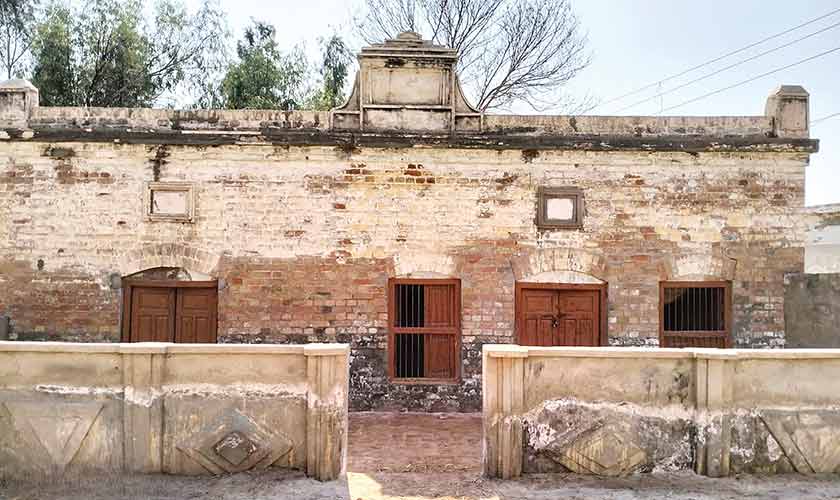
This madrassah became an important centre of learning in Noor Muhammad Shujrah. Over time, several eminent scholars visited the madrassah, including Maulana Ubaidullah Sindhi (d. 1944), Maulana Hamadullah Halejvi, Maulana Muhammad Yusuf Banuri (1908-1977), Maulana Ihtisham-ul Haq Thanvi (1918-1981) and Qazi Ahsan Ahmad Shujaabadi. Several other scholars visited on occasions like dastarbandi (graduation), scholarly lectures and events related to the establishment and development of the institution. Some of them recorded their appreciation in the visitors book.
Hafiz Syed Abdul Ghani Shah passed away in 1968 and was laid to rest in Noor Muhammad Shujrah village. He left behind a son, Syed Shaukat Ali Shah, who carried his father’s legacy with dedication. After the death of Syed Shaukat Ali Shah, the responsibility for carrying forward the family’s legacy was taken up by his son, Syed Liaquat Ali Shah, who similarly upheld the tradition.
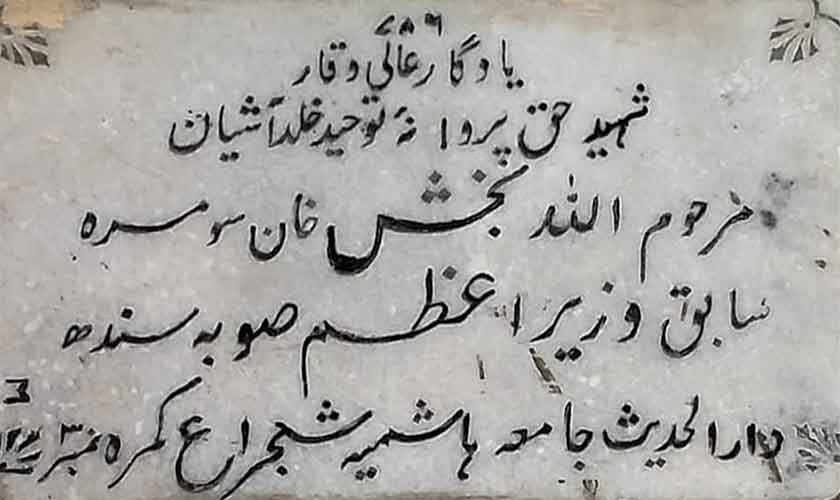
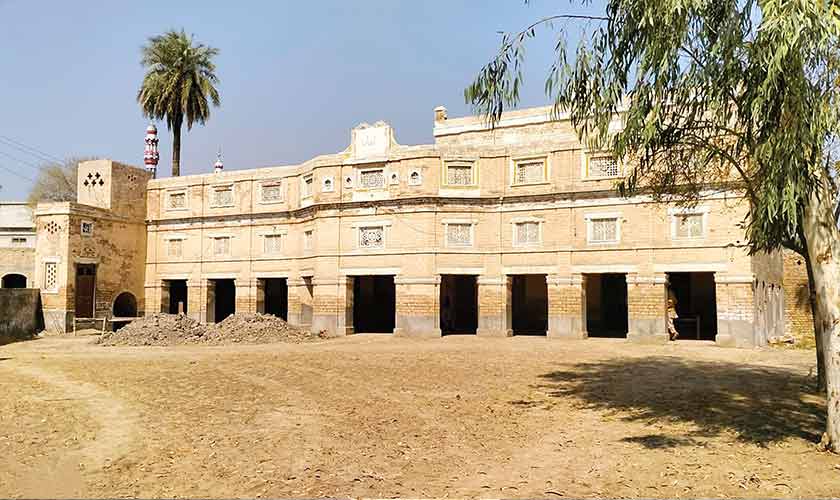
It is important to note that landed elites and officials, not only from Shikarpur and Jacobabad but also from other districts of Sindh, contributed to the construction of the Jamia Hashimia madrassa. The names of these donors are preserved on plaques fixed to the exterior walls of the madrassah rooms, as well as on the adjacent hostel building, which was constructed to accommodate the students. Separate rooms were also built in the madrassah for teachers. On the exterior wall of Room No. 1, a donor plaque records that the room was built in memory of Sardar Muhammad Saleh Khan Bhayo, the landlord of Jagan village in the Shikapur taluka.
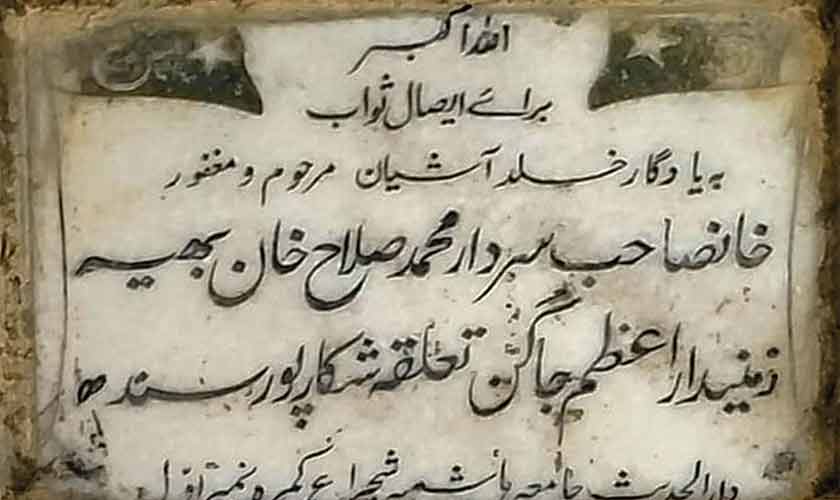
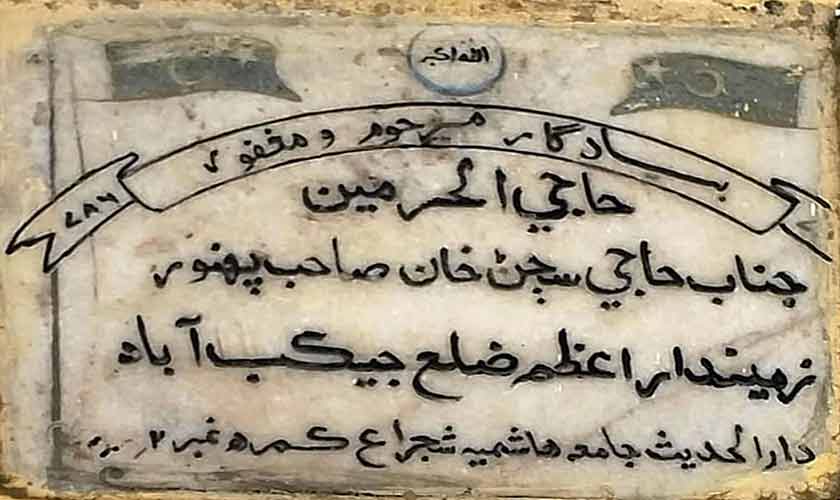
Similarly, the plaque on Room No. 2 states that the room was constructed in memory of Haji Sajjan Khan Panhwar, a prominent landlord of Jacobabad, indicating that his descendants financially supported the madrassah and sponsored the construction of this room. Room No. 3 was built through financial contributions from the descendants of late Allah Bakhah Khan Soomro, a former chief minister of Sindh. Room No. 4 was constructed through donations by AH Khan, who had served as collector of Tharparkar district. The donor plaque on Room No. 5 bears the name of AG Shaikh Sahib. Some other rooms of the madrassah and the adjacent hostel also carry donor plaques. These plaques reflect the significant role of landed elites and government officials in establishing religious seminaries in Sindh. sThe landlords of Sindh not only contributed to the construction of madrassahs and mosques but also supported the development of educational institutions and healthcare facilities. These plaques reveal a long-standing tradition of philanthropy among Sindhi landed elites, officials and merchants whose patronage contributed significantly to the development of religious and educational institutions.
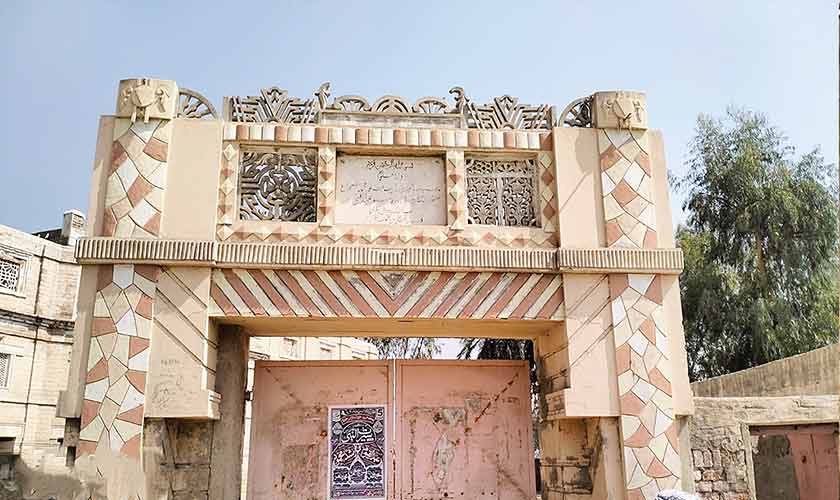
The Jamia Hashimia building was constructed primarily using baked brick masonry, reflecting the vernacular architecture of the colonial era. The ground floor features a series of open arcades supported by thick brick piers, forming a covered verandah. The upper story of the madrassah contains small rectangular windows fitted with decorative latticed screens, allowing ventilation and sunlight.
The religious scholars of Noor Muhammad Shujrah were highly respected for their dedication to teaching. The madrassah building still stands, a lasting testament to their contributions.
The writer, an anthropologist, is an associate professor at the Pakistan Institute of Development Economics, Islamabad. He has authored 18 books on Pakistan’s cultural heritage and anthropology. He tweets @kalhorozulfiqar. He may be contacted at zulfi04@hotmail.com