Print Story
X

| T |
he flight to Astana, the capital of Kazakhstan, was scheduled for 3pm. Almaty airport lies about 10 kilometres from the city centre. Our taxi driver ensured that we arrived on time. A small turboprop aircraft operated by Qazaq Air was ready to take us to our next destination.
The word Astana sounds familiar in Urdu. It evokes a place of peaceful rest. We were eager to experience that sense of calm. Flying over plains, lakes and occasional wind farms, we landed at Nursultan Nazarbayev International Airport at around 5.30pm. A chill lingered in the air. Grey-and-white clouds drifted overhead, forming shifting shapes against the sky.
Our friend was waiting in the arrivals lounge. We felt an immediate sense of ease when we spotted him near the staircase. “Astana is waiting for you,” he said in his usual warm voice.
As we left the airport, the city appeared orderly and green. The sun was setting, casting a golden light that sharpened the colours of the evening. The blue sky, scattered with clouds, was striking. Everything looked neat, clean and inviting. The photographer in me longed to pause and capture the moment, but my friend’s family was waiting at home to welcome us and it would have been discourteous to keep them waiting for longer.
We arrived and immediately felt at home.
I was eager to learn more about the city. Our host was equally keen to show us around but it was getting late and we wanted to get some rest. Sensing our enthusiasm, he took us on a short drive to a coffeehouse so we could glimpse the city’s midnight mood. Buildings were bathed in soft yellow light. Traffic was sparse. Inside, the café was lively. Young people were sipping flavoured tea and coffee.
Astana made an immediate impression that we hoped to deepen during the days ahead. The following morning began later than planned. After a healthy breakfast of muesli, eggs and tea, we set out at 11:30am. The sky was dotted with scattered white clouds drifting like cotton wool.
Driving through the city centre and to the outskirts, we headed for the Balqaragai family forest resort in the Tselinograd area. Along the way, vast stretches of land opened up, marked by green and brown patches of grass. The resort itself was tucked among trees and calm, open landscapes. A clearly marked path wound through the woodland. A gentle breeze stirred the leaves. The trees seemed to whisper. It was a walk to remember.
Within the resort stood an inviting restaurant housed in a wooden structure, tastefully decorated and warm in tone. A young waitress served salads and a colourful fruit drink. We noticed many young men and women working in the shops and restaurants. Later, our friend explained that many young people seek to earn from an early age to sustain a comfortable standard of living. Astana is also a city of global brands: most major international labels are represented in its markets.
On our return from the resort, we took an alternative route along the city’s edge. Expansive grassy fields stretched out on either side, with cars parked beneath clusters of trees. Our host told us that on weekends families gather in these open spaces to enjoy nature and spend time together. The atmosphere felt open and sociable; in a city blessed with such weather, it would seem almost negligent not to make use of the outdoors.
Above us, clouds drifted in soft formations. I tried to capture their fleeting shapes before they dissolved into the wide Kazakh sky.
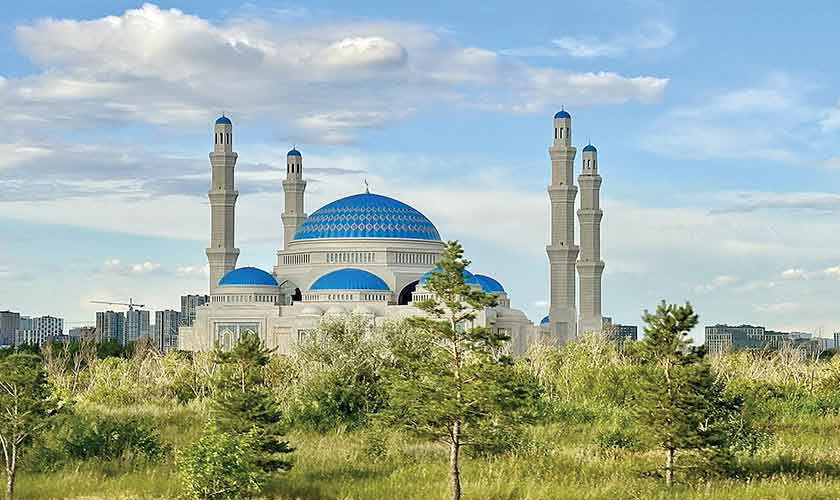
It was time to visit the Grand Mosque of Astana, its blue domes shimmering in the afternoon sunlight. Built in just three years at the initiative of Kazakhstan’s first president, Nursultan Abishevich Nazarbayev, it is among the largest mosques in the world. The principal architect was Aishekul Yerin, a Turkish citizen.
A vast car park accommodates visitors with ease. The central dome rises 83.2 metres, with a diameter of 62 metres. Four minarets frame the structure, each standing 130 metres tall. Beneath the mosque, an underground level houses a large banquet hall used for events.
Families streamed towards the entrance, where one of the tallest wooden doors in the world stands intricately carved. The façade is richly decorated with geometric patterns. Just inside, robes hang neatly on stands, allowing visitors, particularly women without appropriate attire, to cover themselves. Dozens of tourists gathered near the entrance. “It looks like a festival,” I remarked to my friend. He explained that at weekends the mosque draws large numbers of locals, many of whom come to spend quiet time there.
The lighting in the corridors cast a soft glow over the arches and wall motifs, ideal for photography. While my companions moved ahead, I lingered, drawn to the inner curves of the domes above. Every corner and niche seemed to demand attention. I experimented with angles and perspectives, trying to capture the intricacy of the design. The interior was striking in its scale and detail.
I was still taking in the atmosphere when my wife called me to the main prayer hall. “You have to see this,” she said, her voice edged with excitement. Inside, towering pillars rose beneath vast chandeliers, their light reflecting off polished walls. The effect was theatrical yet serene. “Someone has truly poured their heart into this place,” I told my friend.
A sermon was under way in the local language. Men, women and children moved quietly through the space, admiring its grandeur. Some children, less restrained, darted about in bursts of energy. Above, the ribbed dome, adorned with a delicate floral design, drew the eye upward. The floor matched the tones of the carpet beneath, a vast hand-woven piece covering 16,000 square metres, regarded as the largest of its kind in the world.
For a moment, I wanted to lie back and absorb the stillness. After a while, I did. It was both comforting and restorative.
I wanted time to stand still, but it would not. My friend urged me to get ready for “another view to remember.” Puzzled but curious, I followed him without a question. We stopped at a doorway where visitors queued patiently before an elevator.
“We’re going to the top of one of the minarets,” he said, purchasing the tickets.
Moments later, we were ascending. The view from the top was spectacular. The city unfolded beneath us in a sweeping panorama. On one side stood clusters of skyscrapers and modern buildings; on the other, vast green land stretched uninterrupted to the horizon. The contrast was striking. From above, the entire mosque shimmered in the late-afternoon sun, its symmetry and scale fully revealed. Clouds drifted lazily across the sky.
“Nothing could match such a view,” I said to my wife. She stood in quiet awe. Even as we descended and returned to the car, part of me remained there, close to the clouds.
Outside, visitors continued to stream into the mosque. Knowing that it houses dedicated halls for wedding ceremonies, I wondered whether the bustle signalled a special event. “Tonight is special,” my friend said with a knowing smile. “Be ready at 6pm sharp, we’re going somewhere.” He offered no further details, but his confidence was telling.
At the appointed hour, we were ready. The car pulled up before a grand, Roman-style building with towering columns and an imposing façade.
“This is the Astana Opera,” he said. “We’re watching La bohème.”
La bohème, composed by Giacomo Puccini, tells the tragic love story of impoverished young bohemians in 1830s Paris. It was a genuine surprise; we had never attended an opera before.
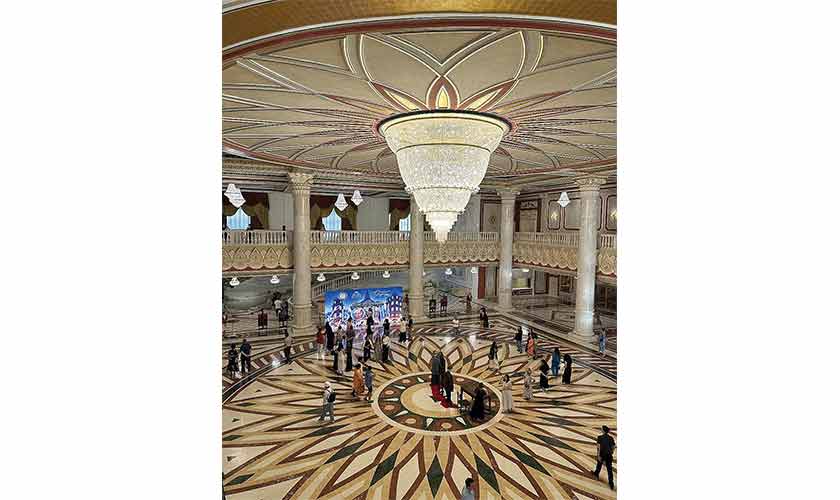
Inside, the hall resembled scenes familiar only from films: tiered balconies sweeping around the auditorium, grand seating arranged across multiple levels, all facing the stage where the drama would unfold. The décor was opulent, an interplay of red and gold. Plush red seat cushions filled the hall. A magnificent chandelier hung at its centre, complemented by smaller ones lining the balconies. The main curtain, deep red with intricate golden embroidery, completed the sense of occasion. Everything felt deliberate and refined.
Most people in the audience were formally dressed so that I stood out in my blue jeans and a tucked-in T-shirt. The evening had taken me by surprise; I had not anticipated such formality.
The performance began promptly. Experiencing live opera felt almost surreal. We were transfixed by the precision of the singers and the orchestra. At one point, the stage held more than 70 performers alongside elaborate props and a detailed backdrop; in other scenes, a single voice carried the entire hall.
“Are we dreaming?” I whispered to my wife.
“Yes, we are,” she replied, without hesitation.
Until that evening, I had never imagined what it would be like to attend a live opera. Now I understood why audiences devote both time and considerable expense to it. The tickets were not inexpensive; however, the experience justified it. The music, the staging and the emotional intensity combined into something immersive and memorable. Even now, I can recall the resonance of the orchestra and the passion of the choreography.
We had spent only three days in the city. They somehow felt fleeting and expansive at the same time.
At the curtain call, the principal performers, the director and the conductor stepped forward to acknowledge the audience. The entire hall rose in a standing ovation that lasted several minutes, applause echoing across the balconies. We left elated, grateful to our host for an evening we had not anticipated and will not easily forget.
It was quarter past nine when we emerged from the vast building. A faint light still lingered in the sky. The temperature hovered between 18 and 20 degrees C. The soft yellow lights lent the pillars an added elegance. It was almost too much to take in. I asked my wife how fortunate we were to experience such beauty and to travel as we did. She said nothing, but her smile said it all.
As we strolled around the building, my friend called for his car and announced another surprise. “Dinner will be special too,” he said. “We’ll walk along the river first, then dine at a hotel where you can try an exclusive dish of horse meat.” He outlined the plan with a chuckle. “In Kazakhstan, how can you miss horsemeat?”
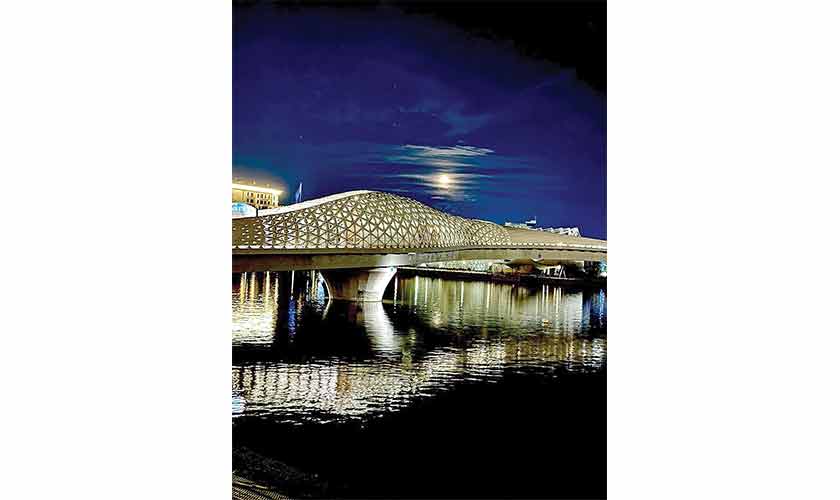
The Ishim River, also known as the Yesil, flows through the capital, dividing it into northern and southern banks. It serves as a focal point for recreation and city views, with popular embankments for evening walks and boat rides. It was a full-moon night. The riverside shimmered with reflected moonlight and the glow of surrounding buildings. The scene felt dramatic and we were part of it. The opera was still fresh in our minds.
We arrived at a fine-dining restaurant where laghman, prepared with horse meat, was served among other dishes. It is an acquired taste; we were trying it for the first time. Salty and firm in texture, it required some adjustment. My friend and I persevered and found ourselves enjoying it. The women preferred to take photographs and politely avoid the experience.
After another brief walk along the riverbank, we made our way back to the car and headed home. The day had been rich with experiences.
Astana became Kazakhstan’s capital in 1997, replacing Almaty, after President Nursultan Nazarbayev proposed the move in 1994, citing Almaty’s seismic vulnerability and strategic considerations. The city was renamed from Akmola to Astana in 1998, then briefly to Nur-Sultan in 2019, before reverting to Astana in 2022.
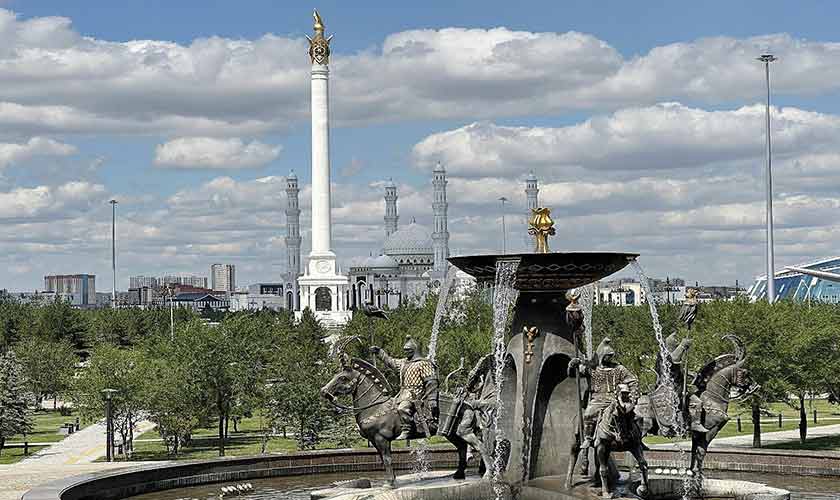
At its centre lies the Nurzhol Boulevard, a grand axis designed by the Japanese architect Kisho Kurokawa to embody harmony between tradition and modernity. Lined with fountains, parks and striking contemporary buildings, it serves as the pedestrian spine of the new capital. We were eager to explore it on foot.
The following day, we planned a visit to Baiterek Tower, one of the city’s most recognisable landmarks. An observation deck offers panoramic views. The structure resembles a nest cradling a golden egg. It is said that President Nazarbayev conceived the design while travelling aboard his presidential aircraft, sketching the concept and instructing aides to ensure the building followed his drawing. The directive was taken seriously and the tower was constructed accordingly. The building also houses a museum.
During our visit, a dedicated tour guide led us through various sections with evident enthusiasm. We took the lift to the top, where visitors queued to climb a short staircase to a raised platform. There, an inauguration plaque marked a significant moment in the tower’s history. The guide recounted how prominent religious scholars from around the world gathered for its opening ceremony - a gesture intended to symbolise interfaith harmony. A special prayer was offered: “May Kazakhstan, the land of peace and accord, be blessed.” Representatives signed a wooden staff encircling a carved globe. From Pakistan, Mehmood Ahmad Ghazi, then head of the Council of Islamic Ideology, signed on behalf of the country’s Muslims.
Another feature drew particular attention: a green marble pedestal bearing a golden handprint of President Nazarbayev. According to popular belief, placing one’s hand within the imprint and making a wish ensures that it will be granted. The guide relayed the story with conviction. I glanced at my wife; she was clearly intrigued.
“Let’s make a wish together,” she said, just as I was about to suggest the same.
We placed our hands upon the imprint and closed our eyes.
“What did you wish for?” she asked.
I simply smiled.
Next, the National Museum awaited us. On the way, however, my friend suggested a stop at a souvenir shop. His secretary, a local Kazakh, accompanied us to help us select gifts. She introduced various cultural artefacts with evident pride, though her expression remained composed. “She reminds me of my childhood teacher,” I whispered to my wife with a smile.
The prices of traditional souvenirs were high, so we avoided larger purchases and chose a decorative plate instead, modest, but meaningful. As we stepped outside, soft white clouds drifted overhead. “The clouds are charming here,” I remarked, as my friend dropped us at the pyramid-shaped Palace of Peace and Reconciliation. The structure, with its glass apex, had already drawn our attention as we approached along the wide avenue.
A steady wind swept across the open space and scattered clouds moved briskly above us - ideal weather for a walk. “We’ll stroll shortly,” my friend said, “but first, prepare to be dazzled by the story of the Golden Man.” Before I could ask about it, he left for a meeting. His secretary noticed my curiosity. “Yes, sir,” she said politely, “it is an important story. The guide will explain.”
The entrance hall was vast, featuring a cutaway model of the building that revealed its internal structure. A young female guide greeted us warmly. She began with a brief introduction: the Palace was designed by Foster and Partners and developed in partnership with Aldar Properties. She spoke fluent English and demonstrated an impressive knowledge of the building’s history and purpose. We followed her through various sections, quickening our pace to keep up.
In a large hall, we encountered a glass display case containing a striking, faceless mannequin clad in shimmering gold. Here, a second guide took over and began recounting the history of the Kazakh steppe. This was the famed Golden Man, an ancient warrior whose attire had originally been covered in thousands of small gold tiles. Though looting and time had stripped parts of the burial site, the reconstructed garment testified to the craftsmanship and wealth of the era. The guide described the dramatic discovery of the relic in the steppe, along with the remains of horses buried beside their owner, artefacts now preserved in the museum.
Later, we were led to the uppermost level of the pyramid, directly beneath its glass apex. There, another symbolic spot awaited visitors. It was said that wishes made at that point would be granted. “Astana seems full of places where dreams may come true,” I remarked lightly to the guide.
When the tour concluded, we stepped back outside. The clouds were still in motion, drifting across the sky as though beckoning us to follow their shifting forms.
Driving along the main highway, we turned towards Nazarbayev University, one of the largest universities in Kazakhstan. Nearby stood a vast shopping mall, which my wife was keen to explore. Inside, we came across a stage set up in the centre of the ground floor. Children aged between seven and 12 sat in neat rows, each holding a guitar-like instrument. My friend explained that learning a musical instrument is compulsory in school. It was an unexpected and welcome discovery.
After some shopping, we returned home for a brief rest before setting out again for a walk my friend had promised. A long pedestrian boulevard, stretching more than 2.5 kilometres, connected major landmarks, a shopping complex at one end and the golden-egg structure of Baiterek at the other. People strolled leisurely, enjoying the atmosphere. Outside one shop, music played and a small crowd had gathered to dance. “They love music,” I observed.
It was a walk to remember. Buildings glowed under evening lights, fountains shimmered and a steady breeze carried the sounds of laughter and conversation. Surrounded by those closest to me, I felt Astana at its finest.
I wished time could pause, but it would not. Close to midnight, the thought of leaving the next morning filled me with quiet sadness. We had spent three days in the city. They somehow felt fleeting and expansive at the same time. The clouds, the blue skies and the green stretches of land felt oddly familiar, though I could not say why.
As we drove to the airport, clouds once again adorned the sky. My friend dropped us at the entrance. Leaning in, I whispered, “Thank you for showing us the city of clouds.”
He smiled. “You took a leap of faith. I hope it was worth it.”
It was more than worth it. Moments later, the escalator carried us towards the departure gate. Astana slowly receded away.
The writer is a professor at the National University of Sciences and Technology.