Print Story
X




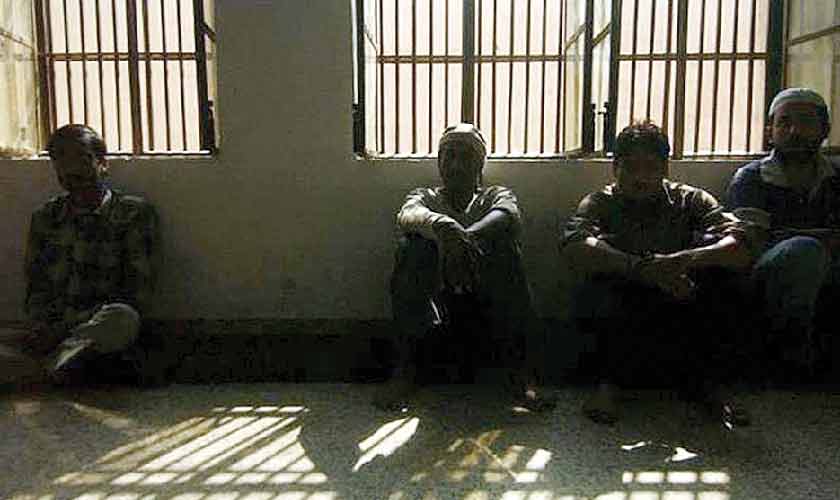
Our crowded jails hold a large number of under-trial prisoners
| P |
akistan’s prisons currently hold more than 74,000 people undergoing trial on various charges. They represent a staggering 73 percent of inmates. The average prisoner endures five to ten years before their guilt (or innocence) is determined.
Described as ‘shadow conviction,’ the prisoners suffer from a systemic crisis involving police incompetence, absence of forensic infrastructure and a judicial culture prioritising case disposal over individual liberty.
Since these people have not been convicted, they are called the “accused.“ Legally speaking, most of them suffer wrongful confinement in the prisons due to the inadequacies of the trial courts. The facts speak for themselves.
The 2025 Justice Project Pakistan report says that 85 percent of death-penalty convictions between 2020 and 2025 were overturned by the Supreme Court.
The prolonged and unnecessary imprisonment had already inflicted devastating consequences: families were torn apart, emotionally shattered by years of separation and pushed into severe socio-economic crises. Breadwinners were lost, children deprived of parental care and households plunged into financial instability. The wrongful confinement not only robbed individuals of their freedom but also left deep scars on entire communities, illustrating a tragic failure of the justice system that reverberates far beyond the courtroom.
The primary engine of wrongful conviction in Pakistan is the over-reliance on oral testimony, formalised under Section 161 of the Criminal Procedure Code. This provision empowers the police to record witness statements during the investigation stage. In practice, this allows statements to be shaped—or coerced—to fit a preconceived narrative. Witnesses may be pressured, intimidated or misled. The accused have little recourse to challenge inconsistencies at this stage. As a result, cases frequently proceed to trial based on flawed or manipulated evidence, creating a dangerous reliance on uncorroborated oral accounts rather than objective, verifiable proof. This structural weakness not only heightens the risk of wrongful conviction but also undermines public confidence in the justice system.
According to the Global Torture Index forced confessions remain the primary method of securing these trial-level convictions in Pakistan.
Additionally, courts tend to rely on the ‘coached or coerced’ witness accounts primarily because they do not possess the tools to challenge their accounts.
Weighed down further by a staggering backlog—currently exceeding 2.2 million pending cases—the courts are often compelled to lean on the prosecution-police narrative, however riddled with gaps and devoid of corroborating evidence, effectively slamming the doors of freedom shut on the accused.
The injustice becomes even more palpable when the accused are poor and cannot afford private counsel to dissect the flawed police indictment, leaving them adrift in a legal system that feels cold, opaque and indifferent. The weight of this miscarriage of justice was starkly illuminated in the recent Supreme Court judgment in Ishfaq Ahmed v. Mushtaq Ahmed, revealing how structural failings and bureaucratic inertia can crush lives, tear families apart and perpetuate cycles of despair.
The 2025 Justice Project Pakistan report says 85 percent of death-penalty convictions between 2020 and 2025 were overturned by the Supreme Court.
The strain of backlogs and reliance on flawed police narratives is magnified by the way lower courts operate. The system rewards speed over sound reasoning, often at the expense of justice. Promotions in the lower judiciary are incentivised through a performance-tracking system that prioritises the “number of cases decided” over the quality of judicial reasoning. Rather than allowing the benefit of the doubt, this system effectively encourages wrongful convictions. Professor Carol Steiker of Harvard Law School describes such a legal system as a “machinery of death” where procedural safeguards are eroded in the pursuit of efficiency.
Years later, when the case finally reaches the Supreme Court, the “torture-tainted” evidence is discarded and the wrongfully convicted individuals are released—often after spending the prime years of their lives behind bars. Consider the recent exoneration of a defendant who endured 18 years on death row, only to be acquitted posthumously. This represents the ultimate failure of the state to uphold its duty under Article 9 of the constitution, which guarantees the right to life and liberty.
For the wrongfully convicted, life is stolen twice: first by the physical confinement of the prison, and again by the social stigma and economic devastation that linger long after acquittal. The “accused-victim” re-enters a world where their home may have been sold, their parents have passed away and their children are strangers. This is not merely a miscarriage of justice but also a systemic violation of human rights, carried out under the colour of law.
Pakistan must move toward an evidentiary standard that favours forensic science over the unreliable ocular accounts permitted under Section 161. First, the recording of all police statements must be audio-visually documented to prevent the script from replacing the truth. Second, Pakistan must enact a Statutory Compensation Act to provide financial and rehabilitative support to the acquitted accused. Finally, the judiciary’s promotion system must be replaced with a quality audit system, where they are evaluated on the durability of their judgments in higher courts rather than the mere volume of their output.
Pakistan’s jails are currently functioning as archives of state error. Every under-trial prisoner acquitted after years of detention represents a conviction that the law was unable to prevent.
By bridging the gap between local procedural reform and global legal theory drawing from the decarceration movements at institutions like Harvard, we can begin to treat the accused not as a disposable unit but as a citizen whose liberty is the ultimate measure of the state’s integrity.
Until we address the ‘shadow convictions’ our halls of justice will continue to be haunted by the ghosts of the innocent.
The writer is a law graduate from Ziauddin University. Her work primarily examines systemic social issues, criminal jurisprudence and judicial reform. She can be reached at, [email protected].